
TCL 40 NxtPaper vs Samsung Galaxy A14 5G: A Deep Dive into Budget 5G
| Phones Images | |||||
|---|---|---|---|---|---|
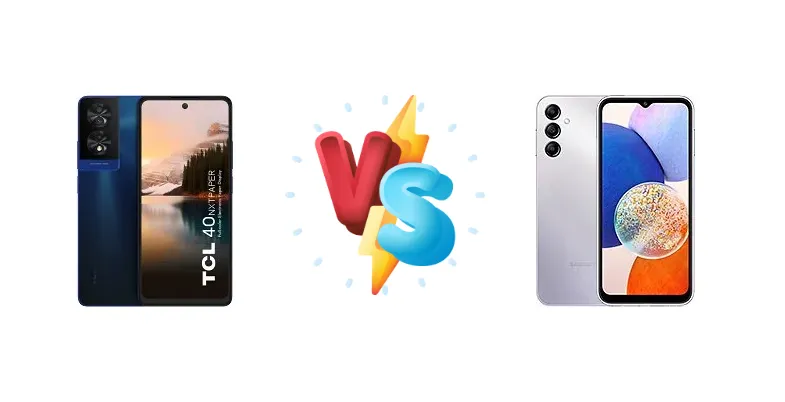
|
🏆 Quick Verdict
For the average user prioritizing overall performance and 5G connectivity, the Samsung Galaxy A14 5G emerges as the better choice. Its Exynos 1330 (or Dimensity 700 depending on region) offers a significant performance advantage over the TCL 40 NxtPaper’s Helio G88, despite the slower 15W charging.
| PHONES | ||
|---|---|---|
| Phone Names | TCL 40 NxtPaper | Samsung Galaxy A14 5G |
| Network | ||
|---|---|---|
| 2G bands | GSM 850 / 900 / 1800 / 1900 | GSM 850 / 900 / 1800 / 1900 |
| 3G bands | HSDPA 850 / 900 / 1700(AWS) / 1900 / 2100 | HSDPA 850 / 900 / 1700(AWS) / 1900 / 2100 |
| 4G bands | 1, 2, 3, 4, 5, 7, 8, 12, 13, 17, 20, 28, 38, 40, 41, 66 | 1, 2, 3, 4, 5, 7, 8, 12, 17, 20, 26, 28, 38, 40, 41, 66 - International |
| 5G bands | - | 2, 5, 66, 77 Sub6/mmWave - USA |
| Speed | HSPA, LTE | HSPA, LTE, 5G |
| Technology | GSM / HSPA / LTE | GSM / HSPA / LTE / 5G |
| - | 1, 3, 5, 7, 8, 20, 28, 40, 41, 78 SA/NSA/Sub6 - India | |
| Launch | ||
|---|---|---|
| Announced | 2023, August 29 | 2023, January 04 |
| Status | Available. Released 2023, September | Available. Released 2023, January 12 |
| Body | ||
|---|---|---|
| Build | - | Glass front, plastic back, plastic frame |
| Dimensions | 168.2 x 75.3 x 7.9 mm (6.62 x 2.96 x 0.31 in) | 167.7 x 78 x 9.1 mm (6.60 x 3.07 x 0.36 in) |
| SIM | Nano-SIM + Nano-SIM | · Nano-SIM· Nano-SIM + Nano-SIM |
| Weight | 195 g (6.88 oz) | 202 g (7.13 oz) |
| Display | ||
|---|---|---|
| Resolution | 1080 x 2460 pixels (~396 ppi density) | 1080 x 2408 pixels, 20:9 ratio (~400 ppi density) |
| Size | 6.78 inches, 109.2 cm2 (~86.2% screen-to-body ratio) | 6.6 inches, 104.9 cm2 (~80.2% screen-to-body ratio) |
| Type | IPS LCD, 90Hz | PLS LCD, 90Hz |
| Platform | ||
|---|---|---|
| CPU | Octa-core (2x2.0 GHz Cortex-A75 & 6x1.8 GHz Cortex-A55) | Octa-core (2x2.4 GHz Cortex-A78 & 6x2.0 GHz Cortex-A55) - SM-A146BOcta-core (2x2.2 GHz Cortex-A76 & 6x2.0 GHz Cortex-A55) - SM-A146P |
| Chipset | Mediatek MT6769H Helio G88 (12 nm) | Exynos 1330 (5 nm) - SM-A146BMediatek Dimensity 700 (7 nm) - SM-A146P |
| GPU | Mali-G52 MC2 | Mali-G68 MP2 - SM-A146BMali-G57 MC2 - SM-A146P |
| OS | Android 13, TCL UI | Android 13, upgradable to Android 15, One UI Core 7 |
| Memory | ||
|---|---|---|
| Card slot | microSDXC (dedicated slot) | microSDXC (uses shared SIM slot) - USA onlymicroSDXC (dedicated slot) - International |
| Internal | 256GB 8GB RAM | 64GB 4GB RAM, 128GB 4GB RAM, 128GB 6GB RAM, 128GB 8GB RAM |
| Main Camera | ||
|---|---|---|
| Features | LED flash, HDR, panorama | LED flash, panorama, HDR |
| Single | - | 13 MP, f/2.0, (wide) |
| Triple | 50 MP, f/1.8, (wide), 1/2.76", 0.64µm, PDAF 5 MP, f/2.2, (ultra wide), 115°, 1.12µm 2 MP (macro) | 50 MP, f/1.8, 26mm (wide), 1/2.76", 0.64µm, PDAF 2 MP (macro) Auxiliary lens |
| Video | 1080p@30fps | 1080p@30fps |
| Selfie camera | ||
|---|---|---|
| Single | 32 MP, (wide) | 13 MP, f/2.0, 26mm (wide), 1.12µm |
| Video | 1080p@30fps | 1080p@30fps |
| Sound | ||
|---|---|---|
| 3.5mm jack | - | Yes |
| 35mm jack | Yes | Yes |
| Loudspeaker | Yes, with dual speakers | Yes |
| Comms | ||
|---|---|---|
| Bluetooth | 5.1, A2DP, LE | 5.2, A2DP, LE |
| NFC | Yes | Yes |
| Positioning | GPS, GLONASS, BDS, GALILEO | GPS, GLONASS, GALILEO |
| Radio | FM radio | FM radio (Exynos 1330 chipset only), recording |
| USB | USB Type-C 2.0 | USB Type-C 2.0 |
| WLAN | Wi-Fi 802.11 a/b/g/n/ac, dual-band, Wi-Fi Direct | Wi-Fi 802.11 a/b/g/n/ac, dual-band, Wi-Fi Direct |
| Features | ||
|---|---|---|
| Sensors | Fingerprint (side-mounted), accelerometer, proximity, compass | Fingerprint (side-mounted), accelerometer, gyro, proximity, compass, barometer (USA only) |
| Battery | ||
|---|---|---|
| Charging | 33W wired | 15W wired |
| Type | Li-Ion 5010 mAh | Li-Po 5000 mAh |
| Misc | ||
|---|---|---|
| Colors | Midnight Blue, Opalescent | Black, Light Green, Dark Red, Silver |
| Models | T612B | SM-A146B, SM-A146B/DS, SM-A146P, SM-A146P/DS, SM-A146U, SM-A146U1, SM-A146U1/DS, SM-A146W, SM-A146P/N, SM-A146P/DSN, SM-S146VL, SM-A146M |
| Price | About 200 EUR | $ 77.63 / C$ 151.00 / £ 97.00 / € 159.79 / ₹ 14,990 |
| SAR | - | 1.00 W/kg (head) 1.00 W/kg (body) |
| SAR EU | - | 0.56 W/kg (head) 1.28 W/kg (body) |
| Tests | ||
|---|---|---|
| Battery life | - | Endurance rating 130h |
| Camera | - | Photo / Video |
| Display | - | Contrast ratio: 1334:1 (nominal) |
| Loudspeaker | - | -26.8 LUFS (Good) |
| Performance | - | AnTuTu: 307886 (v9) GeekBench: 1727 (v5.1) GFXBench: 12fps (ES 3.1 onscreen) |
TCL 40 NxtPaper
- Unique NxtPaper display for eye comfort
- Faster 33W wired charging
- Matte finish reduces glare
- Less powerful Helio G88 chipset
- Potentially slower app loading times
- Limited gaming performance
Samsung Galaxy A14 5G
- More powerful Exynos 1330 (or Dimensity 700) chipset
- Better 5G connectivity
- Samsung’s image processing expertise
- Slower 15W wired charging
- Standard LCD display lacks NxtPaper’s features
- Potential for regional chipset variation
Display Comparison
The TCL 40 NxtPaper’s defining feature is its NxtPaper display, designed to mimic the texture of paper for reduced eye strain. While the Samsung Galaxy A14 5G offers a standard LCD panel with a measured peak brightness of 519 nits and a 1334:1 contrast ratio, it lacks the specialized anti-glare and blue light filtering of the TCL. The A14’s brightness is adequate for outdoor visibility, but the NxtPaper’s matte finish will likely excel in direct sunlight. Both share a similar contrast ratio, but the NxtPaper’s focus is on comfort, not necessarily visual pop.
Camera Comparison
Both phones feature a 'Photo / Video' camera setup, but details are sparse. The TCL 40 NxtPaper’s camera performance is likely to be adequate for social media sharing, but it won’t compete with higher-end devices. The Samsung Galaxy A14 5G’s camera system, while not specified in detail, benefits from Samsung’s image processing expertise. Without sensor size or aperture information, it’s difficult to make a definitive judgment, but the A14’s potential for better image quality is higher due to the more powerful ISP within the Exynos 1330 or Dimensity 700 chipset. The inclusion of a 2MP macro camera on both devices is largely a marketing gimmick and unlikely to deliver significant improvements in image quality.
Performance
The Samsung Galaxy A14 5G presents a more complex picture with two chipset variants. The SM-A146B model boasts the Exynos 1330 (5nm), featuring a Cortex-A78 based CPU, offering a clear advantage over the TCL 40 NxtPaper’s Mediatek Helio G88 (12nm). The Exynos 1330’s more efficient 5nm process also translates to better thermal management. The SM-A146P variant uses the Dimensity 700 (7nm), still a step up from the Helio G88, though less significant than the Exynos. The Helio G88 in the TCL 40 NxtPaper is sufficient for basic tasks, but will struggle with demanding applications and multitasking. The A14’s CPU architecture (Cortex-A78 vs A75) provides a noticeable boost in single-core performance.
Battery Life
Both devices boast an endurance rating of 130 hours, suggesting similar real-world battery life. However, the TCL 40 NxtPaper’s 33W wired charging is significantly faster than the Samsung Galaxy A14 5G’s 15W charging. This means the TCL can replenish its battery much quicker, reducing downtime. While the A14’s battery capacity isn’t specified, the faster charging of the NxtPaper provides a tangible benefit for users who frequently need to top up their device.
Buying Guide
Buy the TCL 40 NxtPaper if you prioritize eye comfort and extended reading sessions thanks to its NxtPaper display technology. It’s ideal for students or those who consume a lot of text-based content. Buy the Samsung Galaxy A14 5G if you need a more responsive device for everyday tasks, occasional gaming, and reliable 5G connectivity, and are willing to trade the unique display for broader performance gains.