
Motorola Moto G Power 5G vs TCL 40 NxtPaper: A Detailed Comparison
| Phones Images | |||||
|---|---|---|---|---|---|
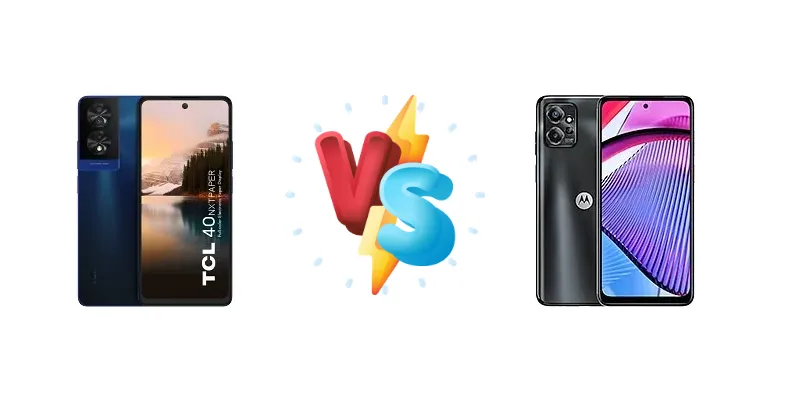
|
🏆 Quick Verdict
For the average user prioritizing performance and future-proofing, the Motorola Moto G Power 5G is the better choice. Its Dimensity 930 chipset offers a significant performance leap over the TCL 40 NxtPaper’s Helio G88, making it more capable for demanding tasks and 5G applications. However, the TCL’s NxtPaper display is a compelling alternative for those prioritizing eye comfort.
| PHONES | ||
|---|---|---|
| Phone Names | TCL 40 NxtPaper | Motorola Moto G Power 5G |
| Network | ||
|---|---|---|
| 2G bands | GSM 850 / 900 / 1800 / 1900 | GSM 850 / 900 / 1800 / 1900 |
| 3G bands | HSDPA 850 / 900 / 1700(AWS) / 1900 / 2100 | HSDPA 850 / 900 / 1700(AWS) / 1900 / 2100 |
| 4G bands | 1, 2, 3, 4, 5, 7, 8, 12, 13, 17, 20, 28, 38, 40, 41, 66 | 1, 2, 3, 4, 5, 7, 8, 12, 13, 14, 17, 20, 25, 26, 29, 30, 38, 39, 40, 41, 48, 66, 71 |
| 5G bands | - | 2, 5, 7, 12, 25, 30, 41, 66, 71, 77, 78 SA/NSA/Sub6 |
| Speed | HSPA, LTE | HSPA, LTE, 5G |
| Technology | GSM / HSPA / LTE | GSM / HSPA / LTE / 5G |
| Launch | ||
|---|---|---|
| Announced | 2023, August 29 | 2023, April 06 |
| Status | Available. Released 2023, September | Available. Released 2023, April 13 |
| Body | ||
|---|---|---|
| Build | - | Glass front, plastic back, plastic frame |
| Dimensions | 168.2 x 75.3 x 7.9 mm (6.62 x 2.96 x 0.31 in) | 163.1 x 74.8 x 8.5 mm (6.42 x 2.94 x 0.33 in) |
| SIM | Nano-SIM + Nano-SIM | Nano-SIM |
| Weight | 195 g (6.88 oz) | 185 g (6.53 oz) |
| - | Water-repellent design | |
| Display | ||
|---|---|---|
| Resolution | 1080 x 2460 pixels (~396 ppi density) | 1080 x 2400 pixels, 20:9 ratio (~405 ppi density) |
| Size | 6.78 inches, 109.2 cm2 (~86.2% screen-to-body ratio) | 6.5 inches, 102.0 cm2 (~83.6% screen-to-body ratio) |
| Type | IPS LCD, 90Hz | IPS LCD, 120Hz |
| Platform | ||
|---|---|---|
| CPU | Octa-core (2x2.0 GHz Cortex-A75 & 6x1.8 GHz Cortex-A55) | Octa-core (2x2.2 GHz Cortex-A78 & 6x2.0 GHz Cortex-A55) |
| Chipset | Mediatek MT6769H Helio G88 (12 nm) | Mediatek Dimensity 930 (6 nm) |
| GPU | Mali-G52 MC2 | IMG BXM-8-256 |
| OS | Android 13, TCL UI | Android 13, upgradable to Android 14 |
| Memory | ||
|---|---|---|
| Card slot | microSDXC (dedicated slot) | microSDXC (dedicated slot) |
| Internal | 256GB 8GB RAM | 128GB 4GB RAM, 256GB 6GB RAM |
| Main Camera | ||
|---|---|---|
| Features | LED flash, HDR, panorama | LED flash, HDR, panorama |
| Triple | 50 MP, f/1.8, (wide), 1/2.76", 0.64µm, PDAF 5 MP, f/2.2, (ultra wide), 115°, 1.12µm 2 MP (macro) | 50 MP, f/1.8, (wide), 0.64µm, PDAF 2 MP (macro) Auxiliary lens |
| Video | 1080p@30fps | 1080p@30fps, gyro-EIS |
| Selfie camera | ||
|---|---|---|
| Single | 32 MP, (wide) | 16 MP, f/2.4, (wide), 1.0µm |
| Video | 1080p@30fps | 1080p@30fps |
| Sound | ||
|---|---|---|
| 3.5mm jack | - | Yes |
| 35mm jack | Yes | Yes |
| Loudspeaker | Yes, with dual speakers | Yes, with stereo speakers |
| Comms | ||
|---|---|---|
| Bluetooth | 5.1, A2DP, LE | 5.3, A2DP, LE |
| NFC | Yes | No |
| Positioning | GPS, GLONASS, BDS, GALILEO | GPS, GLONASS, GALILEO |
| Radio | FM radio | No |
| USB | USB Type-C 2.0 | USB Type-C 2.0 |
| WLAN | Wi-Fi 802.11 a/b/g/n/ac, dual-band, Wi-Fi Direct | Wi-Fi 802.11 a/b/g/n/ac, dual-band |
| Features | ||
|---|---|---|
| Sensors | Fingerprint (side-mounted), accelerometer, proximity, compass | Fingerprint (side-mounted), accelerometer, gyro, proximity, compass |
| Battery | ||
|---|---|---|
| Charging | 33W wired | 15W wired |
| Type | Li-Ion 5010 mAh | Li-Po 5000 mAh |
| Misc | ||
|---|---|---|
| Colors | Midnight Blue, Opalescent | Dark Blue |
| Models | T612B | - |
| Price | About 200 EUR | $ 97.90 / £ 199.00 |
TCL 40 NxtPaper
- Faster 33W charging for quicker top-ups
- Unique NxtPaper display for reduced eye strain
- Potentially more affordable price point
- Less powerful Mediatek Helio G88 chipset
- Limited 5G capabilities compared to the Motorola
- Potentially lower camera performance
Motorola Moto G Power 5G
- More powerful Mediatek Dimensity 930 chipset
- 5G connectivity for faster data speeds
- Improved power efficiency for longer battery life
- Slower 15W charging
- Lacks the unique NxtPaper display technology
- Potentially higher price point
Display Comparison
The TCL 40 NxtPaper’s defining feature is its NxtPaper display, designed to mimic the texture of paper. While specific nit brightness isn’t provided, TCL markets it for outdoor visibility. The Motorola Moto G Power 5G lacks this specialized technology, likely utilizing a standard IPS LCD. The TCL’s focus on eye comfort is a key differentiator, potentially appealing to users sensitive to blue light or screen glare. The Motorola, lacking specific display details, likely prioritizes cost-effectiveness over advanced display features. The TCL's display tech is a niche benefit, while the Motorola likely offers a more standard viewing experience.
Camera Comparison
Without detailed camera specs beyond the chipsets, a direct comparison is limited. However, the Motorola, positioned as a more all-around device, likely benefits from the Dimensity 930’s improved image signal processor (ISP). This ISP can enhance image processing capabilities, resulting in better dynamic range and noise reduction. The TCL 40 NxtPaper likely relies on the Helio G88’s ISP, which is less capable. While both phones likely feature multiple rear cameras, the Motorola’s processing power gives it an edge in image quality, particularly in challenging lighting conditions. We can assume the Motorola will offer a more versatile camera experience.
Performance
The Motorola Moto G Power 5G’s Mediatek Dimensity 930 (6nm) represents a substantial upgrade over the TCL 40 NxtPaper’s Mediatek Helio G88 (12nm). The Dimensity 930 utilizes more efficient 6nm fabrication, resulting in better thermal management and power efficiency. Its CPU configuration – 2x2.2 GHz Cortex-A78 & 6x2.0 GHz Cortex-A55 – is also more powerful than the Helio G88’s 2x2.0 GHz Cortex-A75 & 6x1.8 GHz Cortex-A55. This translates to faster app loading times, smoother multitasking, and improved gaming performance on the Motorola. The 6nm process node of the Dimensity 930 allows for sustained performance under load, minimizing throttling compared to the 12nm Helio G88.
Battery Life
The Motorola Moto G Power 5G features 15W wired charging, while the TCL 40 NxtPaper supports faster 33W wired charging. While the Motorola likely has a larger battery capacity (typical of the 'Power' line), the TCL’s faster charging can offset this difference, allowing for quicker top-ups. A full charge on the TCL will be significantly faster than on the Motorola. However, the Dimensity 930’s superior power efficiency may allow the Motorola to achieve comparable real-world battery life despite the slower charging speed. The TCL prioritizes quick charging, while the Motorola likely focuses on maximizing runtime.
Buying Guide
Buy the TCL 40 NxtPaper if you spend significant time reading ebooks, documents, or browsing the web and value a display designed to reduce eye strain. Buy the Motorola Moto G Power 5G if you prioritize faster performance for gaming, streaming, and multitasking, and want the benefits of 5G connectivity for faster data speeds and improved network reliability.