
Motorola Edge (2023) vs TCL 40 NxtPaper: A Deep Dive into Mid-Range Choices
| Phones Images | |||||
|---|---|---|---|---|---|
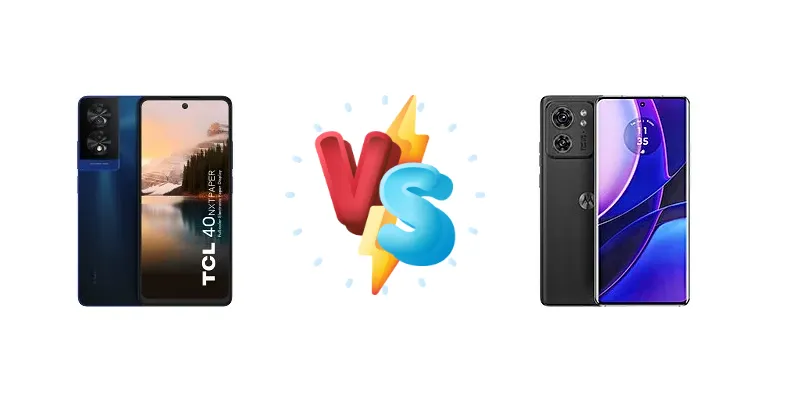
|
🏆 Quick Verdict
For the average user prioritizing performance and fast charging, the Motorola Edge (2023) is the clear winner. Its Dimensity 7030 chipset and 68W charging significantly outperform the TCL 40 NxtPaper’s Helio G88 and 33W charging. However, if eye comfort and a unique reading experience are paramount, the TCL NxtPaper offers a compelling alternative.
| PHONES | ||
|---|---|---|
| Phone Names | TCL 40 NxtPaper | Motorola Edge (2023) |
| Network | ||
|---|---|---|
| 2G bands | GSM 850 / 900 / 1800 / 1900 | GSM 850 / 900 / 1800 / 1900 |
| 3G bands | HSDPA 850 / 900 / 1700(AWS) / 1900 / 2100 | HSDPA 850 / 900 / 1700(AWS) / 1900 / 2100 |
| 4G bands | 1, 2, 3, 4, 5, 7, 8, 12, 13, 17, 20, 28, 38, 40, 41, 66 | 1, 2, 3, 4, 5, 7, 8, 12, 13, 14, 17, 18, 19, 20, 25, 26, 29, 30, 38, 39, 40, 41, 48, 66, 71 |
| 5G bands | - | 1, 2, 3, 5, 7, 12, 14, 20, 25, 26, 29, 30, 38, 40, 41, 48, 66, 70, 71, 77, 78 SA/NSA/Sub6 |
| Speed | HSPA, LTE | HSPA, LTE, 5G |
| Technology | GSM / HSPA / LTE | GSM / HSPA / LTE / 5G |
| Launch | ||
|---|---|---|
| Announced | 2023, August 29 | 2023, October 11 |
| Status | Available. Released 2023, September | Available. Released 2023, October 11 |
| Body | ||
|---|---|---|
| Build | - | Glass front, aluminum frame, silicone polymer back (eco leather) |
| Dimensions | 168.2 x 75.3 x 7.9 mm (6.62 x 2.96 x 0.31 in) | 158.4 x 72 x 7.6 mm (6.24 x 2.83 x 0.30 in) |
| SIM | Nano-SIM + Nano-SIM | Nano-SIM + eSIM |
| Weight | 195 g (6.88 oz) | 168 g (5.93 oz) |
| Display | ||
|---|---|---|
| Resolution | 1080 x 2460 pixels (~396 ppi density) | 1080 x 2400 pixels, 20:9 ratio (~402 ppi density) |
| Size | 6.78 inches, 109.2 cm2 (~86.2% screen-to-body ratio) | 6.6 inches, 103.6 cm2 (~90.8% screen-to-body ratio) |
| Type | IPS LCD, 90Hz | P-OLED, 1B colors, 144Hz, HDR10+, 1200 nits (peak) |
| Platform | ||
|---|---|---|
| CPU | Octa-core (2x2.0 GHz Cortex-A75 & 6x1.8 GHz Cortex-A55) | Octa-core (2x2.5 GHz Cortex-A78 & 6x2.0 GHz Cortex-A55) |
| Chipset | Mediatek MT6769H Helio G88 (12 nm) | MediaTek Dimensity 7030 (6 nm) |
| GPU | Mali-G52 MC2 | Mali-G610 MC3 |
| OS | Android 13, TCL UI | Android 13, planned upgrade to Android 14 |
| Memory | ||
|---|---|---|
| Card slot | microSDXC (dedicated slot) | No |
| Internal | 256GB 8GB RAM | 256GB 8GB RAM |
| Main Camera | ||
|---|---|---|
| Dual | - | 50 MP, f/1.4, (wide), 1/1.5", 1.0µm, multi-directional PDAF, OIS 13 MP, f/2.2, 120˚ (ultrawide), 1.12µm, AF |
| Features | LED flash, HDR, panorama | Dual-LED flash, HDR, panorama |
| Triple | 50 MP, f/1.8, (wide), 1/2.76", 0.64µm, PDAF 5 MP, f/2.2, (ultra wide), 115°, 1.12µm 2 MP (macro) | - |
| Video | 1080p@30fps | 4K@30fps, 1080p@30/60fps, HDR, gyro-EIS |
| Selfie camera | ||
|---|---|---|
| Features | - | HDR |
| Single | 32 MP, (wide) | 32 MP, f/2.4, (wide), 0.8µm |
| Video | 1080p@30fps | 4K@30fps, 1080p@30fps |
| Sound | ||
|---|---|---|
| 35mm jack | Yes | No |
| Loudspeaker | Yes, with dual speakers | Yes, with stereo speakers |
| Comms | ||
|---|---|---|
| Bluetooth | 5.1, A2DP, LE | 5.2, A2DP, LE |
| NFC | Yes | Yes |
| Positioning | GPS, GLONASS, BDS, GALILEO | GPS, GLONASS, GALILEO |
| Radio | FM radio | No |
| USB | USB Type-C 2.0 | USB Type-C 2.0 |
| WLAN | Wi-Fi 802.11 a/b/g/n/ac, dual-band, Wi-Fi Direct | Wi-Fi 802.11 a/b/g/n/ac/6e/k/v/r, tri-band, Wi-Fi Direct |
| Features | ||
|---|---|---|
| Sensors | Fingerprint (side-mounted), accelerometer, proximity, compass | Fingerprint (under display, optical), accelerometer, gyro, proximity, compass, barometer |
| Battery | ||
|---|---|---|
| Charging | 33W wired | 68W wired 15W wireless |
| Type | Li-Ion 5010 mAh | Li-Po 4400 mAh |
| Misc | ||
|---|---|---|
| Colors | Midnight Blue, Opalescent | Eclipse Black |
| Models | T612B | - |
| Price | About 200 EUR | $ 189.95 |
TCL 40 NxtPaper
- Unique NxtPaper display for eye comfort
- More affordable price point
- Lightweight and potentially more portable
- Significantly slower performance
- Slower charging speeds
- Likely lower camera quality
Motorola Edge (2023)
- Faster and more efficient Dimensity 7030 chipset
- 68W wired and 15W wireless charging
- Likely superior camera performance
- Higher price tag
- May not prioritize eye comfort as much
- Potentially heavier build
Display Comparison
The TCL 40 NxtPaper’s defining feature is its NxtPaper display, designed to mimic the texture of paper, reducing blue light and glare. While specific nit brightness isn’t provided, it’s likely lower than the Motorola Edge (2023). The Motorola Edge (2023) likely features a standard AMOLED panel, offering vibrant colors and higher peak brightness for better outdoor visibility. The Motorola Edge (2023) will likely have a higher refresh rate, contributing to smoother scrolling and animations, a feature absent in the TCL 40 NxtPaper. Bezels are expected to be slimmer on the Motorola Edge (2023) due to its more premium positioning.
Camera Comparison
Without detailed camera specs, it’s difficult to make a precise comparison. However, the Motorola Edge (2023), positioned as a more premium device, likely features a larger main sensor with optical image stabilization (OIS) for improved low-light performance and sharper images. The TCL 40 NxtPaper likely relies on software processing to compensate for a potentially smaller sensor. Lens apertures will also play a role; a wider aperture (lower f-number) on the Motorola Edge (2023) will allow more light to reach the sensor, further enhancing low-light photography. The inclusion of OIS on the Motorola Edge (2023) is a significant advantage for video recording, providing smoother and more stable footage.
Performance
The Motorola Edge (2023) boasts the MediaTek Dimensity 7030, fabricated on a 6nm process, offering a significant advantage in power efficiency and performance over the TCL 40 NxtPaper’s MediaTek Helio G88 (12nm). The Dimensity 7030’s Cortex-A78 cores, clocked at 2.5 GHz, provide a noticeable CPU performance boost compared to the Helio G88’s Cortex-A75 cores at 2.0 GHz. This translates to faster app loading times, smoother multitasking, and improved gaming performance. The 6nm process also means less heat generation under sustained load, reducing the likelihood of thermal throttling. While both phones utilize 6x Cortex-A55 cores, the Dimensity 7030’s superior architecture and process node provide a clear advantage.
Battery Life
The TCL 40 NxtPaper’s 33W wired charging is adequate but significantly slower than the Motorola Edge (2023)’s 68W wired charging. The Motorola Edge (2023) also adds 15W wireless charging, a feature absent on the TCL 40 NxtPaper. While battery capacity isn’t specified, the faster charging on the Motorola Edge (2023) allows for quicker top-ups, minimizing downtime. A full charge on the Motorola Edge (2023) is expected to take under an hour, while the TCL 40 NxtPaper will likely require considerably longer. The Dimensity 7030’s 6nm process also contributes to better power efficiency, potentially offsetting any capacity differences.
Buying Guide
Buy the TCL 40 NxtPaper if you spend significant time reading ebooks, articles, or documents and prioritize eye strain reduction with its NxtPaper display. Buy the Motorola Edge (2023) if you’re a power user who values faster performance for gaming, multitasking, and content creation, and appreciate the convenience of rapid charging and wireless charging capabilities.