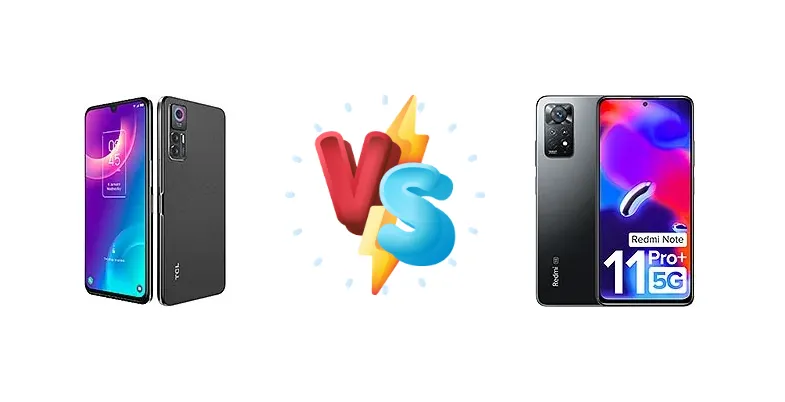
The TCL 30+ and Xiaomi Redmi Note 11 Pro+ 5G (India) represent compelling options in the increasingly competitive budget 5G smartphone space. While both aim to deliver a feature-rich experience without breaking the bank, they take drastically different approaches to core components like the chipset and charging technology. This comparison dissects these differences to determine which device offers the best value for your money.
🏆 Quick Verdict
For the average user prioritizing performance and convenience, the Xiaomi Redmi Note 11 Pro+ 5G (India) is the clear winner. Its Snapdragon 695 chipset, built on a more efficient 6nm process, provides a noticeable performance uplift, and the blazing-fast 67W charging significantly reduces downtime compared to the TCL 30+'s 18W charging.
| Network |
|---|
| 2G bands | GSM 850 / 900 / 1800 / 1900 | GSM 850 / 900 / 1800 / 1900 - SIM 1 & SIM 2 |
| 3G bands | HSDPA 850 / 900 / 1900 / 2100 - EMEA/APAC | HSDPA 850 / 900 / 1900 / 2100 |
| 4G bands | 1, 3, 5, 7, 8, 20, 28, 38, 40, 41 - EMEA | 1, 3, 5, 8, 40, 41 |
| 5G bands | - | 1, 3, 5, 8, 28, 40, 78 SA/NSA |
| Speed | HSPA 42.2/5.76 Mbps, LTE Cat4 150/50 Mbps | HSPA, LTE-A (CA), 5G |
| Technology | GSM / HSPA / LTE | GSM / HSPA / LTE / 5G |
| Launch |
|---|
| Announced | 2022, February 27 | 2022, March 09 |
| Status | Available. Released 2022, April 20 | Available. Released 2022, March 15 |
| Body |
|---|
| Build | Glass front, plastic frame, plastic back | Glass front (Gorilla Glass 5), glass back |
| Dimensions | 164.5 x 75.2 x 7.7 mm (6.48 x 2.96 x 0.30 in) | 164.2 x 76.1 x 8.1 mm (6.46 x 3.00 x 0.32 in) |
| SIM | Nano-SIM + Nano-SIM | Hybrid Dual SIM (Nano-SIM, dual stand-by) |
| Weight | 184 g (6.49 oz) | 202 g (7.13 oz) |
| | - | IP53, dust and splash resistant |
| Display |
|---|
| Protection | - | Corning Gorilla Glass 5 |
| Resolution | 1080 x 2400 pixels, 20:9 ratio (~393 ppi density) | 1080 x 2400 pixels, 20:9 ratio (~395 ppi density) |
| Size | 6.7 inches, 108.4 cm2 (~87.6% screen-to-body ratio) | 6.67 inches, 107.4 cm2 (~86.0% screen-to-body ratio) |
| Type | AMOLED, 650 nits (typ), 900 nits (peak) | Super AMOLED, 120Hz, 700 nits, 1200 nits (peak) |
| Platform |
|---|
| CPU | Octa-core (4x2.3 GHz Cortex-A53 & 4x1.8 GHz Cortex-A53) | Octa-core (2x2.2 GHz Kryo 660 Gold & 6x1.7 GHz Kryo 660 Silver) |
| Chipset | Mediatek MT6765V/CB Helio G37 (12 nm) | Qualcomm SM6375 Snapdragon 695 5G (6 nm) |
| GPU | PowerVR GE8320 | Adreno 619 |
| OS | Android 12, TCL UI 4.0 | Android 11, MIUI 13 |
| Memory |
|---|
| Card slot | microSDXC (dedicated slot) | microSDXC (uses shared SIM slot) |
| Internal | 128GB 4GB RAM | 64GB 6GB RAM, 128GB 6GB RAM, 128GB 8GB RAM, 256GB 8GB RAM |
| | - | UFS 2.2 |
| Main Camera |
|---|
| Features | LED flash, HDR, panorama | LED flash, HDR, panorama |
| Triple | 50 MP, f/1.9, 28mm (wide), 1/2.76", 0.64µm, PDAF
2 MP (macro)
Auxiliary lens | 108 MP, f/1.9, 26mm (wide), 1/1.52", 0.7µm, PDAF
8 MP, f/2.2, 118˚ (ultrawide)
2 MP, f/2.4, (macro) |
| Video | 1080p@30fps | 1080p@30fps |
| Selfie camera |
|---|
| Features | HDR | - |
| Single | 13 MP, f/2.3, 19mm (ultrawide), 1/3", 1.12µm | 16 MP, f/2.5, (wide), 1/3.06" 1.0µm |
| Video | 1080p@30fps | 1080p@30fps |
| Sound |
|---|
| 3.5mm jack | - | Yes |
| 35mm jack | Yes | - |
| Loudspeaker | Yes, with dual speakers | Yes, with stereo speakers |
| | - | 24-bit/192kHz audio |
| Comms |
|---|
| Bluetooth | 5.0, A2DP, LE | 5.1, A2DP, LE |
| Infrared port | - | Yes |
| NFC | Yes (T676K only) | No |
| Positioning | GPS, GLONASS, GALILEO, BDS | GPS, GLONASS, BDS, GALILEO |
| Radio | Unspecified | Unspecified |
| USB | USB Type-C 2.0 | USB Type-C 2.0, OTG |
| WLAN | Wi-Fi 802.11 b/g/n, Wi-Fi Direct | Wi-Fi 802.11 a/b/g/n/ac, dual-band, Wi-Fi Direct |
| Features |
|---|
| Sensors | Fingerprint (side-mounted), accelerometer, proximity, compass | Fingerprint (side-mounted), accelerometer, gyro, proximity, compass |
| Battery |
|---|
| Charging | 18W wired | 67W wired, PD3.0, QC3, 50% in 15 min, 100% in 42 min (advertised) |
| Type | Li-Po 5010 mAh | Li-Po 5000 mAh, non-removable |
| Misc |
|---|
| Colors | Tech Black, Muse Blue | Mirage Blue, Phantom White, Stealth Black |
| Models | T676K, T676J | 2201116SI |
| Price | About 220 EUR | About 250 EUR |
TCL 30+
- Potentially lower price point.
- Simple and straightforward user experience.
- Acceptable for basic smartphone tasks.
- Significantly slower charging (18W).
- Less powerful chipset (Helio G37).
- Likely to struggle with demanding games and apps.
Xiaomi Redmi Note 11 Pro+ 5G (India)
- Much faster 67W charging with PD3.0/QC3.
- More powerful and efficient Snapdragon 695 chipset.
- Better performance for gaming and multitasking.
- Potentially higher price.
- May have more bloatware (typical for Xiaomi).
- Larger file size for system updates.
Display Comparison
While both devices likely feature LCD panels (data not provided), the core difference lies in the processing power driving them. The TCL 30+ utilizes the older Mediatek Helio G37, while the Redmi Note 11 Pro+ 5G boasts the Qualcomm Snapdragon 695. This chipset disparity impacts the responsiveness of the UI and the smoothness of animations, even on the display. The Redmi's 6nm process also contributes to better thermal management, potentially preventing display dimming under sustained load.
Camera Comparison
Without detailed camera specifications, a direct comparison is limited. However, the Redmi Note 11 Pro+ 5G’s chipset generally supports more advanced image signal processing (ISP) capabilities, potentially leading to better image quality, especially in low-light conditions. The Snapdragon 695’s ISP can handle more complex algorithms for noise reduction and dynamic range optimization. While both phones likely include standard camera features, the Redmi’s processing power gives it an edge in computational photography.
Performance
The Snapdragon 695 (6nm) in the Redmi Note 11 Pro+ 5G represents a significant architectural advantage over the Helio G37 (12nm) in the TCL 30+. The Snapdragon’s Kryo 660 Gold cores, clocked at 2.2 GHz, offer superior single-core performance compared to the Cortex-A53 cores in the Helio G37. Furthermore, the 6nm fabrication process translates to improved power efficiency, meaning the Redmi Note 11 Pro+ 5G will likely exhibit less throttling during extended gaming sessions. The TCL 30+'s CPU, with its four Cortex-A53 cores at 2.3 GHz, is geared towards basic tasks, while the Redmi’s configuration is better suited for multitasking and demanding applications.
Battery Life
The TCL 30+’s 18W charging is a considerable disadvantage compared to the Redmi Note 11 Pro+ 5G’s 67W charging. The Redmi advertises a 50% charge in 15 minutes and a full charge in 42 minutes, a game-changer for users who frequently need to top up their battery. While the TCL 30+’s battery capacity isn’t specified, the slower charging speed means significantly longer downtime. The Redmi’s support for PD3.0 and QC3 further enhances charging compatibility and speed.
Buying Guide
Buy the TCL 30+ if you prioritize a lower upfront cost and are comfortable with a more basic user experience. It's suitable for users who primarily use their phone for calls, texts, and light social media. Buy the Xiaomi Redmi Note 11 Pro+ 5G (India) if you value faster performance for gaming and multitasking, and if the convenience of incredibly rapid charging is a high priority. This phone is ideal for users who demand more from their smartphone.
Frequently Asked Questions
❓ Is the Snapdragon 695 in the Redmi Note 11 Pro+ 5G capable of handling demanding games like PUBG Mobile?
Yes, the Snapdragon 695 is capable of running PUBG Mobile at medium to high settings with stable frame rates. While it's not a flagship-level gaming chip, its performance is significantly better than the Helio G37 in the TCL 30+, allowing for a more enjoyable gaming experience. The 6nm process also helps mitigate thermal throttling during extended gaming sessions.
❓ How much faster is the 67W charging on the Redmi Note 11 Pro+ 5G compared to the 18W charging on the TCL 30+ in real-world usage?
The difference is substantial. The Redmi Note 11 Pro+ 5G can go from 0% to 50% in just 15 minutes and fully charge in around 42 minutes. The TCL 30+'s 18W charging will likely take well over two hours to fully charge, making it inconvenient for users who need a quick top-up. This is a key advantage for the Redmi, especially for those with busy lifestyles.
❓ Does the TCL 30+ support 5G connectivity?
Yes, the TCL 30+ does support 5G connectivity thanks to the Mediatek MT6765V/CB Helio G37 chipset. However, the performance of 5G will be limited by the chipset's overall processing power compared to the Snapdragon 695 in the Redmi Note 11 Pro+ 5G.