
OnePlus Nord 2T vs TCL 30+: A Detailed Comparison of Mid-Range Contenders
| Phones Images | |||||
|---|---|---|---|---|---|
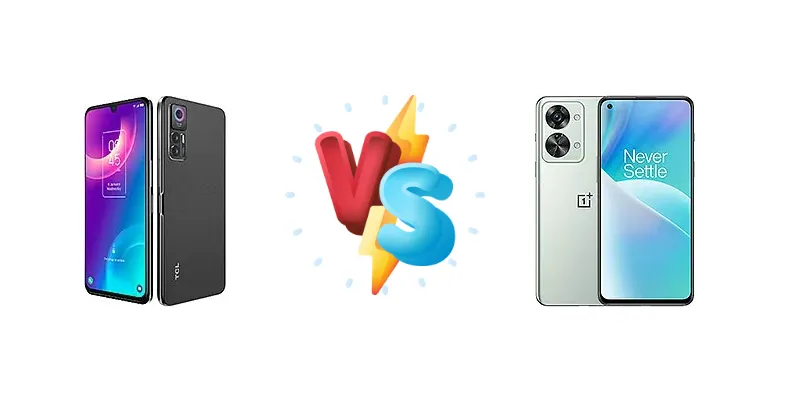
|
🏆 Quick Verdict
For most users, the OnePlus Nord 2T is the superior choice. Its significantly more powerful Dimensity 1300 chipset and blazing-fast 80W charging offer a dramatically improved user experience, justifying the price premium over the TCL 30+'s Helio G37.
| PHONES | ||
|---|---|---|
| Phone Names | TCL 30+ | OnePlus Nord 2T |
| Network | ||
|---|---|---|
| 2G bands | GSM 850 / 900 / 1800 / 1900 | GSM 850 / 900 / 1800 / 1900 |
| 3G bands | HSDPA 850 / 900 / 1900 / 2100 - EMEA/APAC | HSDPA 800 / 850 / 900 / 1700(AWS) / 1800 / 1900 / 2100 |
| 4G bands | 1, 3, 5, 7, 8, 20, 28, 38, 40, 41 - EMEA | 1, 2, 3, 4, 5, 7, 8, 12, 17, 18, 19, 20, 26, 28, 32, 34, 38, 39, 40, 41, 66 |
| 5G bands | - | 1, 3, 7, 8, 20, 28, 38, 41, 78 SA/NSA |
| Speed | HSPA 42.2/5.76 Mbps, LTE Cat4 150/50 Mbps | HSPA 42.2/5.76 Mbps, LTE Cat18 1200/150 Mbps, 5G |
| Technology | GSM / HSPA / LTE | GSM / HSPA / LTE / 5G |
| Launch | ||
|---|---|---|
| Announced | 2022, February 27 | 2022, May 19 |
| Status | Available. Released 2022, April 20 | Available. Released 2022, May 21 |
| Body | ||
|---|---|---|
| Build | Glass front, plastic frame, plastic back | Glass front (Gorilla Glass 5), plastic frame |
| Dimensions | 164.5 x 75.2 x 7.7 mm (6.48 x 2.96 x 0.30 in) | 159.1 x 73.2 x 8.2 mm (6.26 x 2.88 x 0.32 in) |
| SIM | Nano-SIM + Nano-SIM | Nano-SIM + Nano-SIM |
| Weight | 184 g (6.49 oz) | 190 g (6.70 oz) |
| Display | ||
|---|---|---|
| Protection | - | Corning Gorilla Glass 5 |
| Resolution | 1080 x 2400 pixels, 20:9 ratio (~393 ppi density) | 1080 x 2400 pixels, 20:9 ratio (~409 ppi density) |
| Size | 6.7 inches, 108.4 cm2 (~87.6% screen-to-body ratio) | 6.43 inches, 99.8 cm2 (~85.7% screen-to-body ratio) |
| Type | AMOLED, 650 nits (typ), 900 nits (peak) | AMOLED, 90Hz, HDR10+ |
| Platform | ||
|---|---|---|
| CPU | Octa-core (4x2.3 GHz Cortex-A53 & 4x1.8 GHz Cortex-A53) | Octa-core (1x3.0 GHz Cortex-A78 & 3x2.6 GHz Cortex-A78 & 4x2.0 GHz Cortex-A55) |
| Chipset | Mediatek MT6765V/CB Helio G37 (12 nm) | Mediatek Dimensity 1300 (6 nm) |
| GPU | PowerVR GE8320 | Mali-G77 MC9 |
| OS | Android 12, TCL UI 4.0 | Android 12, upgradable to Android 14, OxygenOS 14 |
| Memory | ||
|---|---|---|
| Card slot | microSDXC (dedicated slot) | No |
| Internal | 128GB 4GB RAM | 128GB 8GB RAM, 256GB 12GB RAM |
| - | UFS 3.1 | |
| Main Camera | ||
|---|---|---|
| Features | LED flash, HDR, panorama | Dual-LED flash, HDR, panorama |
| Single | - | 32 MP, f/2.4, (wide), 1/2.8", 0.8µm |
| Triple | 50 MP, f/1.9, 28mm (wide), 1/2.76", 0.64µm, PDAF 2 MP (macro) Auxiliary lens | 50 MP, f/1.9, 24mm (wide), 1/1.56", 1.0µm, PDAF, OIS 8 MP, f/2.2, 120˚ (ultrawide) Auxiliary lens |
| Video | 1080p@30fps | 4K@30fps, 1080p@30/60/120/480fps, gyro-EIS |
| Selfie camera | ||
|---|---|---|
| Features | HDR | Auto HDR |
| Single | 13 MP, f/2.3, 19mm (ultrawide), 1/3", 1.12µm | 32 MP, f/2.4, (wide), 1/2.8", 0.8µm |
| Video | 1080p@30fps | 1080p@30fps, gyro-EIS |
| Sound | ||
|---|---|---|
| 3.5mm jack | - | No |
| 35mm jack | Yes | No |
| Loudspeaker | Yes, with dual speakers | Yes, with stereo speakers |
| Comms | ||
|---|---|---|
| Bluetooth | 5.0, A2DP, LE | 5.2, A2DP, LE, aptX HD |
| NFC | Yes (T676K only) | Yes |
| Positioning | GPS, GLONASS, GALILEO, BDS | GPS, GLONASS, GALILEO, BDS, NavIC |
| Radio | Unspecified | No |
| USB | USB Type-C 2.0 | USB Type-C 2.0, OTG |
| WLAN | Wi-Fi 802.11 b/g/n, Wi-Fi Direct | Wi-Fi 802.11 a/b/g/n/ac/6, dual-band, Wi-Fi Direct |
| Features | ||
|---|---|---|
| Sensors | Fingerprint (side-mounted), accelerometer, proximity, compass | Fingerprint (under display, optical), accelerometer, gyro, proximity, compass |
| Battery | ||
|---|---|---|
| Charging | 18W wired | 80W wired, PD |
| Type | Li-Po 5010 mAh | Li-Po 4500 mAh |
| Misc | ||
|---|---|---|
| Colors | Tech Black, Muse Blue | Gray Shadow, Jade Fog |
| Models | T676K, T676J | CPH2399, CPH2401 |
| Price | About 220 EUR | € 144.39 / $ 169.99 / ₹ 31,490 |
| Tests | ||
|---|---|---|
| Battery life | - | Endurance rating 100h |
| Camera | - | Photo / Video |
| Display | - | Contrast ratio: Infinite (nominal) |
| Loudspeaker | - | -25.6 LUFS (Very good) |
| Performance | - | AnTuTu: 490545 (v8) | 604467 (v9) GeekBench: 2790 (v5.1) GFXBench: 40fps (ES 3.1 onscreen) |
TCL 30+
- Highly affordable price point
- Decent battery endurance (100h)
- Functional for basic smartphone tasks
- Weak processor (Helio G37)
- Slow charging speed (18W)
- Likely limited camera performance
OnePlus Nord 2T
- Powerful processor (Dimensity 1300)
- Ultra-fast 80W charging
- Brighter display for outdoor visibility
- Higher price than the TCL 30+
- May not offer expandable storage
- LCD panel instead of AMOLED
Display Comparison
The OnePlus Nord 2T boasts a brighter display, reaching a measured 636 nits, compared to an unspecified brightness for the TCL 30+. While both likely utilize LCD panels given their price points, the higher peak brightness of the Nord 2T translates to better visibility outdoors. The Nord 2T’s ‘infinite’ contrast ratio (nominal) suggests a standard LCD contrast, while the TCL 30+'s contrast ratio is not specified. Bezels are likely comparable, but the brighter panel gives the Nord 2T a clear advantage for outdoor use.
Camera Comparison
Both phones offer photo and video capabilities, but details are limited. Without specific sensor sizes or aperture information, it’s difficult to make a definitive judgment. However, the Nord 2T’s more powerful ISP (Image Signal Processor) within the Dimensity 1300 chipset will likely result in better image processing, particularly in low-light conditions. The TCL 30+ will likely rely more heavily on software processing to compensate for a potentially less capable sensor. We can assume the Nord 2T will offer more versatile video recording options.
Performance
The performance gap between these phones is substantial. The OnePlus Nord 2T’s Mediatek Dimensity 1300 (6nm) features a core configuration of 1x3.0 GHz Cortex-A78, 3x2.6 GHz Cortex-A78, and 4x2.0 GHz Cortex-A55, offering significantly more processing power than the TCL 30+'s Mediatek Helio G37 (12nm) with its 4x2.3 GHz Cortex-A53 & 4x1.8 GHz Cortex-A53. The 6nm process node of the Dimensity 1300 also provides superior power efficiency, reducing thermal throttling during sustained workloads. This means the Nord 2T will handle gaming and multitasking far more effectively. The TCL 30+ is suitable for basic tasks, but will struggle with demanding applications.
Battery Life
Both devices have an endurance rating of 100 hours, suggesting similar overall battery life despite the TCL 30+'s unspecified battery capacity. However, the charging speeds are drastically different. The OnePlus Nord 2T’s 80W wired charging with PD support allows for a full charge in a fraction of the time compared to the TCL 30+'s 18W charging. This is a significant convenience factor, especially for users who frequently need to top up their battery quickly. The faster charging effectively mitigates any potential battery capacity difference.
Buying Guide
Buy the TCL 30+ if you prioritize absolute affordability and only need a phone for basic tasks like calls, texts, and light social media. You’ll accept compromises in performance and charging speed. Buy the OnePlus Nord 2T if you value a smoother, more responsive experience, faster charging, and the ability to handle more demanding apps and games. It’s the better investment for users who want a phone that will last and perform well over time.