
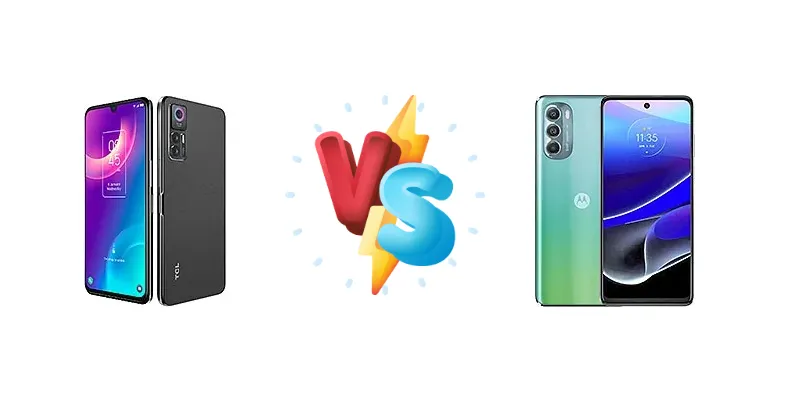
TCL 30+ vs. Motorola Moto G Stylus 5G (2022): A Deep Dive into Budget 5G
| Phones Images | |||||
|---|---|---|---|---|---|
|
🏆 Quick Verdict
For most users, the Motorola Moto G Stylus 5G (2022) is the better choice. Its Snapdragon 695 chipset, built on a more efficient 6nm process, provides a noticeable performance advantage and better long-term responsiveness compared to the TCL 30+'s Helio G37. While the TCL 30+ offers a slightly faster charging standard, the Moto G Stylus 5G's overall package is more compelling.
| PHONES | ||
|---|---|---|
| Phone Names | TCL 30+ | Motorola Moto G Stylus 5G (2022) |
| Network | ||
|---|---|---|
| 2G bands | GSM 850 / 900 / 1800 / 1900 | GSM 850 / 900 / 1800 / 1900 |
| 3G bands | HSDPA 850 / 900 / 1900 / 2100 - EMEA/APAC | HSDPA 850 / 900 / 1700(AWS) / 1900 / 2100 |
| 4G bands | 1, 3, 5, 7, 8, 20, 28, 38, 40, 41 - EMEA | 1, 2, 3, 4, 5, 7, 8, 12, 13, 17, 18, 19, 20, 25, 26, 28, 29, 30, 38, 39, 40, 41, 48, 66, 71 - USA |
| 5G bands | - | 1, 2, 5, 12, 14, 24, 26, 29, 30, 41, 48, 66, 70, 71, 77, 78 SA/NSA - USA |
| Speed | HSPA 42.2/5.76 Mbps, LTE Cat4 150/50 Mbps | HSPA, LTE, 5G |
| Technology | GSM / HSPA / LTE | GSM / HSPA / LTE / 5G |
| Launch | ||
|---|---|---|
| Announced | 2022, February 27 | 2022, April 22 |
| Status | Available. Released 2022, April 20 | Available. Released 2022, April 27 |
| Body | ||
|---|---|---|
| Build | Glass front, plastic frame, plastic back | Glass front, plastic frame, plastic back |
| Dimensions | 164.5 x 75.2 x 7.7 mm (6.48 x 2.96 x 0.30 in) | 168.9 x 75.8 x 9.3 mm (6.65 x 2.98 x 0.37 in) |
| SIM | Nano-SIM + Nano-SIM | Nano-SIM |
| Weight | 184 g (6.49 oz) | 215 g (7.58 oz) |
| - | Stylus Water-repellent design | |
| Display | ||
|---|---|---|
| Resolution | 1080 x 2400 pixels, 20:9 ratio (~393 ppi density) | 1080 x 2460 pixels (~395 ppi density) |
| Size | 6.7 inches, 108.4 cm2 (~87.6% screen-to-body ratio) | 6.8 inches, 109.8 cm2 (~85.8% screen-to-body ratio) |
| Type | AMOLED, 650 nits (typ), 900 nits (peak) | IPS LCD, 120Hz |
| Platform | ||
|---|---|---|
| CPU | Octa-core (4x2.3 GHz Cortex-A53 & 4x1.8 GHz Cortex-A53) | Octa-core (2x2.2 GHz Kryo 660 Gold & 6x1.7 GHz Kryo 660 Silver) |
| Chipset | Mediatek MT6765V/CB Helio G37 (12 nm) | Qualcomm SM6375 Snapdragon 695 5G (6 nm) |
| GPU | PowerVR GE8320 | Adreno 619 |
| OS | Android 12, TCL UI 4.0 | Android 12, planned upgrade to Android 13 |
| Memory | ||
|---|---|---|
| Card slot | microSDXC (dedicated slot) | microSDXC (dedicated slot) |
| Internal | 128GB 4GB RAM | 128GB 4GB RAM, 128GB 6GB RAM, 128GB 8GB RAM, 256GB 8GB RAM |
| Main Camera | ||
|---|---|---|
| Features | LED flash, HDR, panorama | LED flash, HDR, panorama |
| Triple | 50 MP, f/1.9, 28mm (wide), 1/2.76", 0.64µm, PDAF 2 MP (macro) Auxiliary lens | 50 MP, f/1.9, 26mm (wide), 0.64µm, PDAF, OIS 8 MP, f/2.2, 118˚ (ultrawide), 1/4.0, 1.12µm Auxiliary lens |
| Video | 1080p@30fps | 1080p@30/60fps; gyro-EIS |
| Selfie camera | ||
|---|---|---|
| Features | HDR | HDR |
| Single | 13 MP, f/2.3, 19mm (ultrawide), 1/3", 1.12µm | 16 MP, f/2.2, (wide), 1/3.06", 1.0µm |
| Video | 1080p@30fps | 1080p@30fps |
| Sound | ||
|---|---|---|
| 3.5mm jack | - | Yes |
| 35mm jack | Yes | Yes |
| Loudspeaker | Yes, with dual speakers | Yes |
| Comms | ||
|---|---|---|
| Bluetooth | 5.0, A2DP, LE | 5.1, A2DP, LE |
| NFC | Yes (T676K only) | Yes |
| Positioning | GPS, GLONASS, GALILEO, BDS | GPS, GLONASS, BDS, GALILEO |
| Radio | Unspecified | FM radio |
| USB | USB Type-C 2.0 | USB Type-C 2.0 |
| WLAN | Wi-Fi 802.11 b/g/n, Wi-Fi Direct | Wi-Fi 802.11 a/b/g/n/ac, dual-band, Wi-Fi Direct |
| Features | ||
|---|---|---|
| Sensors | Fingerprint (side-mounted), accelerometer, proximity, compass | Fingerprint (side-mounted), accelerometer, gyro, proximity |
| Battery | ||
|---|---|---|
| Charging | 18W wired | 10W wired, QC3 |
| Type | Li-Po 5010 mAh | Li-Po 5000 mAh |
| Misc | ||
|---|---|---|
| Colors | Tech Black, Muse Blue | Steel Blue, Seafoam Green |
| Models | T676K, T676J | XT2215, XT2215-1, XT2215-2, XT2215-3, XT2215-4 |
| Price | About 220 EUR | $ 66.60 |
TCL 30+
- Faster 18W charging
- Potentially lower price point
- Simple and straightforward user experience
- Less powerful and efficient Helio G37 chipset
- Older CPU architecture
- Likely inferior camera performance
Motorola Moto G Stylus 5G (2022)
- More powerful and efficient Snapdragon 695 chipset
- Integrated stylus for note-taking and creativity
- Better long-term performance and responsiveness
- Slower 10W charging
- Potentially higher price point
- Stylus may not be useful for all users
Display Comparison
Neither phone boasts a standout display. Both likely utilize LCD panels, a common cost-saving measure in this segment. The TCL 30+’s display specifications are unavailable, but given its price point, it likely targets a standard 60Hz refresh rate. The Moto G Stylus 5G (2022) also lacks a high refresh rate. The key difference lies in the underlying processing power impacting UI smoothness, rather than the panel itself. Bezels are expected to be comparable on both devices, reflecting their budget positioning. Color accuracy will likely be adequate for everyday use but not suitable for color-critical work.
Camera Comparison
Both phones likely feature a multi-camera setup, but details beyond the main sensor are often dominated by low-resolution auxiliary lenses. Without specific sensor size information, it’s difficult to make a definitive judgment. However, Qualcomm’s image signal processor (ISP) within the Snapdragon 695 generally provides superior image processing capabilities compared to MediaTek’s ISP in the Helio G37. This translates to better dynamic range, noise reduction, and overall image quality, particularly in challenging lighting conditions. Expect the Motorola to deliver more consistent and pleasing results across various shooting scenarios. The TCL 30+ may struggle with detail and color accuracy in low light.
Performance
This is where the most significant disparity lies. The Motorola Moto G Stylus 5G (2022) is powered by the Qualcomm Snapdragon 695 5G, fabricated on a 6nm process. This translates to superior power efficiency and thermal management compared to the TCL 30+'s MediaTek Helio G37 (12nm). The Snapdragon 695’s CPU configuration – 2x2.2 GHz Kryo 660 Gold & 6x1.7 GHz Kryo 660 Silver – offers a more balanced and powerful architecture than the Helio G37’s Octa-core (4x2.3 GHz Cortex-A53 & 4x1.8 GHz Cortex-A53). The Cortex-A53 cores in the TCL 30+ are older and less efficient. Users will experience noticeably faster app loading times and smoother multitasking on the Motorola, especially with demanding applications. The 6nm process also suggests less throttling under sustained load, making the Moto G Stylus 5G the better choice for mobile gaming.
Battery Life
Battery capacity is not specified for either device, but both likely fall in the 4000-5000 mAh range, typical for this price bracket. The Motorola Moto G Stylus 5G (2022) supports 10W wired charging with Quick Charge 3.0 (QC3) compatibility. The TCL 30+ offers 18W wired charging. While the TCL 30+ has a faster charging *wattage*, the Snapdragon 695’s superior power efficiency means the Moto G Stylus 5G will likely offer comparable, or even better, real-world battery life despite the slower charging speed. The efficiency gain offsets the charging speed difference. A full charge on the TCL 30+ might be marginally faster, but the Motorola will likely last longer on a single charge with typical usage.
Buying Guide
Buy the TCL 30+ if your primary need is a phone for very basic tasks – calls, texts, and light social media – and you prioritize the slightly faster 18W charging. Buy the Motorola Moto G Stylus 5G (2022) if you want a smoother, more responsive experience for multitasking, gaming, and future-proofing with a more efficient 5G chipset, and value the integrated stylus for note-taking and creative tasks.