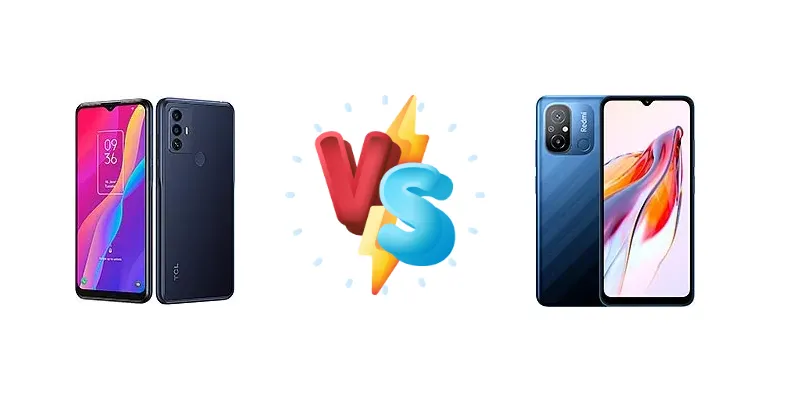
The TCL 30E and Xiaomi Redmi 12C represent the fiercely competitive sub-$150 smartphone market. Both aim to deliver essential smartphone functionality at an accessible price point, but they achieve this with different chipsets and subtle design choices. This comparison dissects the key differences to help you determine which device best suits your needs.
🏆 Quick Verdict
For most users, the Xiaomi Redmi 12C emerges as the better choice. Its Helio G85 chipset, featuring more powerful Cortex-A75 cores, provides a noticeable performance uplift over the TCL 30E’s Helio G25, making it more responsive for everyday tasks and light gaming. Both offer similar battery life and charging speeds.
| Network |
|---|
| 2G bands | GSM 850 / 900 / 1800 / 1900 | GSM 850 / 900 / 1800 / 1900 |
| 3G bands | HSDPA 850 / 900 / 1900 / 2100 - EMEA/APAC | HSDPA 850 / 900 / 2100 |
| 4G bands | 1, 3, 5, 7, 8, 20, 28, 38, 40, 41 - EMEA | 1, 3, 5, 7, 8, 20, 28, 38, 40, 41 - International |
| Speed | HSPA 42.2/11.5 Mbps, LTE Cat5 150/75 Mbps | HSPA, LTE |
| Technology | GSM / HSPA / LTE | GSM / CDMA / HSPA / EVDO / LTE |
| | 2, 3, 4, 5, 7, 8, 12, 13, 17, 26, 28, 66 - LATAM | CDMA2000 1xEV-DO |
| Launch |
|---|
| Announced | 2022, February 27 | 2022, December 31 |
| Status | Available. Released 2022, April 20 | Available. Released 2023, January 01 |
| Body |
|---|
| Build | Glass front, plastic frame, plastic back | - |
| Dimensions | 165.2 x 75.5 x 8.9 mm (6.50 x 2.97 x 0.35 in) | 168.8 x 76.4 x 8.8 mm (6.65 x 3.01 x 0.35 in) |
| SIM | · Nano-SIM· Nano-SIM + Nano-SIM | Nano-SIM + Nano-SIM |
| Weight | 190 g (6.70 oz) | 192 g (6.77 oz) |
| Display |
|---|
| Resolution | 720 x 1600 pixels, 20:9 ratio (~269 ppi density) | 720 x 1650 pixels (~268 ppi density) |
| Size | 6.52 inches, 102.6 cm2 (~82.3% screen-to-body ratio) | 6.71 inches, 106.5 cm2 (~82.6% screen-to-body ratio) |
| Type | IPS LCD, 450 nits (typ) | IPS LCD, 500 nits (typ) |
| Platform |
|---|
| CPU | Octa-core (4x2.0 GHz Cortex-A53 & 4x1.5 GHz Cortex-A53) | Octa-core (2x2.0 GHz Cortex-A75 & 6x1.8 GHz Cortex-A55) |
| Chipset | Mediatek MT6762G Helio G25 (12 nm) | Mediatek MT6769Z Helio G85 (12 nm) |
| GPU | PowerVR GE8320 | Mali-G52 MC2 |
| OS | Android 12 | Android 12, MIUI 13 |
| Memory |
|---|
| Card slot | microSDXC (dedicated slot) | microSDXC (dedicated slot) |
| Internal | 64GB 3GB RAM | 32GB 2GB RAM, 32GB 3GB RAM, 32GB 4GB RAM, 64GB 3GB RAM, 64GB 4GB RAM, 128GB 3GB RAM, 128GB 4GB RAM, 128GB 6GB RAM |
| | eMMC 5.1 | eMMC 5.1 |
| Main Camera |
|---|
| Dual | 50 MP, f/1.9, 28mm (wide), 1/2.76", 0.64µm, PDAF
Auxiliary lens | 50 MP, (wide), PDAF
0.08 MP (depth) |
| Features | LED flash, HDR, panorama | LED flash, HDR |
| Single | 5 MP, f/2.2, 28mm (wide), 1/5", 1.12µm | 50 MP, f/1.8, (wide), 1/2.76", PDAF
Auxiliary lens |
| Video | 1080p@30fps | 1080p@30fps |
| Selfie camera |
|---|
| Features | HDR | - |
| Single | 5 MP, f/2.2, 28mm (wide), 1/5.0", 1.12µm | 5 MP, f/2.2, (wide) |
| Video | 1080p@30fps | 1080p@30fps |
| Sound |
|---|
| 3.5mm jack | Yes | Yes |
| 35mm jack | Yes | Yes |
| Loudspeaker | Yes | Yes |
| Comms |
|---|
| Bluetooth | 5.0, A2DP, LE | 5.1, A2DP, LE |
| NFC | Yes (6127l only) | Yes (market/region dependent) |
| Positioning | GPS, GLONASS, GALILEO, BDS | GPS, GLONASS, BDS, GALILEO |
| Radio | Unspecified | FM radio |
| USB | USB Type-C 2.0 | microUSB 2.0 |
| WLAN | Wi-Fi 802.11 b/g/n, Wi-Fi Direct | Wi-Fi 802.11 a/b/g/n/ac, dual-band, Wi-Fi Direct |
| Features |
|---|
| Sensors | Fingerprint (rear-mounted), accelerometer, proximity, compass | Fingerprint (rear-mounted), accelerometer |
| | - | Virtual proximity sensing |
| Battery |
|---|
| Charging | 10W wired | 10W wired |
| Type | Li-Po 5000 mAh | Li-Po 5000 mAh |
| Misc |
|---|
| Colors | Space Gray, Atlantic Blue | Graphite Gray, Ocean Blue, Mint Green, Lavender Purple |
| Models | 6127A, 6127l | 22120RN86G, 22120RN86I, 22126RN91Y, 2212ARNC4L |
| Price | - | £ 132.99 / € 107.41 |
| SAR | - | 1.08 W/kg (head) 0.64 W/kg (body) |
| SAR EU | - | 0.98 W/kg (head) 0.99 W/kg (body) |
TCL 30E
- Potentially simpler software experience (depending on TCL’s skin)
- Reliable for basic smartphone tasks
- Affordable price point
- Significantly weaker processor compared to Redmi 12C
- Less responsive for multitasking and gaming
- Limited future-proofing
Xiaomi Redmi 12C
- More powerful Helio G85 chipset
- Improved performance for multitasking and gaming
- Better responsiveness in everyday use
- MIUI software can be resource-intensive
- Potential for bloatware
- Similar charging speed to TCL 30E
Display Comparison
Neither TCL nor Xiaomi provide detailed display specifications beyond resolution. However, both likely utilize LCD panels common in this price bracket. The real difference lies in the processing power driving them. While both will be adequate for basic viewing, the Redmi 12C’s more capable chipset will contribute to smoother scrolling and faster app loading times, indirectly improving the perceived display experience. Expect similar color accuracy and viewing angles on both.
Camera Comparison
Both devices are likely to feature similar camera setups focused on affordability. Detailed sensor information is unavailable, but it’s safe to assume both will include a primary camera and potentially a depth or macro sensor. Given the price point, image quality will be heavily reliant on software processing. The Redmi 12C’s more powerful chipset *could* allow for slightly faster image processing and potentially better low-light performance, but the difference will likely be marginal. Focusing on the primary sensor’s megapixel count is misleading; sensor size and lens aperture are far more critical, and this data is unavailable.
Performance
The core differentiator here is the chipset. The Xiaomi Redmi 12C’s Mediatek Helio G85 (12nm) boasts a significant architectural advantage over the TCL 30E’s Helio G25 (12nm). The G85 utilizes two Cortex-A75 cores clocked at 2.0 GHz alongside six Cortex-A55 cores, while the G25 relies solely on four Cortex-A53 cores at 2.0 GHz and four at 1.5 GHz. This means the Redmi 12C will exhibit superior performance in CPU-intensive tasks and a more fluid experience when switching between apps. The A75 cores offer a substantial IPC (Instructions Per Clock) improvement over the A53, translating to faster processing speeds. While both use the same 12nm process, the architectural differences are paramount.
Battery Life
Both the TCL 30E and Xiaomi Redmi 12C feature 10W wired charging, indicating similar charging speeds. A full 0-100% charge will likely take around 2.5-3 hours on both devices. Battery capacity is not specified, but given the target market, both are likely to be in the 5000mAh range. The slightly more efficient Helio G85 in the Redmi 12C *might* translate to marginally better battery life under heavy use, but real-world usage will likely be comparable for average users.
Buying Guide
Buy the TCL 30E if your primary need is a basic, reliable smartphone for essential communication and minimal app usage, and you prioritize a potentially simpler software experience. Buy the Xiaomi Redmi 12C if you want a more responsive device capable of handling multitasking, social media, and casual gaming with greater ease, and are comfortable with Xiaomi’s MIUI software.
Frequently Asked Questions
❓ Will the Redmi 12C struggle with popular apps like Facebook and WhatsApp?
No, the Helio G85 in the Redmi 12C is more than capable of handling everyday apps like Facebook, WhatsApp, and Instagram. The Cortex-A75 cores provide a performance boost that ensures smooth operation even with multiple apps open.
❓ Is the 10W charging speed on either phone a significant drawback?
10W charging is relatively slow by today's standards, but it's typical for phones in this price range. Both the TCL 30E and Redmi 12C will take around 2.5-3 hours to fully charge, so it's best to charge them overnight.
❓ Can the Redmi 12C handle any mobile games?
The Redmi 12C can handle casual mobile games like Candy Crush and Subway Surfers without issue. More demanding games like PUBG Mobile may be playable at lower settings to maintain a stable frame rate, but don't expect a high-end gaming experience.
❓ How does Xiaomi's MIUI software affect performance on the Redmi 12C?
MIUI is a feature-rich but sometimes resource-intensive Android skin. While it offers customization options, it can occasionally lead to slightly slower performance compared to a stock Android experience. However, the Helio G85's extra power helps mitigate this effect.