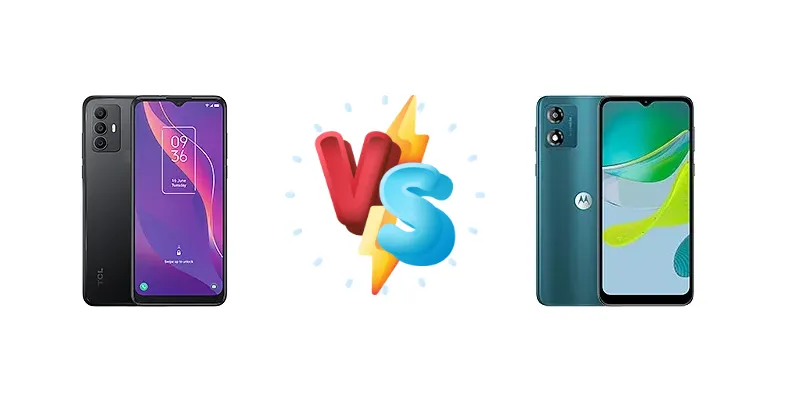
The budget smartphone market is fiercely competitive, offering incredible value for those seeking essential features without breaking the bank. Today, we're pitting two contenders against each other: the TCL 306 and the Motorola Moto E13. Let's dive into a detailed comparison to see which phone emerges as the winner.
🏆 Quick Verdict
The Motorola Moto E13 edges out the TCL 306 thanks to its more powerful processor and generally smoother performance. While both offer basic functionality, the E13's Cortex-A75 cores provide a noticeable boost in responsiveness for everyday tasks and light gaming. Both have similar charging speeds.
| Network |
|---|
| 2G bands | GSM 850 / 900 / 1800 / 1900 | GSM 850 / 900 / 1800 / 1900 |
| 3G bands | HSDPA 850 / 900 / 1900 / 2100 - EMEA, APAC | HSDPA 850 / 900 / 2100 |
| 4G bands | 1, 3, 5, 7, 8, 20, 28, 38, 40, 41 - EMEA | 1, 3, 5, 7, 8, 28, 38, 40, 41 |
| Speed | HSPA 42.2/11.5 Mbps, LTE Cat4 150/75 Mbps | HSPA, LTE |
| Technology | GSM / HSPA / LTE | GSM / HSPA / LTE |
| | 2, 3, 4, 5, 7, 8, 12, 13, 17, 26, 28, 66 - LATAM | 1, 3, 5, 7, 8, 20, 28, 38, 40, 41 |
| Launch |
|---|
| Announced | 2022, January 31 | 2023, January 24 |
| Status | Available. Released 2022, February | Available. Released 2023, February 13 |
| Body |
|---|
| Build | - | Glass front, plastic frame, plastic back |
| Dimensions | 165.2 x 75.5 x 8.9 mm (6.50 x 2.97 x 0.35 in) | 164.2 x 75 x 8.5 mm (6.46 x 2.95 x 0.33 in) |
| SIM | · Nano-SIM· Nano-SIM + Nano-SIM | Nano-SIM + Nano-SIM |
| Weight | 190 g (6.70 oz) | 179.5 g (6.35 oz) |
| | - | Water-resistant design |
| Display |
|---|
| Resolution | 720 x 1600 pixels, 20:9 ratio (~269 ppi density) | 720 x 1600 pixels, 20:9 ratio (~270 ppi density) |
| Size | 6.52 inches, 102.6 cm2 (~82.3% screen-to-body ratio) | 6.5 inches, 102.0 cm2 (~82.8% screen-to-body ratio) |
| Type | IPS LCD, 450 nits (typ) | IPS LCD |
| Platform |
|---|
| CPU | Octa-core (4x2.0 GHz Cortex-A53 & 4x1.5 GHz Cortex-A53) | Octa-core (2x1.6 GHz Cortex-A75 & 6x1.6 GHz Cortex-A55) |
| Chipset | Mediatek MT6762G Helio G25 (12 nm) | Unisoc T606 (12 nm) |
| GPU | PowerVR GE8320 | Mali-G57 MP1 |
| OS | Android 12, TCL UI | Android 13 (Go edition) |
| Memory |
|---|
| Card slot | microSDXC (dedicated slot) | microSDXC (dedicated slot) |
| Internal | 32GB 3GB RAM | 32GB 2GB RAM, 64GB 2GB RAM, 64GB 4GB RAM, 128GB 8GB RAM |
| | eMMC 5.1 | eMMC 5.1 |
| Main Camera |
|---|
| Features | LED flash, HDR, panorama | LED flash, HDR, panorama |
| Single | 5 MP, f/2.2, 27mm (wide) 1/5.0", 1.12µm | 13 MP, f/2.2, (wide), 1.12µm, PDAF |
| Triple | 13 MP, f/2.2, 27mm (wide) 1/3.0", 1.12µm, PDAF
2 MP (macro)
Auxiliary lens | - |
| Video | 1080p@30fps | 1080p@30fps |
| Selfie camera |
|---|
| Features | HDR | - |
| Single | 5 MP, f/2.2, 27mm (wide) 1/5.0", 1.12µm | 5 MP, f/2.4, (wide), 1/5.0", 1.12µm |
| Video | 1080p@30fps | 1080p@30fps |
| Sound |
|---|
| 3.5mm jack | Yes | Yes |
| 35mm jack | Yes | Yes |
| Loudspeaker | Yes | Yes |
| Comms |
|---|
| Bluetooth | 5.0, A2DP | 5.0, A2DP, LE |
| NFC | Yes (market/region dependent) | No |
| Positioning | GPS, GLONASS, GALILEO, BDS | GPS, GLONASS, GALILEO |
| Radio | FM radio | FM radio, recording |
| USB | USB Type-C 2.0, OTG | USB Type-C 2.0, OTG |
| WLAN | Wi-Fi 802.11 b/g/n, Wi-Fi Direct | Wi-Fi 802.11 a/b/g/n/ac, dual-band |
| Features |
|---|
| Sensors | Fingerprint (rear-mounted), accelerometer, proximity, compass | Accelerometer, proximity |
| Battery |
|---|
| Charging | 10W wired | 10W wired |
| Type | Li-Po 5000 mAh | Li-Po 5000 mAh |
| Misc |
|---|
| Colors | Space Gray, Atlantic Blue | Cosmic Black, Creamy White, Aurora Green |
| Models | X668, 6102H | - |
| Price | About 40 EUR | $ 119.99 / € 104.99 |
TCL 306
- Reliable brand
- Simple and easy to use
- Decent battery life
- Lower performance
- Older chipset
- Slow charging
Motorola Moto E13
- Better performance (Cortex-A75 cores)
- Slightly more modern design
- Good value for money
- Basic camera
- 10W charging is slow
- Plastic build
Display Comparison
Both phones likely feature a 6.5-inch HD+ display, offering decent viewing angles for the price. Expect similar color accuracy and brightness levels. The Moto E13 might have a slightly more modern display panel, potentially offering better outdoor visibility, but this is difficult to confirm without specific testing data.
Camera Comparison
Camera specs are often similar in this price range. Both phones likely feature a primary 13MP camera and a depth sensor. Image quality will depend heavily on software processing. Expect decent photos in good lighting conditions, but struggles in low light. The Moto E13 might have slightly better image processing due to its newer chipset.
Performance
This is where the Moto E13 has a clear advantage. The Unisoc T606's dual Cortex-A75 cores provide a significant performance boost compared to the TCL 306's all-Cortex-A53 configuration. Expect smoother multitasking and faster app loading times on the Moto E13. The TCL 306 will handle basic tasks adequately, but may struggle with more demanding applications.
Battery Life
Both phones are expected to have a 5000mAh battery, providing all-day battery life with moderate usage. Charging speeds are identical at 10W, so expect relatively slow charging times.
Buying Guide
The TCL 306 is a good choice for users prioritizing a simple, reliable phone for basic communication and media consumption. The Motorola Moto E13 is better suited for those who want a slightly more responsive experience and occasional light gaming, even on a tight budget.
Frequently Asked Questions
❓ Which phone is better for gaming?
The Motorola Moto E13 is significantly better for gaming due to its more powerful processor. While neither phone is a gaming powerhouse, the E13 will handle light games more smoothly.
❓ How long does the battery last on each phone?
Both phones are expected to offer all-day battery life with moderate usage thanks to their 5000mAh batteries. However, the Moto E13's more efficient chipset might provide slightly better longevity.