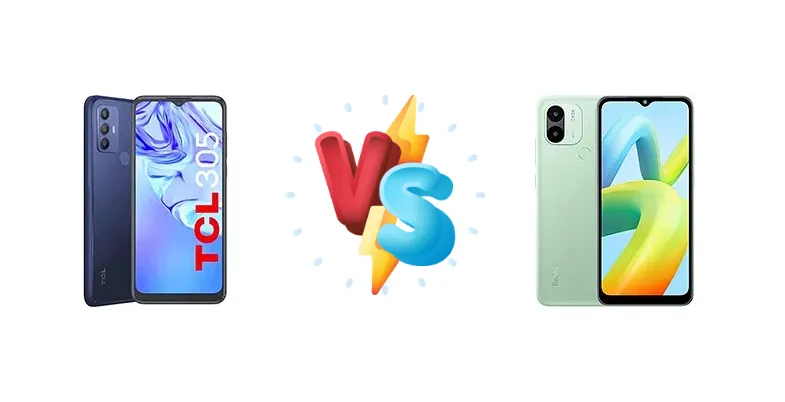
The budget smartphone market is fiercely competitive, offering incredible value for money. The TCL 305 and Xiaomi Redmi A1+ are two contenders vying for your attention. Both pack similar specs, but subtle differences can make a big impact. Let's dive into a detailed comparison to see which phone comes out on top.
🏆 Quick Verdict
Both phones offer very similar performance thanks to the same chipset. The Redmi A1+ likely edges out the TCL 305 due to Xiaomi's generally more competitive pricing and slightly better software optimization. Ultimately, the best choice depends on your local pricing and preferred brand.
| Network |
|---|
| 2G bands | GSM 850 / 900 / 1800 / 1900 | GSM 850 / 900 / 1800 / 1900 - SIM 1 & SIM 2 |
| 3G bands | HSDPA 850 / 900 / 1900 / 2100 - 6102D | HSDPA 850 / 900 / 2100 |
| 4G bands | 1, 3, 5, 7, 8, 20, 28, 38, 40, 41 - 6102D | 1, 3, 5, 7, 8, 20, 28, 38, 40, 41 |
| Speed | HSPA 42.2/11.5 Mbps, LTE Cat4 150/50 Mbps | HSPA, LTE |
| Technology | GSM / HSPA / LTE | GSM / HSPA / LTE |
| | 2, 3, 4, 5, 7, 8, 12, 13, 17, 26, 28, 66 - 6102А | - |
| Launch |
|---|
| Announced | 2022, January 31 | 2022, September 23 |
| Status | Available. Released 2022, February | Available. Released 2022, September 23 |
| Body |
|---|
| Build | Glass front, plastic frame, plastic back | - |
| Dimensions | 165.2 x 75.5 x 8.9 mm (6.50 x 2.97 x 0.35 in) | 164.9 x 76.8 x 9.1 mm (6.49 x 3.02 x 0.36 in) |
| SIM | · Nano-SIM· Nano-SIM + Nano-SIM | Dual SIM (Nano-SIM, dual stand-by) |
| Weight | 190 g (6.70 oz) | 192 g (6.77 oz) |
| Display |
|---|
| Resolution | 720 x 1600 pixels, 20:9 ratio (~269 ppi density) | 720 x 1600 pixels, 20:9 ratio (~269 ppi density) |
| Size | 6.52 inches, 102.6 cm2 (~82.3% screen-to-body ratio) | 6.52 inches, 102.6 cm2 (~81.0% screen-to-body ratio) |
| Type | IPS LCD, 450 nits (typ) | IPS LCD, 400 nits (typ) |
| Platform |
|---|
| CPU | Quad-core 2.0 GHz Cortex-A53 | Quad-core 2.0 GHz Cortex-A53 |
| Chipset | Mediatek MT6761 Helio A22 (12 nm) | Mediatek MT6761 Helio A22 (12 nm) |
| GPU | PowerVR GE8320 | PowerVR GE8320 |
| OS | Android 11 (Go edition), TCL UI | Android 12 (Go edition), MIUI 12 |
| Memory |
|---|
| Card slot | microSDXC (dedicated slot) | microSDXC (dedicated slot) |
| Internal | 32GB 2GB RAM, 64GB 2GB RAM | 32GB 2GB RAM, 32GB 3GB RAM |
| | eMMC 5.1 | eMMC 5.1 |
| Main Camera |
|---|
| Dual | - | 8 MP, f/2.0, (wide)
0.08 MP (depth) |
| Features | LED flash, HDR, panorama | Dual-LED flash, HDR |
| Single | 5 MP, f/2.2, 27mm (wide) 1/5.0", 1.12µm | - |
| Triple | 13 MP, f/2.2, 27mm (wide) 1/3.0", 1.12µm, PDAF
2 MP (macro)
Auxiliary lens | - |
| Video | 1080p@30fps | 1080p@30fps |
| Selfie camera |
|---|
| Features | HDR | - |
| Single | 5 MP, f/2.2, 27mm (wide) 1/5.0", 1.12µm | 5 MP, f/2.2 |
| Video | 1080p@30fps | 1080p@30fps |
| Sound |
|---|
| 3.5mm jack | Yes | Yes |
| 35mm jack | Yes | - |
| Loudspeaker | Yes | Yes |
| Comms |
|---|
| Bluetooth | 5.0, A2DP | 5.0, A2DP, LE |
| NFC | No | No |
| Positioning | GPS, GLONASS, GALILEO | GPS, GLONASS, GALILEO, BDS |
| Radio | FM radio | FM radio |
| USB | USB Type-C 2.0, OTG | microUSB 2.0 |
| WLAN | Wi-Fi 802.11 g/n, Wi-Fi Direct | Wi-Fi 802.11 a/b/g/n |
| Features |
|---|
| Sensors | Fingerprint (rear-mounted), accelerometer, proximity, compass | Fingerprint (rear-mounted), accelerometer |
| Battery |
|---|
| Charging | 10W wired | 10W wired |
| Type | Li-Po 5000 mAh | Li-Po 5000 mAh, non-removable |
| Misc |
|---|
| Colors | Space Gray, Atlantic Blue | Light Green, Light Blue, Black |
| Models | 6102D, 5164D | 220733SFG |
| Price | About 200 EUR | € 78.30 / £ 72.30 / ₹ 6,670 |
| SAR | - | 1.00 W/kg (head) 1.10 W/kg (body) |
| SAR EU | - | 0.91 W/kg (head) 1.00 W/kg (body) |
TCL 305
- Potentially slightly better display color accuracy
- May have wider availability in some regions
- Decent battery life
- Entry-level performance
- Slow charging
- Camera performance is average
Xiaomi Redmi A1+
- Competitive pricing
- Xiaomi's MIUI software
- Decent battery life
- Reliable brand reputation
- Entry-level performance
- Slow charging
- Camera performance is average
Display Comparison
Both phones feature a 6.5-inch HD+ display, offering decent viewing angles for everyday use. While both are adequate, the TCL 305 might have slightly better color accuracy, though this is difficult to confirm without testing. Expect similar brightness levels and viewing experiences.
Camera Comparison
The TCL 305 typically features a 13MP main camera, while the Redmi A1+ also boasts a 13MP main camera. Image quality will be comparable, with both struggling in low-light conditions. Expect decent daytime shots, but don't expect flagship-level photography. Both likely have a front-facing camera around 5MP for selfies.
Performance
Performance is virtually identical. The Mediatek Helio A22 chipset is entry-level, so don't expect blazing speeds. Both phones will handle basic tasks like browsing, social media, and light gaming without issue. Demanding games are out of the question. Software optimization will be a key differentiator here, with Xiaomi potentially having a slight edge.
Battery Life
Both phones are expected to have a 5000mAh battery, providing all-day battery life with moderate usage. Charging speeds are limited to 10W wired charging on both devices, so expect relatively slow charging times.
Buying Guide
The TCL 305 is a good option if you prioritize a slightly larger screen and potentially better availability in certain regions. The Xiaomi Redmi A1+ is ideal for those seeking the absolute best value for their money and prefer Xiaomi's MIUI interface.
Frequently Asked Questions
❓ Which phone is better for gaming?
Neither phone is ideal for gaming. The Mediatek Helio A22 chipset is entry-level and struggles with demanding games. Both are suitable for casual games only.
❓ What is the difference in software?
The TCL 305 likely runs a more stock Android experience, while the Redmi A1+ uses Xiaomi's MIUI. MIUI offers more features and customization options, but can also be more resource-intensive.