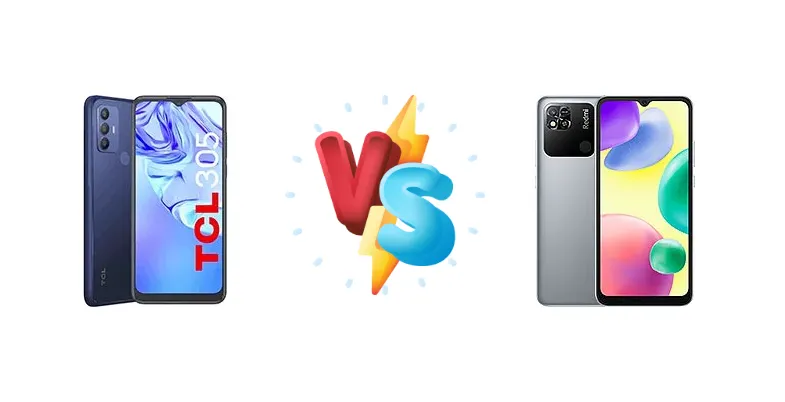
Looking for an affordable smartphone that doesn't completely break the bank? The TCL 305 and Xiaomi Redmi 10A are both contenders in the budget phone arena. But which one offers the best bang for your buck? Let's dive into a detailed comparison to help you decide.
🏆 Quick Verdict
The Xiaomi Redmi 10A edges out the TCL 305 thanks to its slightly more powerful processor and generally better overall performance. While both are budget options, the Redmi 10A provides a smoother experience for everyday tasks and light gaming, making it the slightly better choice.
| Network |
|---|
| 2G bands | GSM 850 / 900 / 1800 / 1900 | GSM 850 / 900 / 1800 / 1900 |
| 3G bands | HSDPA 850 / 900 / 1900 / 2100 - 6102D | HSDPA 850 / 900 / 2100 |
| 4G bands | 1, 3, 5, 7, 8, 20, 28, 38, 40, 41 - 6102D | 1, 3, 5, 8, 40, 41 - International |
| Speed | HSPA 42.2/11.5 Mbps, LTE Cat4 150/50 Mbps | HSPA, LTE |
| Technology | GSM / HSPA / LTE | GSM / HSPA / CDMA2000 / LTE |
| | 2, 3, 4, 5, 7, 8, 12, 13, 17, 26, 28, 66 - 6102А | 1, 3, 5, 8, 34, 38, 39, 40, 41 - China |
| Launch |
|---|
| Announced | 2022, January 31 | 2022, March 29 |
| Status | Available. Released 2022, February | Available. Released 2022, March 31 |
| Body |
|---|
| Build | Glass front, plastic frame, plastic back | - |
| Dimensions | 165.2 x 75.5 x 8.9 mm (6.50 x 2.97 x 0.35 in) | 164.9 x 77.1 x 9 mm (6.49 x 3.04 x 0.35 in) |
| SIM | · Nano-SIM· Nano-SIM + Nano-SIM | Nano-SIM + Nano-SIM |
| Weight | 190 g (6.70 oz) | 194 g (6.84 oz) |
| Display |
|---|
| Resolution | 720 x 1600 pixels, 20:9 ratio (~269 ppi density) | 720 x 1600 pixels, 20:9 ratio (~269 ppi density) |
| Size | 6.52 inches, 102.6 cm2 (~82.3% screen-to-body ratio) | 6.53 inches, 102.9 cm2 (~81.0% screen-to-body ratio) |
| Type | IPS LCD, 450 nits (typ) | IPS LCD, 400 nits (typ) |
| Platform |
|---|
| CPU | Quad-core 2.0 GHz Cortex-A53 | Octa-core (4x2.0 GHz Cortex-A53 & 4x1.5 GHz Cortex-A53) |
| Chipset | Mediatek MT6761 Helio A22 (12 nm) | Mediatek MT6762G Helio G25 (12 nm) |
| GPU | PowerVR GE8320 | PowerVR GE8320 |
| OS | Android 11 (Go edition), TCL UI | Android 11, MIUI 12.5 |
| Memory |
|---|
| Card slot | microSDXC (dedicated slot) | microSDXC |
| Internal | 32GB 2GB RAM, 64GB 2GB RAM | 32GB 2GB RAM, 32GB 3GB RAM, 64GB 3GB RAM, 64GB 4GB RAM, 128GB 4GB RAM, 128GB 6GB RAM |
| | eMMC 5.1 | - |
| Main Camera |
|---|
| Features | LED flash, HDR, panorama | LED flash |
| Single | 5 MP, f/2.2, 27mm (wide) 1/5.0", 1.12µm | 13 MP, f/2.2, (wide), 1.0µm, AF |
| Triple | 13 MP, f/2.2, 27mm (wide) 1/3.0", 1.12µm, PDAF
2 MP (macro)
Auxiliary lens | - |
| Video | 1080p@30fps | 1080p@30fps |
| Selfie camera |
|---|
| Features | HDR | HDR |
| Single | 5 MP, f/2.2, 27mm (wide) 1/5.0", 1.12µm | 5 MP |
| Video | 1080p@30fps | 1080p@30fps |
| Sound |
|---|
| 3.5mm jack | Yes | Yes |
| 35mm jack | Yes | Yes |
| Loudspeaker | Yes | Yes |
| Comms |
|---|
| Bluetooth | 5.0, A2DP | 5.0, A2DP, LE |
| NFC | No | No |
| Positioning | GPS, GLONASS, GALILEO | GPS, GLONASS, BDS |
| Radio | FM radio | No |
| USB | USB Type-C 2.0, OTG | microUSB 2.0 |
| WLAN | Wi-Fi 802.11 g/n, Wi-Fi Direct | Wi-Fi 802.11 a/b/g/n, Wi-Fi Direct |
| Features |
|---|
| Sensors | Fingerprint (rear-mounted), accelerometer, proximity, compass | Fingerprint (rear-mounted), accelerometer, proximity |
| Battery |
|---|
| Charging | 10W wired | 10W wired |
| Type | Li-Po 5000 mAh | Li-Ion 5000 mAh |
| Misc |
|---|
| Colors | Space Gray, Atlantic Blue | Charcoal Black, Sea Blue, Slate Grey |
| Models | 6102D, 5164D | 220233L2C, 220233L2G, 220233L2I |
| Price | About 200 EUR | € 60.00 / $ 66.55 |
| SAR | - | 0.90 W/kg (head) 0.65 W/kg (body) |
| SAR EU | - | 0.40 W/kg (head) 0.99 W/kg (body) |
TCL 305
- Simple and clean user interface
- Decent battery life
- Compact and lightweight design
- Less powerful processor
- Lower camera quality compared to Redmi 10A
- Limited storage options
Xiaomi Redmi 10A
- More powerful processor for smoother performance
- Better camera quality
- Slightly larger screen
- Good value for money
- Can feel slightly bulky
- 10W charging is slow
- Software can be a bit cluttered
Display Comparison
Both phones feature a 6.53-inch display, but the Redmi 10A typically has a slightly higher resolution (720 x 1600 pixels) compared to the TCL 305 (likely 720 x 1600, but confirmation needed). The Redmi 10A's screen often exhibits slightly better color accuracy and brightness, though both are adequate for everyday use. Viewing angles are acceptable on both.
Camera Comparison
The Redmi 10A generally boasts a more versatile camera setup, often including a higher resolution main sensor (typically 13MP) and potentially additional lenses like a depth sensor. The TCL 305's camera is adequate for basic snapshots, but the Redmi 10A typically captures more detailed and vibrant images, especially in good lighting conditions. Both phones have a front-facing camera around 5MP.
Performance
The Redmi 10A's Mediatek Helio G25 chipset with its octa-core processor provides a noticeable performance advantage over the TCL 305's Helio A22 quad-core processor. Expect smoother app loading, faster multitasking, and slightly better gaming performance on the Redmi 10A. Both phones will struggle with demanding games.
Battery Life
Both phones feature a 5000mAh battery, promising all-day battery life under moderate usage. However, the Redmi 10A's more efficient processor may give it a slight edge in overall battery endurance. Charging speeds are identical at 10W wired.
Buying Guide
The TCL 305 is a good option for users prioritizing a clean, simple interface and basic functionality. The Xiaomi Redmi 10A is ideal for those needing a bit more processing power for multitasking and occasional gaming, and who appreciate a slightly larger screen.
Frequently Asked Questions
❓ Which phone is better for gaming?
The Xiaomi Redmi 10A is the better choice for gaming due to its more powerful processor. However, neither phone is ideal for demanding games.
❓ How much storage do these phones offer?
Both phones typically offer storage options ranging from 32GB to 64GB, expandable via microSD card. Check specific model variants for exact storage configurations.