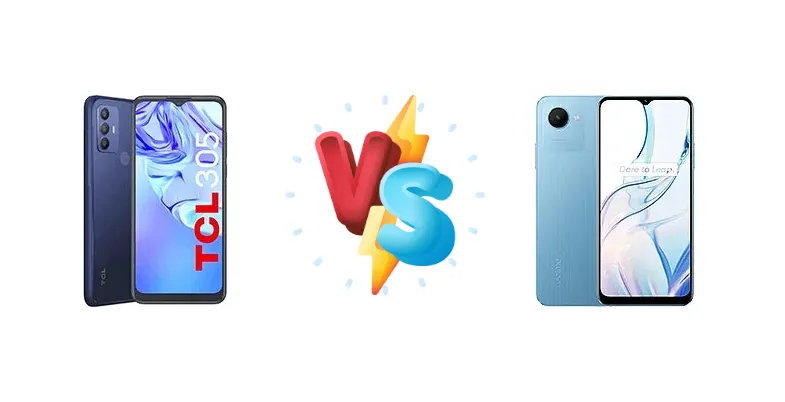
The sub-$150 smartphone market is fiercely competitive. Both the TCL 305 and Realme C30s aim to deliver essential smartphone functionality at an incredibly accessible price point. However, they take different approaches to achieving this, primarily in their core processing power. This comparison dissects the key differences to determine which device offers the best value for your money.
🏆 Quick Verdict
For the average user prioritizing responsiveness and multitasking, the Realme C30s is the better choice. Its octa-core CPU provides a noticeable performance advantage over the TCL 305’s quad-core processor, making everyday tasks smoother. While both offer similar charging speeds, the C30s’ processing power justifies the slight price difference.
| Network |
|---|
| 2G bands | GSM 850 / 900 / 1800 / 1900 | GSM 850 / 900 / 1800 / 1900 |
| 3G bands | HSDPA 850 / 900 / 1900 / 2100 - 6102D | HSDPA 850 / 900 / 2100 |
| 4G bands | 1, 3, 5, 7, 8, 20, 28, 38, 40, 41 - 6102D | 1, 3, 5, 8, 38, 40, 41 |
| Speed | HSPA 42.2/11.5 Mbps, LTE Cat4 150/50 Mbps | HSPA, LTE |
| Technology | GSM / HSPA / LTE | GSM / HSPA / LTE |
| | 2, 3, 4, 5, 7, 8, 12, 13, 17, 26, 28, 66 - 6102А | - |
| Launch |
|---|
| Announced | 2022, January 31 | 2022, September 14 |
| Status | Available. Released 2022, February | Available. Released 2022, September 23 |
| Body |
|---|
| Build | Glass front, plastic frame, plastic back | Glass front, plastic frame, plastic back |
| Dimensions | 165.2 x 75.5 x 8.9 mm (6.50 x 2.97 x 0.35 in) | 164.2 x 75.7 x 8.5 mm (6.46 x 2.98 x 0.33 in) |
| SIM | · Nano-SIM· Nano-SIM + Nano-SIM | Nano-SIM + Nano-SIM |
| Weight | 190 g (6.70 oz) | 186 g (6.56 oz) |
| Display |
|---|
| Resolution | 720 x 1600 pixels, 20:9 ratio (~269 ppi density) | 720 x 1600 pixels, 20:9 ratio (~270 ppi density) |
| Size | 6.52 inches, 102.6 cm2 (~82.3% screen-to-body ratio) | 6.5 inches, 102.0 cm2 (~82.1% screen-to-body ratio) |
| Type | IPS LCD, 450 nits (typ) | IPS LCD |
| Platform |
|---|
| CPU | Quad-core 2.0 GHz Cortex-A53 | Octa-core 1.6 GHz Cortex-A55 |
| Chipset | Mediatek MT6761 Helio A22 (12 nm) | - |
| GPU | PowerVR GE8320 | IMG8322 |
| OS | Android 11 (Go edition), TCL UI | Android 12, Realme UI Go |
| Memory |
|---|
| Card slot | microSDXC (dedicated slot) | microSDXC (dedicated slot) |
| Internal | 32GB 2GB RAM, 64GB 2GB RAM | 32GB 2GB RAM, 32GB 3GB RAM, 64GB 3GB RAM, 64GB 4GB RAM |
| | eMMC 5.1 | - |
| Main Camera |
|---|
| Features | LED flash, HDR, panorama | LED flash, HDR, panorama |
| Single | 5 MP, f/2.2, 27mm (wide) 1/5.0", 1.12µm | 8 MP, (wide), 1/4.0", 1.12µm |
| Triple | 13 MP, f/2.2, 27mm (wide) 1/3.0", 1.12µm, PDAF
2 MP (macro)
Auxiliary lens | - |
| Video | 1080p@30fps | 1080p@30fps |
| Selfie camera |
|---|
| Features | HDR | HDR |
| Single | 5 MP, f/2.2, 27mm (wide) 1/5.0", 1.12µm | 5 MP, (wide), 1/5.0", 1.12µm |
| Video | 1080p@30fps | 720p@30fps |
| Sound |
|---|
| 3.5mm jack | Yes | Yes |
| 35mm jack | Yes | Yes |
| Loudspeaker | Yes | Yes |
| Comms |
|---|
| Bluetooth | 5.0, A2DP | 4.2, A2DP |
| NFC | No | No |
| Positioning | GPS, GLONASS, GALILEO | GPS, GLONASS |
| Radio | FM radio | Unspecified |
| USB | USB Type-C 2.0, OTG | microUSB 2.0, OTG |
| WLAN | Wi-Fi 802.11 g/n, Wi-Fi Direct | Wi-Fi 802.11 b/g/n |
| Features |
|---|
| Sensors | Fingerprint (rear-mounted), accelerometer, proximity, compass | Fingerprint (side-mounted), accelerometer, proximity |
| Battery |
|---|
| Charging | 10W wired | 10W wired |
| Type | Li-Po 5000 mAh | 5000 mAh |
| Misc |
|---|
| Colors | Space Gray, Atlantic Blue | Stripe Blue, Stripe Black |
| Models | 6102D, 5164D | RMX3690 |
| Price | About 200 EUR | About 100 EUR |
TCL 305
- Potentially lower price point
- Simple and straightforward user experience
- Reliable for basic communication tasks
- Quad-core processor limits multitasking
- Less responsive user interface
- May struggle with demanding apps
Realme C30s
- Octa-core processor for smoother performance
- More efficient Cortex-A55 architecture
- Better multitasking capabilities
- Slightly higher price compared to TCL 305
- May not offer significant camera improvements
- 10W charging is relatively slow
Display Comparison
Neither TCL nor Realme provide display specifications beyond size in their marketing materials. Given the price point, both likely utilize LCD panels with 720p+ resolution. Expect similar viewing experiences, with neither offering features like high refresh rates or HDR support. Bezels are likely to be substantial on both devices, maximizing screen real estate within a compact form factor. Color accuracy will likely be standard for this segment, prioritizing power efficiency over color fidelity.
Camera Comparison
Both devices are expected to feature basic camera setups, likely with a primary sensor and potentially a secondary depth or macro lens. Given the lack of detailed specifications, it’s safe to assume image quality will be adequate for casual snapshots in good lighting conditions. The Realme C30s may benefit from slightly more advanced image processing algorithms, but significant differences are unlikely. Focusing on megapixel counts alone is misleading in this segment; sensor size and image processing are far more critical.
Performance
The core difference lies in the processors. The Realme C30s boasts an octa-core 1.6 GHz Cortex-A55 CPU, while the TCL 305 is equipped with a quad-core 2.0 GHz Cortex-A53. While the TCL 305’s cores have a higher clock speed, the C30s’ eight cores provide superior multitasking capabilities. The Cortex-A55 architecture is also more efficient than the A53, potentially leading to better battery life under sustained load. This translates to smoother app switching, faster web browsing, and a more responsive overall experience on the Realme C30s. The TCL 305 will likely struggle with more demanding applications or running multiple apps simultaneously.
Battery Life
Both the TCL 305 and Realme C30s support 10W wired charging. This is standard for entry-level smartphones and translates to roughly 2-3 hours for a full charge. Battery capacity is not specified for either device, but both likely house batteries in the 5000mAh range, providing all-day battery life with moderate usage. The Realme C30s’ more efficient processor may contribute to slightly longer battery life, especially during demanding tasks.
Buying Guide
Buy the TCL 305 if you need a basic smartphone for calls, texts, and light social media use, and are extremely budget-constrained. Its simplicity and lower price point make it ideal for first-time smartphone users or those needing a reliable backup device. Buy the Realme C30s if you prefer a more responsive experience for multitasking, occasional gaming, and a generally smoother user interface. The octa-core processor offers a significant upgrade in performance for a minimal price increase.
Frequently Asked Questions
❓ Will the Realme C30s handle popular games like PUBG Mobile?
While the Realme C30s can *run* PUBG Mobile, expect to play at the lowest graphics settings and potentially experience frame drops during intense moments. The processor isn't designed for demanding gaming, but it's capable of casual gaming experiences.
❓ Is the TCL 305 a good option for elderly users who primarily need a phone for calls and texts?
Yes, the TCL 305 is an excellent choice for elderly users or those with basic needs. Its simplicity and affordability make it a reliable device for essential communication without the complexity of advanced features.
❓ Does either phone support fast charging beyond 10W?
No, both the TCL 305 and Realme C30s are limited to 10W wired charging. This is typical for phones in this price range, and you shouldn't expect significantly faster charging speeds.
❓ How much storage do these phones typically come with, and is it expandable?
Both phones generally ship with 32GB of internal storage, which is quite limited. Fortunately, both devices support microSD card expansion, allowing you to add up to 512GB or 1TB of additional storage for photos, videos, and apps.