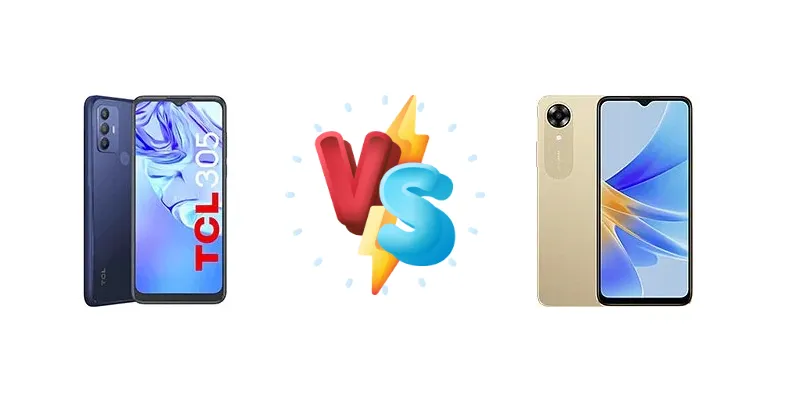
The TCL 305 and Oppo A17k represent the very bottom end of the smartphone market, competing fiercely for users prioritizing affordability. Both devices aim to deliver essential smartphone functionality without breaking the bank, but significant differences in their core processing power dictate which phone is better suited for different users. This comparison dives deep into the specifications to reveal which device offers the best value.
🏆 Quick Verdict
For most users, the Oppo A17k is the better choice. Its MediaTek Helio G35 chipset, featuring an octa-core CPU, provides a noticeable performance uplift over the TCL 305’s quad-core Helio A22. While both phones offer basic functionality, the A17k handles multitasking and app loading with greater ease, making it the more responsive daily driver.
| Network |
|---|
| 2G bands | GSM 850 / 900 / 1800 / 1900 | GSM 850 / 900 / 1800 / 1900 |
| 3G bands | HSDPA 850 / 900 / 1900 / 2100 - 6102D | HSDPA 850 / 900 / 2100 |
| 4G bands | 1, 3, 5, 7, 8, 20, 28, 38, 40, 41 - 6102D | 1, 3, 5, 8, 38, 40, 41 |
| Speed | HSPA 42.2/11.5 Mbps, LTE Cat4 150/50 Mbps | HSPA, LTE |
| Technology | GSM / HSPA / LTE | GSM / HSPA / LTE |
| | 2, 3, 4, 5, 7, 8, 12, 13, 17, 26, 28, 66 - 6102А | - |
| Launch |
|---|
| Announced | 2022, January 31 | 2022, October 13 |
| Status | Available. Released 2022, February | Available. Released 2022, October 18 |
| Body |
|---|
| Build | Glass front, plastic frame, plastic back | - |
| Dimensions | 165.2 x 75.5 x 8.9 mm (6.50 x 2.97 x 0.35 in) | 164.2 x 75.6 x 8.3 mm (6.46 x 2.98 x 0.33 in) |
| SIM | · Nano-SIM· Nano-SIM + Nano-SIM | Nano-SIM + Nano-SIM |
| Weight | 190 g (6.70 oz) | 189 g (6.67 oz) |
| | - | IPX4 water resistance |
| Display |
|---|
| Protection | - | Panda Glass |
| Resolution | 720 x 1600 pixels, 20:9 ratio (~269 ppi density) | 720 x 1612 pixels, 20:9 ratio (~269 ppi density) |
| Size | 6.52 inches, 102.6 cm2 (~82.3% screen-to-body ratio) | 6.56 inches, 103.4 cm2 (~83.3% screen-to-body ratio) |
| Type | IPS LCD, 450 nits (typ) | IPS LCD, 480 nits (typ), 600 nits (HBM) |
| Platform |
|---|
| CPU | Quad-core 2.0 GHz Cortex-A53 | Octa-core (4x2.3 GHz Cortex-A53 & 4x1.8 GHz Cortex-A53) |
| Chipset | Mediatek MT6761 Helio A22 (12 nm) | Mediatek MT6765 Helio G35 (12 nm) |
| GPU | PowerVR GE8320 | PowerVR GE8320 |
| OS | Android 11 (Go edition), TCL UI | Android 12, ColorOS 12.1 |
| Memory |
|---|
| Card slot | microSDXC (dedicated slot) | microSDXC |
| Internal | 32GB 2GB RAM, 64GB 2GB RAM | 64GB 3GB RAM |
| | eMMC 5.1 | eMMC 5.1 |
| Main Camera |
|---|
| Features | LED flash, HDR, panorama | LED flash, panorama |
| Single | 5 MP, f/2.2, 27mm (wide) 1/5.0", 1.12µm | 8 MP, f/2.0, (wide), AF |
| Triple | 13 MP, f/2.2, 27mm (wide) 1/3.0", 1.12µm, PDAF
2 MP (macro)
Auxiliary lens | - |
| Video | 1080p@30fps | 1080p@30fps |
| Selfie camera |
|---|
| Features | HDR | - |
| Single | 5 MP, f/2.2, 27mm (wide) 1/5.0", 1.12µm | 5 MP, f/2.2, (wide) |
| Video | 1080p@30fps | 1080p@30fps |
| Sound |
|---|
| 3.5mm jack | Yes | Yes |
| 35mm jack | Yes | Yes |
| Loudspeaker | Yes | Yes |
| Comms |
|---|
| Bluetooth | 5.0, A2DP | 5.3, A2DP, LE, aptX HD |
| NFC | No | No |
| Positioning | GPS, GLONASS, GALILEO | GPS, GLONASS, BDS, GALILEO |
| Radio | FM radio | Unspecified |
| USB | USB Type-C 2.0, OTG | microUSB 2.0, OTG |
| WLAN | Wi-Fi 802.11 g/n, Wi-Fi Direct | Wi-Fi 802.11 a/b/g/n/ac, dual-band |
| Features |
|---|
| Sensors | Fingerprint (rear-mounted), accelerometer, proximity, compass | Fingerprint (side-mounted), accelerometer, proximity, compass |
| Battery |
|---|
| Charging | 10W wired | - |
| Type | Li-Po 5000 mAh | Li-Po 5000 mAh |
| Misc |
|---|
| Colors | Space Gray, Atlantic Blue | Navy Blue, Gold |
| Models | 6102D, 5164D | CPH2471 |
| Price | About 200 EUR | About 130 EUR |
TCL 305
- Extremely affordable
- Simple and easy to use
- Functional for basic tasks
- Slow performance
- Limited multitasking capabilities
- Struggles with demanding apps
Oppo A17k
- Noticeably faster performance
- Smoother multitasking
- More responsive user interface
- Still limited for demanding tasks
- 10W charging is slow
- Camera quality is basic
Display Comparison
Neither TCL nor Oppo provide detailed display specifications beyond resolution. However, given the price point, both likely utilize LCD panels. The real difference lies in the processing power driving the display; a smoother UI on the A17k will translate to a more pleasant visual experience, even if the panels themselves are similar. Expect both to struggle in direct sunlight.
Camera Comparison
Both phones likely feature basic camera setups, and detailed sensor information is scarce. Focusing on the chipset, the A17k’s Helio G35 includes a more advanced Image Signal Processor (ISP) than the A22 in the TCL 305. This translates to potentially better image processing, including improved noise reduction and color accuracy. However, given the likely use of low-cost sensors in both devices, the difference in image quality will be modest. Expect both to perform adequately in good lighting conditions but struggle in low light.
Performance
The core differentiator is the chipset. The Oppo A17k’s MediaTek Helio G35 is an octa-core processor (4x2.3 GHz Cortex-A53 & 4x1.8 GHz Cortex-A53), offering significantly more processing power than the TCL 305’s MediaTek MT6761 Helio A22, which is a quad-core 2.0 GHz Cortex-A53. This means the A17k will exhibit faster app launch times, smoother multitasking, and a more responsive user interface. The Helio G35 also includes a slightly more capable GPU, allowing for marginally better gaming performance, though both phones are limited to less demanding titles. The A22 in the TCL 305 will struggle with even moderate multitasking.
Battery Life
Both devices feature 10W wired charging, indicating similar charging speeds. While battery capacity isn't specified, the A17k’s more efficient Helio G35 chipset may contribute to slightly longer battery life under typical usage. However, the difference will likely be minimal, and both phones will require daily charging with moderate use. The 10W charging speed is slow by modern standards, requiring several hours for a full charge on both devices.
Buying Guide
Buy the TCL 305 if your primary need is a very basic, reliable phone for calls, texts, and light app usage, and you are extremely budget-constrained. It's a functional device for those who prioritize simplicity above all else. Buy the Oppo A17k if you want a smoother, more responsive experience, even with basic tasks, and anticipate using multiple apps or occasionally playing less demanding mobile games. The A17k offers a better long-term user experience for a minimal price increase.
Frequently Asked Questions
❓ Will the Oppo A17k handle popular social media apps like Facebook and Instagram without lagging?
Yes, the Oppo A17k’s Helio G35 chipset is capable of running social media apps like Facebook and Instagram smoothly. While it won’t offer the same performance as higher-end devices, the octa-core processor provides enough power for a reasonably responsive experience. The TCL 305 may exhibit noticeable lag when switching between these apps.
❓ Can I play games like PUBG Mobile or Call of Duty Mobile on either of these phones?
While technically possible, neither the TCL 305 nor the Oppo A17k are well-suited for playing demanding games like PUBG Mobile or Call of Duty Mobile. You’ll likely need to run these games at the lowest graphics settings and may still experience significant frame rate drops. The Oppo A17k will offer a slightly better experience due to its more powerful GPU, but it’s still not ideal for serious gaming.
❓ How long will it take to fully charge either phone from 0%?
With both phones utilizing 10W charging, expect a full charge from 0% to take approximately 3-4 hours. This is a relatively slow charging speed compared to modern smartphones, so it’s best to charge them overnight.
❓ Is the TCL 305 a good option for a first smartphone for a senior citizen?
The TCL 305 could be a suitable first smartphone for a senior citizen, primarily due to its simplicity and affordability. However, its slow performance might be frustrating for some. The larger screen size (assuming a standard size for this segment) could also be beneficial for readability. If budget allows, the Oppo A17k offers a more responsive experience that might be preferable.