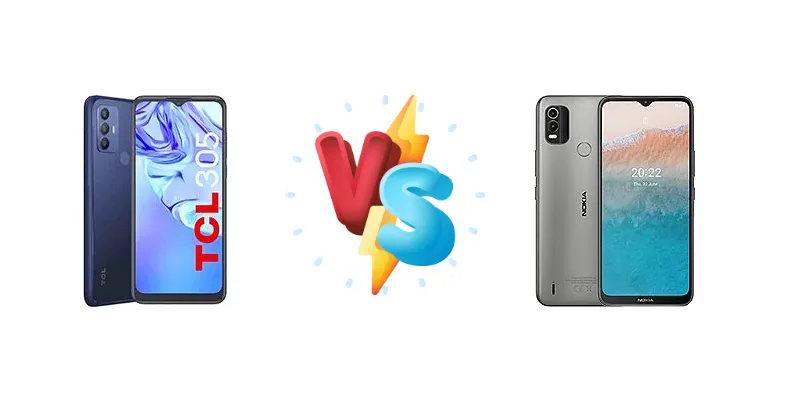
The TCL 305 and Nokia C21 Plus represent the extreme end of the smartphone price spectrum, targeting users prioritizing affordability above all else. Both devices aim to deliver a functional Android experience, but they achieve this with significantly different hardware. This comparison dissects their core components to determine which offers the best value for users on a tight budget.
🏆 Quick Verdict
For the average user prioritizing responsiveness in basic tasks, the Nokia C21 Plus edges out the TCL 305. Its octa-core Unisoc SC9863A, despite being built on an older 28nm process, provides a noticeable performance advantage over the quad-core Mediatek Helio A22 in the TCL 305, making everyday navigation smoother.
| Network |
|---|
| 2G bands | GSM 850 / 900 / 1800 / 1900 | GSM 850 / 900 / 1800 / 1900 |
| 3G bands | HSDPA 850 / 900 / 1900 / 2100 - 6102D | HSDPA 850 / 900 / 2100 |
| 4G bands | 1, 3, 5, 7, 8, 20, 28, 38, 40, 41 - 6102D | LTE |
| Speed | HSPA 42.2/11.5 Mbps, LTE Cat4 150/50 Mbps | HSPA 42.2/5.76 Mbps, LTE Cat4 150/50 Mbps |
| Technology | GSM / HSPA / LTE | GSM / HSPA / LTE |
| | 2, 3, 4, 5, 7, 8, 12, 13, 17, 26, 28, 66 - 6102А | HSDPA 850 / 900 / 1700(AWS) / 1900 / 2100 |
| Launch |
|---|
| Announced | 2022, January 31 | 2022, February 28 |
| Status | Available. Released 2022, February | Available. Released 2022, April 29 |
| Body |
|---|
| Build | Glass front, plastic frame, plastic back | Glass front, aluminum frame, plastic back |
| Dimensions | 165.2 x 75.5 x 8.9 mm (6.50 x 2.97 x 0.35 in) | 164.8 x 75.9 x 8.6 mm (6.49 x 2.99 x 0.34 in) |
| SIM | · Nano-SIM· Nano-SIM + Nano-SIM | · Nano-SIM· Nano-SIM + Nano-SIM |
| Weight | 190 g (6.70 oz) | 178 g or 191 g (6.28 oz) |
| | - | Splash protection |
| Display |
|---|
| Protection | - | Scratch-resistant glass |
| Resolution | 720 x 1600 pixels, 20:9 ratio (~269 ppi density) | 720 x 1600 pixels, 20:9 ratio (~269 ppi density) |
| Size | 6.52 inches, 102.6 cm2 (~82.3% screen-to-body ratio) | 6.52 inches, 102.6 cm2 (~82.1% screen-to-body ratio) |
| Type | IPS LCD, 450 nits (typ) | IPS LCD |
| Platform |
|---|
| CPU | Quad-core 2.0 GHz Cortex-A53 | Octa-core (4x1.6 GHz Cortex-A55 & 4x1.2 GHz Cortex-A55) |
| Chipset | Mediatek MT6761 Helio A22 (12 nm) | Unisoc SC9863A (28 nm) |
| GPU | PowerVR GE8320 | IMG8322 |
| OS | Android 11 (Go edition), TCL UI | Android 11 (Go edition) |
| Memory |
|---|
| Card slot | microSDXC (dedicated slot) | microSDXC (dedicated slot) |
| Internal | 32GB 2GB RAM, 64GB 2GB RAM | 32GB 2GB RAM, 32GB 3GB RAM, 64GB 2GB RAM, 64GB 3GB RAM, 64GB 4GB RAM |
| | eMMC 5.1 | eMMC 5.1 |
| Main Camera |
|---|
| Dual | - | 13 MP, (wide), AF
Auxiliary lens |
| Features | LED flash, HDR, panorama | LED flash, HDR, panorama |
| Single | 5 MP, f/2.2, 27mm (wide) 1/5.0", 1.12µm | 5 MP |
| Triple | 13 MP, f/2.2, 27mm (wide) 1/3.0", 1.12µm, PDAF
2 MP (macro)
Auxiliary lens | - |
| Video | 1080p@30fps | 1080p@30fps |
| Selfie camera |
|---|
| Features | HDR | LED flash |
| Single | 5 MP, f/2.2, 27mm (wide) 1/5.0", 1.12µm | 5 MP |
| Video | 1080p@30fps | 720p |
| Sound |
|---|
| 3.5mm jack | Yes | Yes |
| 35mm jack | Yes | Yes |
| Loudspeaker | Yes | Yes |
| Comms |
|---|
| Bluetooth | 5.0, A2DP | 4.2, A2DP |
| NFC | No | No |
| Positioning | GPS, GLONASS, GALILEO | GPS |
| Radio | FM radio | FM radio |
| USB | USB Type-C 2.0, OTG | microUSB 2.0 |
| WLAN | Wi-Fi 802.11 g/n, Wi-Fi Direct | Wi-Fi 802.11 b/g/n |
| Features |
|---|
| Sensors | Fingerprint (rear-mounted), accelerometer, proximity, compass | Fingerprint (rear-mounted), accelerometer, proximity |
| Battery |
|---|
| Charging | 10W wired | 10W wired |
| Type | Li-Po 5000 mAh | Li-Ion 4000/5050 mAh |
| Misc |
|---|
| Colors | Space Gray, Atlantic Blue | Dark Cyan, Warm Gray |
| Models | 6102D, 5164D | TA-1433, TA-1431, TA-1426, TA-1424 |
| Price | About 200 EUR | About 120 EUR |
| SAR | - | 0.57 W/kg (head) 0.65 W/kg (body) |
| SAR EU | - | 0.40 W/kg (head) 0.99 W/kg (body) |
TCL 305
- Potentially longer battery life due to efficient chipset.
- Lower price point (likely).
- Simple and straightforward Android experience.
- Slower performance compared to the Nokia C21 Plus.
- Less responsive user interface.
- Limited multitasking capabilities.
Nokia C21 Plus
- More responsive performance thanks to the octa-core processor.
- Smoother multitasking experience.
- Potentially better image processing.
- Less battery life under heavy usage.
- Larger process node (28nm) leads to higher power consumption.
- May be slightly more expensive.
Display Comparison
Neither TCL nor Nokia provide detailed display specifications for these models. Given their price point, both likely utilize LCD panels with 720p+ resolution. The absence of detailed specs suggests neither phone prioritizes display quality. Expect basic viewing experiences suitable for essential tasks, but not ideal for media consumption. Bezels are likely substantial on both devices to minimize production costs.
Camera Comparison
Both phones are unlikely to excel in photography. Detailed camera specs are scarce, but given the target market, expect basic sensors. Focusing on the chipset's image signal processor (ISP) capabilities is crucial. The Unisoc SC9863A likely has a more capable ISP than the Helio A22, potentially leading to slightly better image processing, particularly in low-light conditions. However, don't expect flagship-level results from either device. The presence of a 2MP macro camera on either device is largely marketing fluff and offers minimal practical benefit.
Performance
The core difference lies in the chipsets. The TCL 305’s Mediatek Helio A22 (12nm) features a quad-core Cortex-A53 CPU clocked at 2.0 GHz. This is a relatively basic processor designed for minimal power consumption. Conversely, the Nokia C21 Plus utilizes the Unisoc SC9863A (28nm) with an octa-core configuration – four Cortex-A55 cores at 1.6 GHz and four at 1.2 GHz. While the Unisoc chip is fabricated on a larger, less efficient 28nm node, the eight cores provide a significant advantage in multi-threaded tasks. The Cortex-A55 cores are also more efficient than the A53, potentially offsetting some of the process node disadvantage. This translates to smoother app switching and a more responsive user interface on the Nokia C21 Plus.
Battery Life
Both devices feature 10W wired charging, indicating a similar charging experience. While battery capacity isn't specified, the TCL 305’s more efficient Helio A22 chipset, built on a 12nm process, *should* translate to longer battery life under light usage. However, the Nokia C21 Plus’s more powerful processor will consume more power during active use. The actual battery life difference will depend heavily on individual usage patterns. Expect both phones to comfortably last a full day with moderate use.
Buying Guide
Buy the TCL 305 if you need a simple, extremely affordable device primarily for calls, texts, and light app usage, and are willing to accept occasional slowdowns. Buy the Nokia C21 Plus if you prefer a more responsive experience for multitasking, social media browsing, and occasional gaming, even if it means potentially slightly reduced battery life due to the more power-hungry chipset.
Frequently Asked Questions
❓ Will the Nokia C21 Plus struggle with popular apps like Facebook or WhatsApp?
While the Nokia C21 Plus won't deliver a blazing-fast experience, its octa-core processor should handle Facebook and WhatsApp reasonably well. Expect some loading times and occasional lag, but it should be usable for basic social media interaction. The TCL 305 may exhibit more noticeable slowdowns with these apps.
❓ Is the 10W charging speed on either phone sufficient for daily use?
10W charging is slow by modern standards, but adequate for these budget devices. Expect a full charge to take several hours. Both phones are designed for overnight charging, so the slow charging speed is unlikely to be a major inconvenience for most users. Prioritizing battery life over fast charging is a common trade-off in this price segment.
❓ Can either of these phones handle basic mobile games?
Simple 2D games should run acceptably on both devices. However, demanding 3D games will likely be unplayable or suffer from severe frame rate drops. The Nokia C21 Plus, with its more powerful processor, will offer a slightly better gaming experience, but don't expect to play graphically intensive titles.