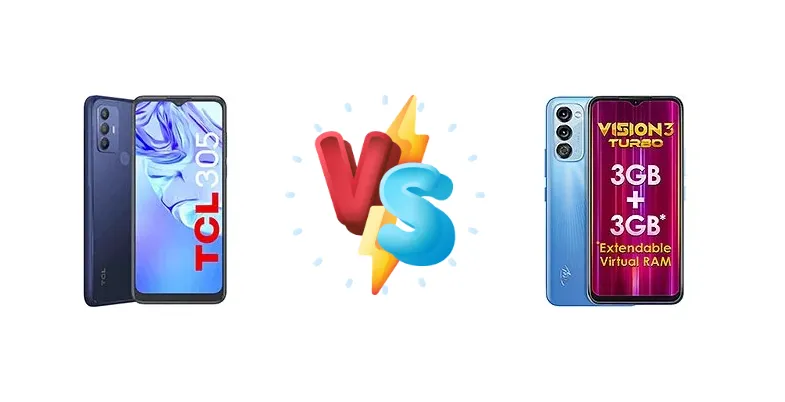
The sub-$150 smartphone market is fiercely competitive. Both the TCL 305 and the itel Vision 3 Turbo aim to deliver essential smartphone functionality at an incredibly affordable price. However, they take different approaches to achieving this, with the TCL 305 relying on a tried-and-true MediaTek chipset, while the itel Vision 3 Turbo opts for a newer, but less power-efficient Unisoc processor and faster charging.
🏆 Quick Verdict
For the average user prioritizing basic tasks and longer battery life, the itel Vision 3 Turbo emerges as the better choice. Its octa-core processor, despite being built on an older process, offers a noticeable performance advantage over the TCL 305’s quad-core CPU, and the 18W charging significantly reduces downtime.
| Network |
|---|
| 2G bands | GSM 850 / 900 / 1800 / 1900 | GSM 850 / 900 / 1800 / 1900 |
| 3G bands | HSDPA 850 / 900 / 1900 / 2100 - 6102D | HSDPA 850 / 900 / 2100 |
| 4G bands | 1, 3, 5, 7, 8, 20, 28, 38, 40, 41 - 6102D | LTE |
| Speed | HSPA 42.2/11.5 Mbps, LTE Cat4 150/50 Mbps | HSPA, LTE |
| Technology | GSM / HSPA / LTE | GSM / HSPA / LTE |
| | 2, 3, 4, 5, 7, 8, 12, 13, 17, 26, 28, 66 - 6102А | - |
| Launch |
|---|
| Announced | 2022, January 31 | 2022 |
| Status | Available. Released 2022, February | Available. Released 2022 |
| Body |
|---|
| Build | Glass front, plastic frame, plastic back | - |
| Dimensions | 165.2 x 75.5 x 8.9 mm (6.50 x 2.97 x 0.35 in) | - |
| SIM | · Nano-SIM· Nano-SIM + Nano-SIM | Dual SIM |
| Weight | 190 g (6.70 oz) | - |
| Display |
|---|
| Resolution | 720 x 1600 pixels, 20:9 ratio (~269 ppi density) | 720 x 1600 pixels, 20:9 ratio (~266 ppi density) |
| Size | 6.52 inches, 102.6 cm2 (~82.3% screen-to-body ratio) | 6.6 inches, 105.2 cm2 |
| Type | IPS LCD, 450 nits (typ) | IPS LCD |
| Platform |
|---|
| CPU | Quad-core 2.0 GHz Cortex-A53 | Octa-core (4x1.6 GHz Cortex-A55 & 4x1.2 GHz Cortex-A55) |
| Chipset | Mediatek MT6761 Helio A22 (12 nm) | Unisoc SC9863A (28 nm) |
| GPU | PowerVR GE8320 | IMG8322 |
| OS | Android 11 (Go edition), TCL UI | Android 11 (Go edition) |
| Memory |
|---|
| Card slot | microSDXC (dedicated slot) | microSDXC |
| Internal | 32GB 2GB RAM, 64GB 2GB RAM | 64GB 3GB RAM |
| | eMMC 5.1 | - |
| Main Camera |
|---|
| Features | LED flash, HDR, panorama | LED flash |
| Single | 5 MP, f/2.2, 27mm (wide) 1/5.0", 1.12µm | 8 MP (wide)
Auxiliary lens |
| Triple | 13 MP, f/2.2, 27mm (wide) 1/3.0", 1.12µm, PDAF
2 MP (macro)
Auxiliary lens | - |
| Video | 1080p@30fps | 1080p@30fps |
| Selfie camera |
|---|
| Features | HDR | - |
| Single | 5 MP, f/2.2, 27mm (wide) 1/5.0", 1.12µm | 5 MP |
| Video | 1080p@30fps | Yes |
| Sound |
|---|
| 3.5mm jack | Yes | - |
| 35mm jack | Yes | Yes |
| Loudspeaker | Yes | Yes |
| Comms |
|---|
| Bluetooth | 5.0, A2DP | Yes |
| NFC | No | No |
| Positioning | GPS, GLONASS, GALILEO | GPS |
| Radio | FM radio | Unspecified |
| USB | USB Type-C 2.0, OTG | microUSB |
| WLAN | Wi-Fi 802.11 g/n, Wi-Fi Direct | Yes |
| Features |
|---|
| Sensors | Fingerprint (rear-mounted), accelerometer, proximity, compass | Fingerprint (rear-mounted), accelerometer |
| Battery |
|---|
| Charging | 10W wired | 18W wired |
| Type | Li-Po 5000 mAh | 5000 mAh |
| Misc |
|---|
| Colors | Space Gray, Atlantic Blue | Blue |
| Models | 6102D, 5164D | - |
| Price | About 200 EUR | - |
TCL 305
- Potentially better battery life due to more efficient chipset.
- Established MediaTek chipset with potentially wider software support.
- Lower price point (likely).
- Significantly slower performance compared to the itel Vision 3 Turbo.
- Slower 10W charging.
- Less responsive user experience.
itel Vision 3 Turbo
- Faster octa-core processor for smoother multitasking.
- 18W fast charging for quicker top-ups.
- More responsive user interface.
- Less efficient 28nm process may lead to faster battery drain.
- Unisoc chipset may have limited software support.
- Potentially higher price point.
Display Comparison
Neither TCL nor itel provide detailed display specifications beyond resolution. However, given the price point, both likely utilize LCD panels. The real difference lies under the hood. The TCL 305’s Helio A22 chipset has a less powerful GPU, which may translate to lower frame rates in basic UI animations. The itel Vision 3 Turbo, while also using a basic panel, benefits from the more capable graphics processing of the Unisoc SC9863A, offering a smoother visual experience.
Camera Comparison
Both devices likely feature basic camera setups geared towards casual photography. Without detailed sensor information, it’s difficult to make a definitive judgment. However, the processing capabilities of the Unisoc SC9863A in the itel Vision 3 Turbo may allow for slightly better image processing, potentially resulting in more detailed and vibrant photos. It's important to note that both phones likely rely heavily on software algorithms to enhance image quality, and the results will vary depending on lighting conditions.
Performance
The core difference here is architectural. The TCL 305’s MediaTek Helio A22 is a quad-core processor built on a 12nm process. This means fewer cores and a more efficient manufacturing process. Conversely, the itel Vision 3 Turbo utilizes the Unisoc SC9863A, an octa-core chip (4x1.6 GHz Cortex-A55 & 4x1.2 GHz Cortex-A55) fabricated on a larger 28nm node. While the 28nm process is less efficient, the increased core count provides a significant advantage in multi-threaded tasks. This translates to faster app loading times and smoother multitasking on the itel Vision 3 Turbo, particularly for users running multiple apps simultaneously. The Cortex-A55 cores in the itel are also a newer generation than the A53 cores in the TCL, offering improved performance per clock cycle.
Battery Life
While battery capacity isn't specified, the itel Vision 3 Turbo’s 18W wired charging is a clear advantage over the TCL 305’s 10W charging. This means significantly faster top-ups, reducing downtime. The less efficient 28nm process of the Unisoc chip may lead to slightly faster battery drain during intensive use, but the faster charging mitigates this concern. For users who frequently find themselves needing to quickly recharge, the itel Vision 3 Turbo is the superior option.
Buying Guide
Buy the TCL 305 if you prioritize a known chipset with established software support and are primarily focused on extremely light usage like calls, texts, and occasional social media. Buy the itel Vision 3 Turbo if you prefer a more responsive experience for multitasking, streaming, and light gaming, and value the convenience of faster charging, even if it means potentially shorter battery life between charges.
Frequently Asked Questions
❓ Will the itel Vision 3 Turbo struggle with popular apps like WhatsApp and Facebook?
No, the octa-core Unisoc SC9863A processor in the itel Vision 3 Turbo is more than capable of handling everyday apps like WhatsApp, Facebook, and web browsing without significant lag. While it won't offer a flagship-level experience, it provides a smooth and responsive user experience for these common tasks.
❓ Is the TCL 305 a good option for someone who primarily uses their phone for calls and texts?
Yes, the TCL 305 is a suitable choice for users who primarily need a phone for basic communication. Its quad-core processor is sufficient for calls and texts, and its potentially more efficient chipset could offer slightly longer battery life in standby mode. However, be prepared for a slower experience if you attempt to run more demanding apps.
❓ Can the itel Vision 3 Turbo handle light gaming?
The itel Vision 3 Turbo can handle light gaming, such as casual puzzle games or older titles. However, don't expect to play graphically intensive games at high settings. The Unisoc SC9863A's GPU is not designed for demanding gaming experiences.
❓ What type of charging cable does the itel Vision 3 Turbo use?
The itel Vision 3 Turbo uses a Micro-USB charging cable. While not as modern as USB-C, it's a common standard and cables are readily available.