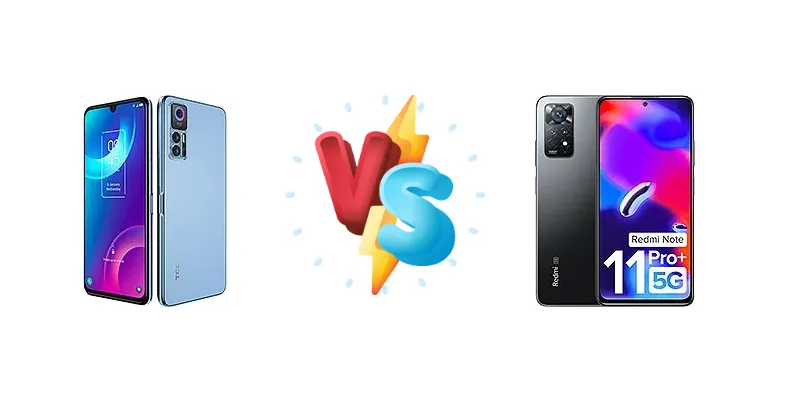
The TCL 30 and Xiaomi Redmi Note 11 Pro+ 5G (India) represent compelling options in the increasingly competitive budget 5G smartphone market. While both aim to deliver a feature-rich experience without breaking the bank, they take drastically different approaches to core components like the chipset and charging technology. This comparison dissects these differences to determine which device offers the best value for your money.
🏆 Quick Verdict
For the average user prioritizing performance and convenience, the Xiaomi Redmi Note 11 Pro+ 5G (India) is the clear winner. Its Snapdragon 695 chipset, built on a more efficient 6nm process, provides a noticeable performance uplift, and the blazing-fast 67W charging significantly reduces downtime. The TCL 30 remains a viable option for those on a tighter budget.
| Network |
|---|
| 2G bands | GSM 850 / 900 / 1800 / 1900 | GSM 850 / 900 / 1800 / 1900 - SIM 1 & SIM 2 |
| 3G bands | HSDPA 850 / 900 / 1900 / 2100 | HSDPA 850 / 900 / 1900 / 2100 |
| 4G bands | 1, 3, 5, 7, 8, 20, 28, 38, 40, 41 | 1, 3, 5, 8, 40, 41 |
| 5G bands | - | 1, 3, 5, 8, 28, 40, 78 SA/NSA |
| Speed | HSPA 42.2/5.76 Mbps, LTE Cat4 150/50 Mbps | HSPA, LTE-A (CA), 5G |
| Technology | GSM / HSPA / LTE | GSM / HSPA / LTE / 5G |
| Launch |
|---|
| Announced | 2022, February 27 | 2022, March 09 |
| Status | Available. Released 2022, April 20 | Available. Released 2022, March 15 |
| Body |
|---|
| Build | Glass front, plastic frame, plastic back | Glass front (Gorilla Glass 5), glass back |
| Dimensions | 164.5 x 75.2 x 7.7 mm (6.48 x 2.96 x 0.30 in) | 164.2 x 76.1 x 8.1 mm (6.46 x 3.00 x 0.32 in) |
| SIM | Nano-SIM + Nano-SIM | Hybrid Dual SIM (Nano-SIM, dual stand-by) |
| Weight | 184 g (6.49 oz) | 202 g (7.13 oz) |
| | - | IP53, dust and splash resistant |
| Display |
|---|
| Protection | - | Corning Gorilla Glass 5 |
| Resolution | 1080 x 2400 pixels, 20:9 ratio (~393 ppi density) | 1080 x 2400 pixels, 20:9 ratio (~395 ppi density) |
| Size | 6.7 inches, 108.4 cm2 (~87.6% screen-to-body ratio) | 6.67 inches, 107.4 cm2 (~86.0% screen-to-body ratio) |
| Type | AMOLED, 650 nits (typ), 900 nits (peak) | Super AMOLED, 120Hz, 700 nits, 1200 nits (peak) |
| Platform |
|---|
| CPU | Octa-core (4x2.3 GHz Cortex-A53 & 4x1.8 GHz Cortex-A53) | Octa-core (2x2.2 GHz Kryo 660 Gold & 6x1.7 GHz Kryo 660 Silver) |
| Chipset | Mediatek MT6765V/CB Helio G37 (12 nm) | Qualcomm SM6375 Snapdragon 695 5G (6 nm) |
| GPU | PowerVR GE8320 | Adreno 619 |
| OS | Android 12, TCL UI 4.0 | Android 11, MIUI 13 |
| Memory |
|---|
| Card slot | microSDXC (dedicated slot) | microSDXC (uses shared SIM slot) |
| Internal | 64GB 4GB RAM | 64GB 6GB RAM, 128GB 6GB RAM, 128GB 8GB RAM, 256GB 8GB RAM |
| | eMMC 5.1 | UFS 2.2 |
| Main Camera |
|---|
| Features | LED flash, HDR, panorama | LED flash, HDR, panorama |
| Single | 8 MP, f/2.0, 26mm (wide), 1/4", 1.12µm | - |
| Triple | 50 MP, f/1.9, 28mm (wide), 1/2.76", 0.64µm, PDAF
2 MP (macro)
Auxiliary lens | 108 MP, f/1.9, 26mm (wide), 1/1.52", 0.7µm, PDAF
8 MP, f/2.2, 118˚ (ultrawide)
2 MP, f/2.4, (macro) |
| Video | 1080p@30fps | 1080p@30fps |
| Selfie camera |
|---|
| Features | HDR | - |
| Single | 8 MP, f/2.0, 26mm (wide), 1/4.0", 1.12µm | 16 MP, f/2.5, (wide), 1/3.06" 1.0µm |
| Video | 1080p@30fps | 1080p@30fps |
| Sound |
|---|
| 3.5mm jack | Yes | Yes |
| 35mm jack | Yes | - |
| Loudspeaker | Yes, with dual speakers | Yes, with stereo speakers |
| | - | 24-bit/192kHz audio |
| Comms |
|---|
| Bluetooth | 5.0, A2DP, LE | 5.1, A2DP, LE |
| Infrared port | - | Yes |
| NFC | Yes | No |
| Positioning | GPS, GLONASS, GALILEO, BDS | GPS, GLONASS, BDS, GALILEO |
| Radio | Unspecified | Unspecified |
| USB | USB Type-C 2.0 | USB Type-C 2.0, OTG |
| WLAN | Wi-Fi 802.11 b/g/n, Wi-Fi Direct | Wi-Fi 802.11 a/b/g/n/ac, dual-band, Wi-Fi Direct |
| Features |
|---|
| Sensors | Fingerprint (side-mounted), accelerometer, proximity, compass | Fingerprint (side-mounted), accelerometer, gyro, proximity, compass |
| Battery |
|---|
| Charging | 18W wired | 67W wired, PD3.0, QC3, 50% in 15 min, 100% in 42 min (advertised) |
| Type | Li-Po 5010 mAh | Li-Po 5000 mAh, non-removable |
| Misc |
|---|
| Colors | Tech Black, Muse Blue | Mirage Blue, Phantom White, Stealth Black |
| Models | T676H | 2201116SI |
| Price | About 200 EUR | About 250 EUR |
TCL 30
- Lower price point makes it accessible.
- Functional and reliable for basic tasks.
- 5G connectivity offers future-proofing.
- Significantly slower charging speed.
- Less powerful chipset leads to slower performance.
- Likely inferior camera quality.
Xiaomi Redmi Note 11 Pro+ 5G (India)
- Much faster 67W charging.
- More powerful and efficient Snapdragon 695 chipset.
- Likely better camera performance.
- Higher price compared to the TCL 30.
- May not be a significant upgrade for very basic users.
- Software bloatware is common with Xiaomi devices.
Display Comparison
Neither TCL nor Xiaomi provide detailed display specs in the provided data. However, given the market positioning, we can infer both likely utilize IPS LCD panels. The key difference will likely be in brightness and color calibration. The Redmi Note 11 Pro+ 5G, being a slightly higher-tier device, may offer a marginally brighter display for better outdoor visibility. Without specific nit ratings, it's difficult to definitively state a winner, but Xiaomi's history suggests a more refined display experience.
Camera Comparison
Without detailed camera specifications beyond the chipsets, a direct comparison is limited. However, the Redmi Note 11 Pro+ 5G’s positioning suggests a more sophisticated camera system. While both phones likely feature a multi-camera setup, the Redmi Note 11 Pro+ 5G is likely to have a larger main sensor and potentially more advanced image processing capabilities. The TCL 30 will likely focus on providing adequate image quality for social media sharing, while the Redmi Note 11 Pro+ 5G aims for more detailed and versatile photography.
Performance
The performance gap between these two devices is significant. The Xiaomi Redmi Note 11 Pro+ 5G’s Qualcomm Snapdragon 695 5G (6nm) is a substantial upgrade over the TCL 30’s MediaTek Helio G37 (12nm). The 6nm process node of the Snapdragon 695 translates to improved power efficiency and reduced thermal throttling, meaning sustained performance will be higher during demanding tasks. The Snapdragon 695’s CPU architecture – 2x2.2 GHz Kryo 660 Gold & 6x1.7 GHz Kryo 660 Silver – is also more modern and efficient than the TCL 30’s 4x2.3 GHz Cortex-A53 & 4x1.8 GHz Cortex-A53 configuration. This difference will be most noticeable in gaming and multitasking.
Battery Life
The TCL 30’s 18W wired charging is a significant disadvantage compared to the Xiaomi Redmi Note 11 Pro+ 5G’s 67W wired charging, which also supports PD3.0 and QC3. The Redmi Note 11 Pro+ 5G advertises a 50% charge in 15 minutes and a full charge in 42 minutes. While battery capacity isn’t specified, the faster charging speed dramatically reduces downtime. Even if the TCL 30 has a slightly larger battery, the Redmi Note 11 Pro+ 5G’s charging speed will likely result in more usable battery life throughout the day due to quicker top-ups.
Buying Guide
Buy the TCL 30 if you need a functional, basic 5G smartphone and prioritize minimizing upfront cost above all else. It's a good choice for users who primarily use their phone for calls, texts, and light social media. Buy the Xiaomi Redmi Note 11 Pro+ 5G (India) if you prefer a smoother, more responsive experience, faster charging, and are willing to spend a bit more for a more future-proof device. This is ideal for users who enjoy mobile gaming, streaming video, or frequently use demanding apps.
Frequently Asked Questions
❓ Will the Snapdragon 695 in the Redmi Note 11 Pro+ 5G handle demanding games like PUBG Mobile smoothly?
The Snapdragon 695 is capable of running PUBG Mobile at medium to high settings with reasonable frame rates. While it won't deliver a flagship-level gaming experience, it provides a significantly smoother experience than the Helio G37 in the TCL 30, especially during prolonged gaming sessions due to its superior thermal efficiency.
❓ How much faster is the 67W charging on the Redmi Note 11 Pro+ 5G compared to the 18W charging on the TCL 30 in real-world use?
The 67W charging on the Redmi Note 11 Pro+ 5G can fully charge the device in approximately 42 minutes, while the TCL 30’s 18W charging will likely take over two hours. This means you can quickly top up your Redmi Note 11 Pro+ 5G during a short break, whereas the TCL 30 requires a much longer charging period, impacting its usability throughout the day.
❓ Does the TCL 30 support VoLTE and VoWiFi for improved call quality?
Given its 5G capabilities, the TCL 30 likely supports VoLTE (Voice over LTE). However, VoWiFi (Voice over Wi-Fi) support is less certain and depends on regional carrier compatibility. Check with your carrier to confirm VoWiFi support before purchasing.
❓ Is the performance difference between the Helio G37 and Snapdragon 695 noticeable for everyday tasks like browsing and social media?
Yes, the difference is noticeable. While both phones can handle basic tasks, the Snapdragon 695 provides a smoother and more responsive experience when multitasking, opening apps, and scrolling through content. The TCL 30 may exhibit slight lag or stuttering during these activities.