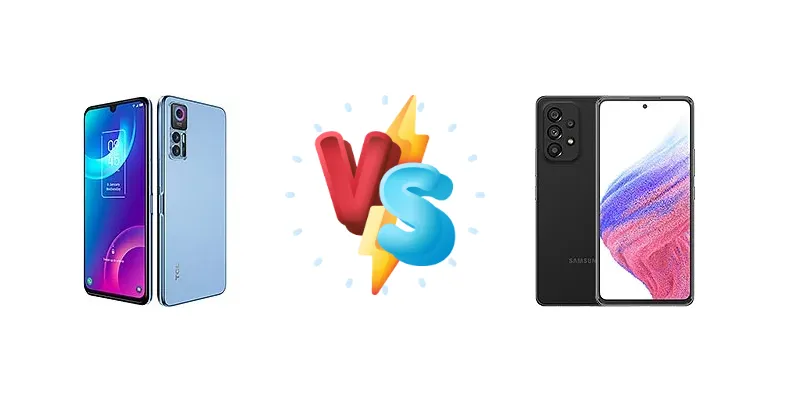
The TCL 30 and Samsung Galaxy A53 5G represent compelling options in the crowded mid-range smartphone market. While both offer 5G connectivity, they diverge significantly in their internal hardware and target audience. This comparison dissects their key differences to determine which device delivers the best value for your money.
🏆 Quick Verdict
For the average user prioritizing a smoother overall experience and a brighter, more vibrant display, the Samsung Galaxy A53 5G is the better choice. Its Exynos 1280 chipset provides a noticeable performance uplift over the TCL 30’s Helio G37, justifying the price difference for those who multitask or game.
| Network |
|---|
| 2G bands | GSM 850 / 900 / 1800 / 1900 | GSM 850 / 900 / 1800 / 1900 |
| 3G bands | HSDPA 850 / 900 / 1900 / 2100 | HSDPA 850 / 900 / 1700(AWS) / 1900 / 2100 |
| 4G bands | 1, 3, 5, 7, 8, 20, 28, 38, 40, 41 | 1, 2, 3, 4, 5, 7, 12, 14, 20, 29, 30, 38, 39, 40, 41, 46, 48, 66 - SM-A536U |
| 5G bands | - | 2, 5, 41, 66, 77, 78 SA/NSA/Sub6/mmWave - SM-A536U |
| Speed | HSPA 42.2/5.76 Mbps, LTE Cat4 150/50 Mbps | HSPA, LTE, 5G |
| Technology | GSM / HSPA / LTE | GSM / HSPA / LTE / 5G |
| | - | 2, 5, 48, 66, 77, 78, 260, 261 SA/NSA/Sub6/mmWave - SM-A536V |
| Launch |
|---|
| Announced | 2022, February 27 | 2022, March 17 |
| Status | Available. Released 2022, April 20 | Available. Released 2022, March 24 |
| Body |
|---|
| Build | Glass front, plastic frame, plastic back | Glass front (Gorilla Glass 5), plastic frame, plastic back |
| Dimensions | 164.5 x 75.2 x 7.7 mm (6.48 x 2.96 x 0.30 in) | 159.6 x 74.8 x 8.1 mm (6.28 x 2.94 x 0.32 in) |
| SIM | Nano-SIM + Nano-SIM | · Nano-SIM· Nano-SIM + Nano-SIM |
| Weight | 184 g (6.49 oz) | 189 g (6.67 oz) |
| | - | IP67 dust/water resistant (up to 1m for 30 min) |
| Display |
|---|
| Protection | - | Corning Gorilla Glass 5 |
| Resolution | 1080 x 2400 pixels, 20:9 ratio (~393 ppi density) | 1080 x 2400 pixels, 20:9 ratio (~405 ppi density) |
| Size | 6.7 inches, 108.4 cm2 (~87.6% screen-to-body ratio) | 6.5 inches, 102.0 cm2 (~85.4% screen-to-body ratio) |
| Type | AMOLED, 650 nits (typ), 900 nits (peak) | Super AMOLED, 120Hz, 800 nits (HBM) |
| Platform |
|---|
| CPU | Octa-core (4x2.3 GHz Cortex-A53 & 4x1.8 GHz Cortex-A53) | Octa-core (2x2.4 GHz Cortex-A78 & 6x2.0 GHz Cortex-A55) |
| Chipset | Mediatek MT6765V/CB Helio G37 (12 nm) | Exynos 1280 (5 nm) |
| GPU | PowerVR GE8320 | Mali-G68 |
| OS | Android 12, TCL UI 4.0 | Android 12, up to 4 major Android upgrades, One UI 8 |
| Memory |
|---|
| Card slot | microSDXC (dedicated slot) | microSDXC (uses shared SIM slot) |
| Internal | 64GB 4GB RAM | 128GB 4GB RAM, 128GB 6GB RAM, 128GB 8GB RAM, 256GB 6GB RAM, 256GB 8GB RAM |
| | eMMC 5.1 | - |
| Main Camera |
|---|
| Features | LED flash, HDR, panorama | LED flash, panorama, HDR |
| Quad | - | 64 MP, f/1.8, 26mm (wide), 1/1.7X", 0.8µm, PDAF, OIS
12 MP, f/2.2, 123˚ (ultrawide), 1.12µm
5 MP (macro)
Auxiliary lens |
| Single | 8 MP, f/2.0, 26mm (wide), 1/4", 1.12µm | 32 MP, f/2.2, 26mm (wide), 1/2.8", 0.8µm |
| Triple | 50 MP, f/1.9, 28mm (wide), 1/2.76", 0.64µm, PDAF
2 MP (macro)
Auxiliary lens | - |
| Video | 1080p@30fps | 4K@30fps, 1080p@30/60fps; gyro-EIS |
| Selfie camera |
|---|
| Features | HDR | HDR |
| Single | 8 MP, f/2.0, 26mm (wide), 1/4.0", 1.12µm | 32 MP, f/2.2, 26mm (wide), 1/2.8", 0.8µm |
| Video | 1080p@30fps | 4K@30fps, 1080p@30fps |
| Sound |
|---|
| 3.5mm jack | Yes | No |
| 35mm jack | Yes | No |
| Loudspeaker | Yes, with dual speakers | Yes, with stereo speakers |
| Comms |
|---|
| Bluetooth | 5.0, A2DP, LE | 5.1, A2DP, LE |
| NFC | Yes | Yes (market/region dependent) |
| Positioning | GPS, GLONASS, GALILEO, BDS | GPS, GLONASS, GALILEO, BDS |
| Radio | Unspecified | No |
| USB | USB Type-C 2.0 | USB Type-C 2.0, OTG |
| WLAN | Wi-Fi 802.11 b/g/n, Wi-Fi Direct | Wi-Fi 802.11 a/b/g/n/ac, dual-band, Wi-Fi Direct |
| Features |
|---|
| Sensors | Fingerprint (side-mounted), accelerometer, proximity, compass | Fingerprint (under display, optical), accelerometer, gyro, compass, barometer (market/region dependent) |
| | - | Virtual proximity sensing |
| Battery |
|---|
| Charging | 18W wired | 25W wired |
| Type | Li-Po 5010 mAh | Li-Po 5000 mAh |
| Misc |
|---|
| Colors | Tech Black, Muse Blue | Black, White, Blue, Peach |
| Models | T676H | SM-A536B, SM-A536B/DS, SM-A536U, SM-A536U1, SM-A5360, SM-A536E, SM-A536E/DS, SM-A536V, SM-A536W, SM-A536N, SM-S536DL |
| Price | About 200 EUR | $ 151.42 / £ 185.00 / € 169.14 |
| SAR | - | 0.75 W/kg (head) 1.58 W/kg (body) |
| SAR EU | - | 0.89 W/kg (head) 1.60 W/kg (body) |
| Tests |
|---|
| Battery life | - |
Endurance rating 113h
|
| Camera | - |
Photo / Video |
| Display | - |
Contrast ratio: Infinite (nominal) |
| Loudspeaker | - |
-26.5 LUFS (Good)
|
| Performance | - |
AnTuTu: 329802 (v8), 379313 (v9)
GeekBench: 1891 (v5.1)
GFXBench: 19fps (ES 3.1 onscreen) |
TCL 30
- More affordable price point
- 5G connectivity
- Acceptable battery life
- Significantly weaker performance
- Lower display quality
- Likely inferior camera
Samsung Galaxy A53 5G
- Faster and more efficient processor
- Brighter and more vibrant display
- Faster charging speeds
- Higher price
- Potential for software bloat (Samsung)
- May not be significantly better in all camera scenarios
Display Comparison
The Samsung Galaxy A53 5G boasts a significantly brighter display, reaching a measured peak brightness of 830 nits, compared to the TCL 30’s unspecified brightness. This makes the A53 far more usable outdoors under direct sunlight. While both are likely LCD panels (given the price points), the A53’s higher brightness and 'Infinite' contrast ratio (likely marketing for a good black level) suggest a more visually appealing experience. The TCL 30’s display specs are minimal, indicating a focus on cost reduction rather than visual fidelity.
Camera Comparison
Both devices feature photo and video capabilities, but details are sparse. The TCL 30 likely relies on a more basic camera setup to keep costs down. The Samsung Galaxy A53 5G, while not a camera champion, benefits from Samsung’s image processing expertise. Without specific sensor sizes or aperture information for the TCL 30, it’s safe to assume the A53 will deliver superior image quality, particularly in low-light conditions. The A53’s camera system is likely to include Optical Image Stabilization (OIS), a feature rarely found in this price bracket, further enhancing image clarity.
Performance
The core difference lies in the chipsets. The Samsung Galaxy A53 5G’s Exynos 1280, fabricated on a 5nm process, offers a substantial advantage in both performance and efficiency over the TCL 30’s 12nm Mediatek Helio G37. The Exynos 1280’s CPU configuration – 2x2.4 GHz Cortex-A78 and 6x2.0 GHz Cortex-A55 – is architecturally superior to the TCL 30’s 4x2.3 GHz Cortex-A53 & 4x1.8 GHz Cortex-A53. This translates to faster app loading times, smoother multitasking, and better gaming performance on the A53. The 5nm process also means the Exynos chip will generate less heat under load, reducing the likelihood of performance throttling.
Battery Life
Both phones share an endurance rating of 113 hours, suggesting similar real-world battery life despite the TCL 30’s lack of detailed battery capacity information. However, the Samsung Galaxy A53 5G supports 25W wired charging, significantly faster than the TCL 30’s 18W charging. This means the A53 can replenish its battery more quickly, minimizing downtime. While both will likely last a full day for moderate users, the A53’s faster charging is a clear convenience advantage.
Buying Guide
Buy the TCL 30 if you need a functional, affordable 5G phone for basic tasks like calling, texting, and light social media use, and are willing to compromise on performance. Buy the Samsung Galaxy A53 5G if you prioritize a more responsive user experience, a superior display for media consumption, and a more capable camera system, even if it means spending a bit more.
Frequently Asked Questions
❓ Does the Exynos 1280 in the Samsung Galaxy A53 5G tend to overheat during prolonged gaming sessions?
While the Exynos 1280 isn't known for extreme overheating, it can get warm during extended gaming. However, the 5nm fabrication process and Samsung's thermal management solutions generally prevent significant throttling, maintaining a playable frame rate for most titles. The TCL 30's Helio G37 is more likely to throttle due to its less efficient 12nm process.
❓ Is the 2MP macro camera on either phone actually useful for taking detailed close-up photos?
Generally, 2MP macro cameras on phones in this price range are of limited utility. The low resolution results in images lacking detail and sharpness. They are often included as a marketing feature rather than a genuinely useful photographic tool. The Samsung A53's overall camera system is more capable, but don't expect professional-grade macro photography.
❓ Can the Samsung Galaxy A53 5G reliably maintain 60fps in popular games like PUBG Mobile?
The Samsung Galaxy A53 5G can generally maintain 60fps in PUBG Mobile at medium graphics settings. However, achieving consistently high frame rates at higher settings may require reducing the graphics quality to avoid frame drops. The TCL 30 will struggle to maintain a stable 60fps even at lower settings.