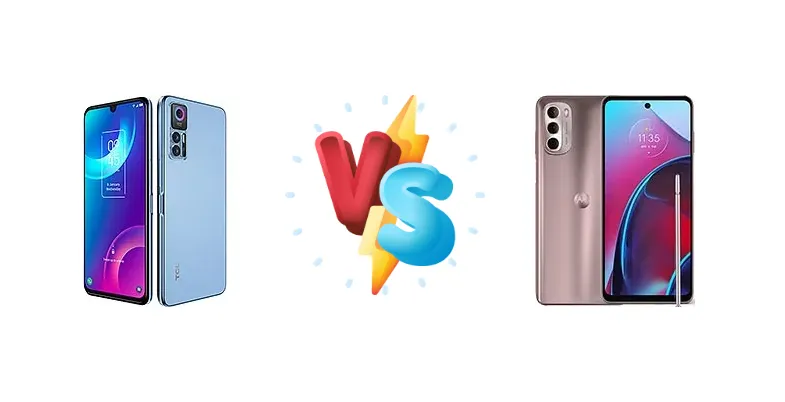
The TCL 30 and Motorola Moto G Stylus (2022) represent compelling options in the sub-$200 smartphone market. Both aim to deliver essential features without breaking the bank, but they take different approaches. The TCL 30 focuses on a streamlined experience, while the Moto G Stylus (2022) adds the productivity of a built-in stylus. This comparison dives deep into their specifications to determine which device offers the best overall package.
🏆 Quick Verdict
For most users, the Motorola Moto G Stylus (2022) is the better choice. While the TCL 30 is a capable device, the Moto G Stylus’s Helio G88 chipset, featuring more powerful Cortex-A75 cores, provides a noticeable performance advantage in everyday tasks and light gaming, justifying the slightly slower charging.
| Network |
|---|
| 2G bands | GSM 850 / 900 / 1800 / 1900 | GSM 850 / 900 / 1800 / 1900 |
| 3G bands | HSDPA 850 / 900 / 1900 / 2100 | HSDPA 850 / 900 / 1700(AWS) / 1900 / 2100 |
| 4G bands | 1, 3, 5, 7, 8, 20, 28, 38, 40, 41 | 1, 2, 3, 4, 5, 7, 8, 12, 13, 14, 17, 25, 26, 29, 30, 38, 41, 66, 71 |
| Speed | HSPA 42.2/5.76 Mbps, LTE Cat4 150/50 Mbps | HSPA, LTE |
| Technology | GSM / HSPA / LTE | GSM / HSPA / LTE |
| Launch |
|---|
| Announced | 2022, February 27 | 2022, February 03 |
| Status | Available. Released 2022, April 20 | Available. Released 2022, February 17 |
| Body |
|---|
| Build | Glass front, plastic frame, plastic back | - |
| Dimensions | 164.5 x 75.2 x 7.7 mm (6.48 x 2.96 x 0.30 in) | 170.2 x 75.9 x 9.5 mm (6.70 x 2.99 x 0.37 in) |
| SIM | Nano-SIM + Nano-SIM | Nano-SIM |
| Weight | 184 g (6.49 oz) | 216 g (7.62 oz) |
| | - | Stylus
Water-repellent coating |
| Display |
|---|
| Resolution | 1080 x 2400 pixels, 20:9 ratio (~393 ppi density) | 1080 x 2460 pixels (~396 ppi density) |
| Size | 6.7 inches, 108.4 cm2 (~87.6% screen-to-body ratio) | 6.8 inches, 109.3 cm2 (~84.6% screen-to-body ratio) |
| Type | AMOLED, 650 nits (typ), 900 nits (peak) | IPS LCD, 90Hz |
| Platform |
|---|
| CPU | Octa-core (4x2.3 GHz Cortex-A53 & 4x1.8 GHz Cortex-A53) | Octa-core (2x2.0 GHz Cortex-A75 & 6x1.8 GHz Cortex-A55) |
| Chipset | Mediatek MT6765V/CB Helio G37 (12 nm) | Mediatek MT6769H Helio G88 (12 nm) |
| GPU | PowerVR GE8320 | Mali-G52 MC2 |
| OS | Android 12, TCL UI 4.0 | Android 11 |
| Memory |
|---|
| Card slot | microSDXC (dedicated slot) | microSDXC (dedicated slot) |
| Internal | 64GB 4GB RAM | 64GB 4GB RAM, 128GB 4GB RAM, 128GB 6GB RAM |
| | eMMC 5.1 | - |
| Main Camera |
|---|
| Features | LED flash, HDR, panorama | LED flash, HDR, panorama |
| Single | 8 MP, f/2.0, 26mm (wide), 1/4", 1.12µm | - |
| Triple | 50 MP, f/1.9, 28mm (wide), 1/2.76", 0.64µm, PDAF
2 MP (macro)
Auxiliary lens | 50 MP, f/1.9, 26mm (wide), 0.64µm, PDAF
8 MP, f/2.2, 118˚ (ultrawide), 1/4.0, 1.12µm
Auxiliary lens |
| Video | 1080p@30fps | 1080p@30/60fps; gyro-EIS |
| Selfie camera |
|---|
| Features | HDR | HDR |
| Single | 8 MP, f/2.0, 26mm (wide), 1/4.0", 1.12µm | 16 MP, f/2.2, (wide), 1/3.06", 1.0µm |
| Video | 1080p@30fps | 1080p@30fps |
| Sound |
|---|
| 3.5mm jack | Yes | Yes |
| 35mm jack | Yes | Yes |
| Loudspeaker | Yes, with dual speakers | Yes |
| Comms |
|---|
| Bluetooth | 5.0, A2DP, LE | 5.0, A2DP, LE |
| NFC | Yes | No |
| Positioning | GPS, GLONASS, GALILEO, BDS | GPS, GLONASS, BDS, GALILEO |
| Radio | Unspecified | No |
| USB | USB Type-C 2.0 | USB Type-C 2.0 |
| WLAN | Wi-Fi 802.11 b/g/n, Wi-Fi Direct | Wi-Fi 802.11 a/b/g/n/ac, dual-band, Wi-Fi Direct |
| Features |
|---|
| Sensors | Fingerprint (side-mounted), accelerometer, proximity, compass | Fingerprint (side-mounted), accelerometer, gyro, proximity |
| Battery |
|---|
| Charging | 18W wired | 10W wired |
| Type | Li-Po 5010 mAh | Li-Po 5000 mAh |
| Misc |
|---|
| Colors | Tech Black, Muse Blue | Twilight Blue, Metallic Rose |
| Models | T676H | - |
| Price | About 200 EUR | $ 90.99 |
TCL 30
- Faster 18W charging
- Potentially lower price point
- Streamlined software experience
- Less powerful processor
- Less efficient CPU architecture
- Potentially shorter battery life
Motorola Moto G Stylus (2022)
- More powerful Helio G88 chipset
- Integrated stylus for productivity
- Better CPU architecture for smoother performance
- Slower 10W charging
- Potentially higher price
- Software bloatware (typical of Motorola)
Display Comparison
Neither TCL nor Motorola provide detailed display specifications beyond resolution. However, the focus here isn't on flagship-level visuals. Both likely utilize IPS LCD panels, common in this price bracket. The real difference lies under the hood. The TCL 30’s Helio G37 is paired with a less efficient CPU architecture, potentially impacting overall system responsiveness, even if the display itself is similar in quality. Bezels are expected to be comparable, and color accuracy will likely be standard for budget devices.
Camera Comparison
Detailed camera specs are unavailable, but the market segment suggests both phones will feature modest camera systems. Focusing on the chipset’s image signal processor (ISP), the Helio G88 in the Moto G Stylus generally offers better image processing capabilities than the Helio G37. This translates to potentially better dynamic range and noise reduction in photos. While both likely include a primary camera and depth/macro sensors, the G88’s ISP is more likely to produce usable results in challenging lighting conditions. The TCL 30’s ISP will likely struggle more with low-light photography.
Performance
The Motorola Moto G Stylus (2022) holds a clear advantage in processing power. Its Mediatek Helio G88 chipset features two Cortex-A75 cores clocked at 2.0 GHz, alongside six Cortex-A55 cores. This contrasts with the TCL 30’s Helio G37, which relies solely on four Cortex-A53 cores clocked at 2.3 GHz and another four at 1.8 GHz. While the TCL 30’s cores have a higher clock speed, the A75 architecture in the Moto G Stylus is significantly more efficient and powerful, resulting in smoother multitasking and faster app loading times. The G88’s integrated GPU also offers a better gaming experience. The TCL 30 will handle basic tasks, but the Moto G Stylus provides headroom for more demanding applications.
Battery Life
Battery capacity is not specified for either device. However, the TCL 30’s 18W charging is faster than the Moto G Stylus’s 10W charging. This means the TCL 30 will reach a full charge more quickly. However, the more efficient Helio G88 chipset in the Moto G Stylus will likely result in better overall battery life, offsetting the slower charging speed. Users prioritizing quick top-ups might lean towards the TCL 30, while those who need all-day battery life will likely benefit from the Moto G Stylus’s efficiency.
Buying Guide
Buy the TCL 30 if you prioritize a minimalist software experience and are primarily focused on basic smartphone functions like calling, texting, and light social media use. Buy the Motorola Moto G Stylus (2022) if you value the added functionality of a stylus for note-taking, sketching, or precise navigation, and if you need a phone that can handle slightly more demanding tasks without significant slowdown.
Frequently Asked Questions
❓ Will the Motorola Moto G Stylus (2022) struggle with graphically intensive games like PUBG Mobile?
While the Helio G88 isn't a gaming powerhouse, it's capable of running PUBG Mobile at medium settings with reasonable frame rates. Expect some occasional stuttering during intense firefights, but it's a playable experience. The TCL 30’s Helio G37 will likely require even lower settings and may exhibit more noticeable performance drops.
❓ How useful is the stylus on the Moto G Stylus (2022) for everyday tasks?
The stylus adds significant value for note-taking, sketching, and precise navigation. It's particularly useful for signing documents, editing photos, or quickly jotting down ideas. While not everyone will utilize it constantly, it provides a unique level of convenience and productivity not found on the TCL 30.
❓ Does the TCL 30 support fast charging with any charger other than the included one?
The TCL 30 supports up to 18W charging via USB-C. While it will work with any USB-C charger, it will only fast charge with a Power Delivery (PD) compatible charger capable of delivering 18W or higher. Using a standard 5W charger will result in significantly slower charging times.