
Google Pixel 6a vs TCL 30: A Deep Dive into Performance and Value
| Phones Images | |||||
|---|---|---|---|---|---|
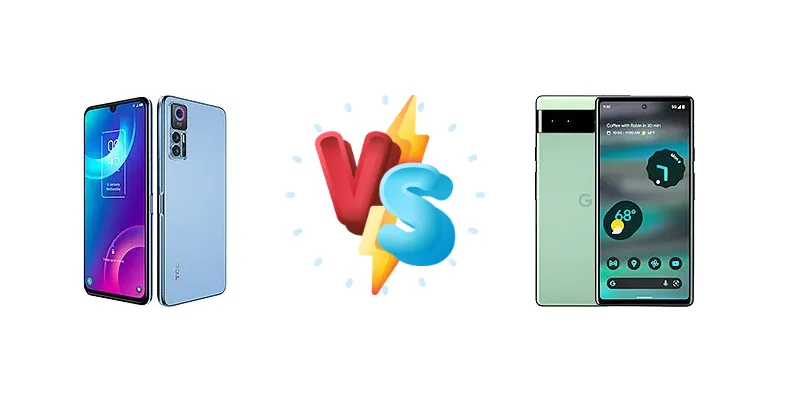
|
🏆 Quick Verdict
For most users, the Google Pixel 6a is the superior choice. Its Google Tensor chipset delivers a dramatically faster and smoother experience, particularly in tasks like image processing and app loading. While the TCL 30 offers comparable battery life, its significantly weaker processor makes it a less compelling option overall.
| PHONES | ||
|---|---|---|
| Phone Names | TCL 30 | Google Pixel 6a |
| Network | ||
|---|---|---|
| 2G bands | GSM 850 / 900 / 1800 / 1900 | GSM 850 / 900 / 1800 / 1900 |
| 3G bands | HSDPA 850 / 900 / 1900 / 2100 | HSDPA 800 / 850 / 900 / 1700(AWS) / 1900 / 2100 |
| 4G bands | 1, 3, 5, 7, 8, 20, 28, 38, 40, 41 | 1, 2, 3, 4, 5, 7, 8, 12, 13, 14, 17, 18, 19, 20, 25, 26, 28, 29, 30, 38, 39, 40, 41, 42, 48, 66, 71 - GX7AS, GB62Z (USA/Canada) |
| 5G bands | - | 1, 2, 3, 5, 7, 8, 12, 20, 25, 28, 30, 38, 40, 41, 48, 66, 71, 77, 78 SA/NSA/Sub6 - GX7AS (USA/Canada) |
| Speed | HSPA 42.2/5.76 Mbps, LTE Cat4 150/50 Mbps | HSPA, LTE, 5G |
| Technology | GSM / HSPA / LTE | GSM / HSPA / LTE / 5G |
| - | 1, 2, 3, 5, 7, 8, 12, 20, 25, 28, 30, 40, 48, 66, 71, 77, 78 SA/NSA/Sub6 - G1AZG (International) | |
| Launch | ||
|---|---|---|
| Announced | 2022, February 27 | 2022, May 11 |
| Status | Available. Released 2022, April 20 | Available. Released 2022, July 21 |
| Body | ||
|---|---|---|
| Build | Glass front, plastic frame, plastic back | Glass front (Gorilla Glass 3), aluminum frame, plastic back |
| Dimensions | 164.5 x 75.2 x 7.7 mm (6.48 x 2.96 x 0.30 in) | 152.2 x 71.8 x 8.9 mm (5.99 x 2.83 x 0.35 in) |
| SIM | Nano-SIM + Nano-SIM | Nano-SIM + eSIM |
| Weight | 184 g (6.49 oz) | 178 g (6.28 oz) |
| - | IP67 dust/water resistant (up to 1m for 30 min) | |
| Display | ||
|---|---|---|
| Protection | - | Corning Gorilla Glass 3 |
| Resolution | 1080 x 2400 pixels, 20:9 ratio (~393 ppi density) | 1080 x 2400 pixels, 20:9 ratio (~429 ppi density) |
| Size | 6.7 inches, 108.4 cm2 (~87.6% screen-to-body ratio) | 6.1 inches, 90.7 cm2 (~83.0% screen-to-body ratio) |
| Type | AMOLED, 650 nits (typ), 900 nits (peak) | OLED, HDR |
| - | Always-on display | |
| Platform | ||
|---|---|---|
| CPU | Octa-core (4x2.3 GHz Cortex-A53 & 4x1.8 GHz Cortex-A53) | Octa-core (2x2.80 GHz Cortex-X1 & 2x2.25 GHz Cortex-A76 & 4x1.80 GHz Cortex-A55) |
| Chipset | Mediatek MT6765V/CB Helio G37 (12 nm) | Google Tensor (5 nm) |
| GPU | PowerVR GE8320 | Mali-G78 MP20 |
| OS | Android 12, TCL UI 4.0 | Android 12, upgradable to Android 15, up to 5 major Android upgrades |
| Memory | ||
|---|---|---|
| Card slot | microSDXC (dedicated slot) | No |
| Internal | 64GB 4GB RAM | 128GB 6GB RAM |
| eMMC 5.1 | UFS 3.1 | |
| Main Camera | ||
|---|---|---|
| Dual | - | 12.2 MP, f/1.7, 27mm, (wide), 1/2.55", 1.4µm, dual pixel PDAF, OIS 12 MP, f/2.2, 17mm, 114˚ (ultrawide), 1.25µm |
| Features | LED flash, HDR, panorama | Dual-LED flash, Pixel Shift, Auto-HDR, panorama |
| Single | 8 MP, f/2.0, 26mm (wide), 1/4", 1.12µm | 8 MP, f/2.0, 24mm (wide), 1.12µm |
| Triple | 50 MP, f/1.9, 28mm (wide), 1/2.76", 0.64µm, PDAF 2 MP (macro) Auxiliary lens | - |
| Video | 1080p@30fps | 4K@30/60fps, 1080p@30/60/120/240fps; gyro-EIS, OIS |
| Selfie camera | ||
|---|---|---|
| Features | HDR | HDR, panorama |
| Single | 8 MP, f/2.0, 26mm (wide), 1/4.0", 1.12µm | 8 MP, f/2.0, 24mm (wide), 1.12µm |
| Video | 1080p@30fps | 1080p@30fps |
| Sound | ||
|---|---|---|
| 3.5mm jack | Yes | No |
| 35mm jack | Yes | No |
| Loudspeaker | Yes, with dual speakers | Yes, with stereo speakers |
| Comms | ||
|---|---|---|
| Bluetooth | 5.0, A2DP, LE | 5.2, A2DP, LE |
| NFC | Yes | Yes |
| Positioning | GPS, GLONASS, GALILEO, BDS | GPS, GLONASS, GALILEO, QZSS |
| Radio | Unspecified | No |
| USB | USB Type-C 2.0 | USB Type-C 3.1 |
| WLAN | Wi-Fi 802.11 b/g/n, Wi-Fi Direct | Wi-Fi 802.11 a/b/g/n/ac/6e, dual-band, Wi-Fi Direct |
| Features | ||
|---|---|---|
| Sensors | Fingerprint (side-mounted), accelerometer, proximity, compass | Fingerprint (under display, optical), accelerometer, gyro, proximity, compass, barometer |
| Battery | ||
|---|---|---|
| Charging | 18W wired | 18W wired, PD3.0 |
| Type | Li-Po 5010 mAh | Li-Po 4410 mAh |
| Misc | ||
|---|---|---|
| Colors | Tech Black, Muse Blue | Chalk, Charcoal, Sage |
| Models | T676H | GX7AS, GB62Z, G1AZG, GB17L |
| Price | About 200 EUR | $ 138.99 / C$ 228.74 / ₹ 23,999 |
| Tests | ||
|---|---|---|
| Battery life | - | Endurance rating 94h |
| Display | - | Contrast ratio: Infinite (nominal) |
TCL 30
- Significantly faster performance with Google Tensor chip
- Superior camera quality and image processing
- Brighter and higher-quality display
- Faster charging with PD3.0
- Higher price point than the TCL 30
- May not offer expandable storage
Google Pixel 6a
- More affordable price
- Comparable battery life to the Pixel 6a
- Potentially expandable storage (market dependent)
- Simple and straightforward user experience
- Significantly slower performance
- Lower-quality display
- Less capable camera system
- Less frequent software updates
Display Comparison
The Pixel 6a boasts a significantly brighter display, reaching 876 nits measured, compared to an unspecified brightness for the TCL 30. This translates to better visibility outdoors under direct sunlight. While both likely utilize IPS LCD panels (given the price points), the Pixel 6a’s infinite contrast ratio (nominal) suggests superior black levels and overall image quality. The TCL 30’s display specifications are less detailed, suggesting a more basic panel aimed at cost savings.
Camera Comparison
While both phones likely feature multi-camera systems, the Pixel 6a benefits from Google’s renowned computational photography. The Pixel 6a’s image processing capabilities, powered by the Tensor chip, will produce superior photos, especially in challenging lighting conditions. The TCL 30’s camera performance is likely more dependent on the hardware itself, and without detailed sensor information, it’s difficult to assess its capabilities beyond basic photography. The Pixel 6a’s focus on software optimization gives it a clear advantage.
Performance
The performance gap between these two devices is substantial. The Google Pixel 6a’s Google Tensor chip, built on a 5nm process, features a powerful octa-core configuration with 2x2.80 GHz Cortex-X1 cores, 2x2.25 GHz Cortex-A76 cores, and 4x1.80 GHz Cortex-A55 cores. This is a massive upgrade over the TCL 30’s MediaTek Helio G37 (12nm), which relies on four Cortex-A53 cores clocked at 2.3 GHz and another four at 1.8 GHz. The Tensor chip’s more advanced architecture and smaller fabrication node deliver significantly faster processing speeds, improved efficiency, and better graphics performance. This difference will be noticeable in everything from app launch times to demanding games.
Battery Life
Both the TCL 30 and Pixel 6a achieve an endurance rating of 94 hours, indicating comparable battery life under typical usage. However, the Pixel 6a’s 18W charging with PD3.0 support offers faster and more efficient charging compared to the TCL 30’s standard 18W wired charging. While both can fully charge in a similar timeframe, the Pixel 6a’s PD3.0 compatibility allows for more versatile charging options and potentially faster charging with compatible chargers.
Buying Guide
Buy the TCL 30 if you prioritize absolute affordability and only need a phone for basic tasks like calls, texts, and light social media browsing. You’ll appreciate its long battery life and lower price tag. Buy the Google Pixel 6a if you value performance, a superior camera experience, and Google’s software features, even if it means spending a bit more. It’s ideal for users who multitask, play mobile games, or rely heavily on their phone’s camera.