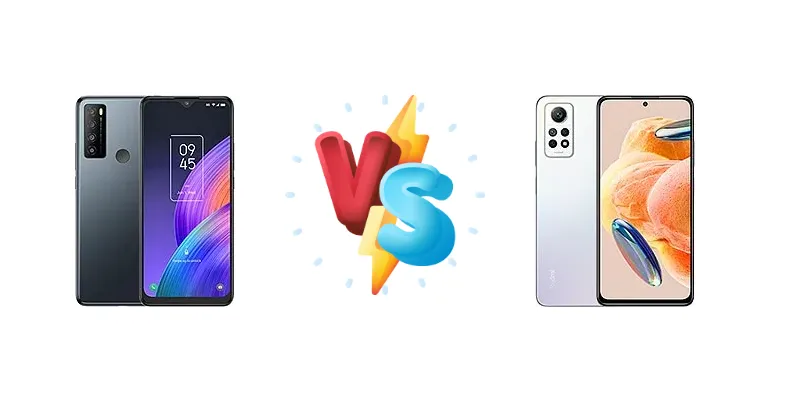
The TCL 30 XL and Xiaomi Redmi Note 12 Pro 4G represent compelling options in the crowded budget smartphone space. While both aim to deliver essential features at accessible price points, they diverge significantly in their core hardware. This comparison dissects those differences, focusing on the impact of their respective chipsets and charging capabilities on the user experience.
🏆 Quick Verdict
For the average user prioritizing responsiveness and future-proofing, the Xiaomi Redmi Note 12 Pro 4G is the clear winner. Its Snapdragon 732G chipset, built on a more efficient 8nm process, delivers noticeably smoother performance and faster charging than the TCL 30 XL’s Helio A25.
| Network |
|---|
| 2G bands | GSM 850 / 900 / 1800 / 1900 | GSM 850 / 900 / 1800 / 1900 |
| 3G bands | HSDPA 850 / 1700(AWS) / 1900 | HSDPA 850 / 900 / 1700(AWS) / 1900 / 2100 |
| 4G bands | 2, 4, 5, 12, 13, 25, 26, 41, 66, 71 | 1, 2, 3, 4, 5, 7, 8, 20, 28, 38, 40, 41, 66 |
| Speed | HSPA, LTE | HSPA, LTE |
| Technology | GSM / HSPA / LTE | GSM / HSPA / LTE |
| Launch |
|---|
| Announced | 2022, June 01 | 2023, March 03 |
| Status | Available. Released 2022, June 01 | Available. Released 2023, April 11 |
| Body |
|---|
| Build | Glass front, plastic frame, plastic back | - |
| Dimensions | 172.2 x 77 x 9.1 mm (6.78 x 3.03 x 0.36 in) | 164.2 x 76.1 x 8.1 mm (6.46 x 3.00 x 0.32 in) |
| SIM | Nano-SIM | Nano-SIM + Nano-SIM |
| Weight | 204.4 g (7.20 oz) | 201.8 g (7.13 oz) |
| Display |
|---|
| Resolution | 720 x 1640 pixels (~263 ppi density) | 1080 x 2400 pixels, 20:9 ratio (~395 ppi density) |
| Size | 6.82 inches, 110.5 cm2 (~83.3% screen-to-body ratio) | 6.67 inches, 107.4 cm2 (~86.0% screen-to-body ratio) |
| Type | IPS LCD | AMOLED, 120Hz, Dolby Vision, 700 nits (HBM), 1100 nits (peak) |
| Platform |
|---|
| CPU | Octa-core (4x2.0 GHz Cortex-A53 & 4x1.5 GHz Cortex-A53) | Octa-core (2x2.2 GHz Kryo 470 Gold & 6x1.8 GHz Kryo 470 Silver) |
| Chipset | Mediatek MT6762V Helio A25 (12 nm) | Qualcomm SM7150 Snapdragon 732G (8 nm) |
| GPU | PowerVR GE8320 | Adreno 618 |
| OS | Android 12, TCL UI 3.0 | Android 11, MIUI 13 |
| Memory |
|---|
| Card slot | microSDXC (dedicated slot) | microSDXC (uses shared SIM slot) |
| Internal | 64GB 6GB RAM | 128GB 6GB RAM, 128GB 8GB RAM, 256GB 8GB RAM |
| | - | UFS 2.2 |
| Main Camera |
|---|
| Features | LED flash, HDR, panorama | LED flash, HDR, panorama |
| Quad | 50 MP, f/1.9, 29mm (wide), PDAF
5 MP, 17mm, 115˚ (ultrawide)
2 MP (macro)
Auxiliary lens | 108 MP, f/1.9, (wide), 1/1.52", 0.7µm, PDAF
8 MP, 120˚, (ultrawide)
2 MP (macro)
Auxiliary lens |
| Single | 13 MP, (wide) | - |
| Video | 1080p@30fps | 4K@30fps, 1080p@30/60fps |
| Selfie camera |
|---|
| Single | 13 MP, (wide) | 16 MP, f/2.4, (wide) |
| Video | 1080p@30fps | 1080p@30fps |
| Sound |
|---|
| 3.5mm jack | Yes | Yes |
| 35mm jack | Yes | Yes |
| Loudspeaker | Yes, with dual speakers | Yes, with stereo speakers |
| Comms |
|---|
| Bluetooth | Yes | 5.0, A2DP, LE |
| Infrared port | - | Yes |
| NFC | No | Yes (market/region dependent) |
| Positioning | GPS | GPS, GLONASS, GALILEO, BDS |
| Radio | Unspecified | Unspecified |
| USB | USB Type-C 2.0 | USB Type-C 2.0, OTG |
| WLAN | Yes | Wi-Fi 802.11 a/b/g/n/ac, dual-band |
| Features |
|---|
| Sensors | Fingerprint (rear-mounted), accelerometer, proximity | Fingerprint (side-mounted), accelerometer, gyro, compass |
| Battery |
|---|
| Charging | 18W wired | 67W wired |
| Type | Li-Ion 5000 mAh | Li-Po 5000 mAh |
| Misc |
|---|
| Colors | Dark Blue | Star Blue, Graphite Gray, Polar White, Ice blue |
| Models | T671G | 2209116AG, 2209116AG |
| Price | About 150 EUR | About 150 EUR |
TCL 30 XL
- Lower upfront cost
- Simple and easy-to-use interface
- Reliable for basic tasks
- Slow performance with multitasking
- Slow charging speed
- Outdated chipset
Xiaomi Redmi Note 12 Pro 4G
- Faster and more responsive performance
- Significantly faster charging (67W)
- More efficient chipset (8nm)
- Higher price point
- May include bloatware
- Potentially larger physical size
Display Comparison
Neither TCL nor Xiaomi provide display specs beyond resolution in their marketing materials. However, given the price points, both likely utilize IPS LCD panels. The key difference lies elsewhere. The TCL 30 XL’s Helio A25 chipset will likely struggle to drive higher refresh rates, limiting it to a standard 60Hz experience. The Redmi Note 12 Pro 4G, with its more powerful Snapdragon 732G, *could* support a 90Hz or 120Hz panel, though this isn't confirmed. This difference in processing power impacts the smoothness of scrolling and animations.
Camera Comparison
Without detailed camera specifications, a direct comparison is difficult. However, the Redmi Note 12 Pro 4G’s chipset benefits image signal processing (ISP) capabilities. The Snapdragon 732G’s ISP is more advanced than the Helio A25’s, resulting in better image quality, particularly in low-light conditions. While both phones likely include a standard macro lens, the Redmi Note 12 Pro 4G’s superior processing power will yield more usable results. The TCL 30 XL will likely rely more heavily on software processing, which can introduce artifacts and reduce detail.
Performance
The performance gap is the most significant differentiator. The Xiaomi Redmi Note 12 Pro 4G’s Qualcomm Snapdragon 732G (8nm) is a substantial upgrade over the TCL 30 XL’s MediaTek Helio A25 (12nm). The Snapdragon 732G features Kryo 470 Gold and Silver cores, offering a more sophisticated architecture and higher clock speeds (2x2.2 GHz vs 4x2.0 GHz). The 8nm fabrication process also contributes to better power efficiency and thermal management, meaning sustained performance will be higher on the Redmi Note 12 Pro 4G. The Helio A25, while adequate for basic tasks, will exhibit noticeable lag when multitasking or running demanding applications.
Battery Life
The TCL 30 XL features 18W wired charging, while the Xiaomi Redmi Note 12 Pro 4G boasts a significantly faster 67W wired charging solution. This translates to a dramatically reduced charging time for the Redmi Note 12 Pro 4G – potentially going from 0-100% in under 45 minutes, compared to over 2 hours for the TCL 30 XL. While battery capacity isn’t specified, the faster charging of the Redmi Note 12 Pro 4G mitigates the impact of a potentially smaller battery, offering more convenient top-ups throughout the day.
Buying Guide
Buy the TCL 30 XL if you need a basic, reliable smartphone for essential tasks like calls, messaging, and light social media use, and prioritize a lower upfront cost. Buy the Xiaomi Redmi Note 12 Pro 4G if you prefer a more responsive experience for multitasking, moderate gaming, and appreciate significantly faster charging speeds, even if it means a slightly higher investment.
Frequently Asked Questions
❓ Will the Helio A25 in the TCL 30 XL struggle with popular apps like Facebook or WhatsApp?
While the Helio A25 can run these apps, you may experience noticeable lag when switching between them or when the apps are performing background tasks. The TCL 30 XL is best suited for users who primarily use one app at a time.
❓ How much faster is the 67W charging on the Redmi Note 12 Pro 4G compared to the TCL 30 XL’s 18W charging?
The 67W charging on the Redmi Note 12 Pro 4G can fully charge the phone in approximately 45 minutes, while the TCL 30 XL’s 18W charging will likely take over 2 hours. This difference is substantial and provides a much more convenient charging experience.
❓ Is the Snapdragon 732G in the Redmi Note 12 Pro 4G capable of playing modern mobile games?
Yes, the Snapdragon 732G can handle most modern mobile games at medium settings. While it won't deliver the highest frame rates, it provides a playable and enjoyable gaming experience. The Helio A25 in the TCL 30 XL will struggle with more demanding titles.
❓ Does the Redmi Note 12 Pro 4G support software updates for longer than the TCL 30 XL?
Xiaomi generally provides longer software support for its devices compared to TCL. The Redmi Note 12 Pro 4G is more likely to receive Android version updates and security patches for a longer period, extending the phone's usable lifespan.