
Poco X4 Pro 5G vs TCL 30+: A Detailed Comparison for Budget Shoppers
| Phones Images | |||||
|---|---|---|---|---|---|
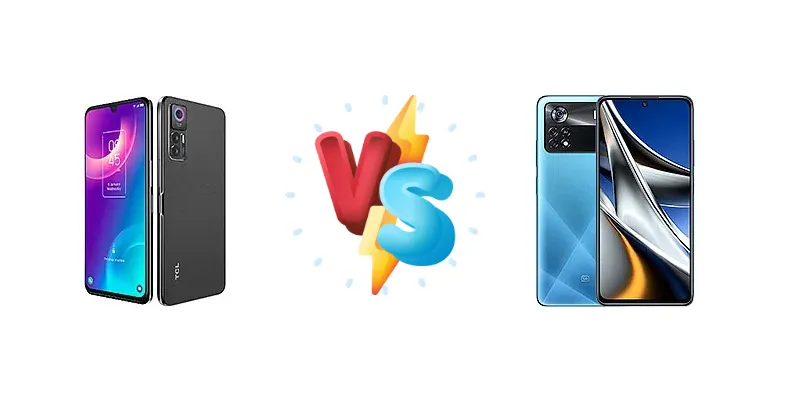
|
🏆 Quick Verdict
For most users, the Xiaomi Poco X4 Pro 5G is the better choice. Its Snapdragon 695 5G chipset, built on a more efficient 6nm process, offers superior performance and future-proofing compared to the TCL 30+'s Helio G37. The significantly faster 67W charging is a game-changer, offsetting the similar battery endurance ratings.
| PHONES | ||
|---|---|---|
| Phone Names | TCL 30+ | Xiaomi Poco X4 Pro 5G |
| Network | ||
|---|---|---|
| 2G bands | GSM 850 / 900 / 1800 / 1900 - SIM 1 & SIM 2 (dual-SIM) | GSM 850 / 900 / 1800 / 1900 |
| 3G bands | HSDPA 850 / 900 / 1900 / 2100 - EMEA/APAC | HSDPA 800 / 850 / 900 / 1700(AWS) / 1900 / 2100 - Global |
| 4G bands | 1, 3, 5, 7, 8, 20, 28, 38, 40, 41 - EMEA | 1, 2, 3, 4, 5, 7, 8, 12, 17, 18, 19, 20, 26, 28, 38, 40, 41 - Global |
| 5G bands | - | 1, 3, 5, 7, 8, 20, 28, 38, 40, 41, 77, 78 SA/NSA - Global |
| Speed | HSPA 42.2/5.76 Mbps, LTE Cat4 150/50 Mbps | HSPA, LTE, 5G |
| Technology | GSM / HSPA / LTE | GSM / HSPA / LTE / 5G |
| 2, 3, 4, 5, 7, 8, 12, 13, 17, 26, 28, 38, 40, 66 - LATAM | 1, 3, 5, 8, 28, 40, 78 SA/NSA - India | |
| Launch | ||
|---|---|---|
| Announced | 2022, February 27 | 2022, February 28 |
| Status | Available. Released 2022, April 20 | Available. Released 2022, March 23 |
| Body | ||
|---|---|---|
| Build | Glass front, plastic frame, plastic back | Glass front (Gorilla Glass 5), glass back, plastic frame |
| Dimensions | 164.5 x 75.2 x 7.7 mm (6.48 x 2.96 x 0.30 in) | 164.2 x 76.1 x 8.1 mm (6.46 x 3.00 x 0.32 in) |
| SIM | Dual SIM (Nano-SIM, dual stand-by) | Nano-SIM + Nano-SIM |
| Weight | 184 g (6.49 oz) | 205 g (7.23 oz) |
| - | IP53, dust and splash resistant | |
| Display | ||
|---|---|---|
| Protection | - | Corning Gorilla Glass 5 |
| Resolution | 1080 x 2400 pixels, 20:9 ratio (~393 ppi density) | 1080 x 2400 pixels, 20:9 ratio (~395 ppi density) |
| Size | 6.7 inches, 108.4 cm2 (~87.6% screen-to-body ratio) | 6.67 inches, 107.4 cm2 (~86.0% screen-to-body ratio) |
| Type | AMOLED, 650 nits (typ), 900 nits (peak) | Super AMOLED, 120Hz, 700 nits, 1200 nits (peak) |
| Platform | ||
|---|---|---|
| CPU | Octa-core (4x2.3 GHz Cortex-A53 & 4x1.8 GHz Cortex-A53) | Octa-core (2x2.2 GHz Kryo 660 Gold & 6x1.7 GHz Kryo 660 Silver) |
| Chipset | Mediatek MT6765V/CB Helio G37 (12 nm) | Qualcomm SM6375 Snapdragon 695 5G (6 nm) |
| GPU | PowerVR GE8320 | Adreno 619 |
| OS | Android 12, TCL UI 4.0 | Android 11, MIUI 13 for POCO |
| Memory | ||
|---|---|---|
| Card slot | microSDXC (dedicated slot) | microSDXC (uses shared SIM slot) |
| Internal | 128GB 4GB RAM | 64GB 6GB RAM, 128GB 6GB RAM, 128GB 8GB RAM, 256GB 6GB RAM, 256GB 8GB RAM |
| eMMC 5.1 | UFS 2.2 | |
| Main Camera | ||
|---|---|---|
| Features | LED flash, HDR, panorama | LED flash, HDR, panorama |
| Single | - | 16 MP, f/2.5, (wide), 1/3.06" 1.0µm |
| Triple | 50 MP, f/1.9, 28mm (wide), 1/2.76", 0.64µm, PDAF 2 MP, f/2.4, (macro) 2 MP, f/2.4, (depth) | 108 MP, f/1.9, 26mm (wide), 1/1.52", 0.7µm, PDAF - Global version 64 MP, f/1.8, 26mm (wide), 0.7µm, PDAF - India version 8 MP, f/2.2, 118˚ (ultrawide), 1/4.0", 1.12µm 2 MP (macro) |
| Video | 1080p@30fps | 1080p@30fps |
| Selfie camera | ||
|---|---|---|
| Features | HDR | HDR, panorama |
| Single | 13 MP, f/2.3, 19mm (ultrawide), 1/3", 1.12µm | 16 MP, f/2.5, (wide), 1/3.06" 1.0µm |
| Video | 1080p@30fps | 1080p@30fps |
| Sound | ||
|---|---|---|
| 3.5mm jack | Yes | Yes |
| 35mm jack | - | Yes |
| Loudspeaker | Yes, with dual speakers | Yes, with stereo speakers |
| - | 24-bit/192kHz audio | |
| Comms | ||
|---|---|---|
| Bluetooth | 5.0, A2DP, LE | 5.1, A2DP, LE |
| Infrared port | - | Yes |
| NFC | Yes (T676K only) | Yes (market/region dependent) |
| Positioning | GPS, GLONASS, GALILEO, BDS | GPS, GLONASS, BDS, GALILEO |
| Radio | Unspecified | FM radio |
| USB | USB Type-C 2.0 | USB Type-C 2.0, OTG |
| WLAN | Wi-Fi 802.11 b/g/n, Wi-Fi Direct | Wi-Fi 802.11 a/b/g/n/ac, dual-band, Wi-Fi Direct |
| Features | ||
|---|---|---|
| Sensors | Fingerprint (side-mounted), accelerometer, proximity, compass | Fingerprint (side-mounted), accelerometer, gyro, proximity, compass |
| Battery | ||
|---|---|---|
| Charging | 18W wired | 67W wired, PD3.0, QC3, 70% in 22 min, 100% in 41 min |
| Type | Li-Po 5010 mAh, non-removable | Li-Po 5000 mAh |
| Misc | ||
|---|---|---|
| Colors | Tech Black, Muse Blue | Laser Black, Laser Blue, Poco Yellow |
| Models | T676K, T676J | 2201116PG |
| Price | About 220 EUR | € 160.40 / $ 419.99 / £ 255.00 / ₹ 12,940 |
| SAR | - | 1.06 W/kg (head) 1.09 W/kg (body) |
| SAR EU | - | 0.60 W/kg (head) 0.96 W/kg (body) |
| Tests | ||
|---|---|---|
| Battery life | - | Endurance rating 119h |
| Camera | - | Photo / Video |
| Display | - | Contrast ratio: Infinite (nominal) |
| Loudspeaker | - | -26.8 LUFS (Good) |
| Performance | - | AnTuTu: 335353 (v8), 384646 (v9) GeekBench: 2063 (v5.1) GFXBench: 17fps (ES 3.1 onscreen) |
TCL 30+
- Most affordable option
- Functional and reliable for basic tasks
- Decent battery endurance
- Outdated Helio G37 chipset
- Slow 18W charging
- Lacks 5G connectivity
Xiaomi Poco X4 Pro 5G
- Faster Snapdragon 695 5G chipset
- Ultra-fast 67W charging
- 5G connectivity for future-proofing
- Slightly higher price point
- Camera performance details are unknown
- May not be significantly better in all tasks
Display Comparison
Both devices share an 'Infinite' (nominal) contrast ratio, suggesting typical IPS LCD characteristics. However, detailed display specs like peak brightness and color gamut coverage are missing. Given TCL's history with display technology, the 30+ *may* have a slight edge in color accuracy, but the Poco X4 Pro 5G's larger screen size (typically found in this model range) could offer a more immersive viewing experience. Without concrete data, it's difficult to declare a clear winner.
Camera Comparison
Both phones feature 'Photo / Video' capabilities, but lack specific details. The absence of sensor size or aperture information makes a direct comparison impossible. However, Xiaomi generally focuses on camera performance in its Poco line, suggesting the X4 Pro 5G likely has a more capable camera system. The TCL 30+ likely prioritizes affordability over camera quality, potentially resulting in lower-resolution images and less effective low-light performance. We can assume both will include standard features like HDR, but image processing algorithms will likely differ significantly.
Performance
The Poco X4 Pro 5G’s Qualcomm Snapdragon 695 5G (6nm) represents a significant architectural advantage over the TCL 30+'s MediaTek Helio G37 (12nm). The 6nm process inherently offers better power efficiency, translating to less heat generation and potentially sustained performance during prolonged use. The Snapdragon 695’s Kryo 660 Gold cores (2x2.2 GHz) are also more powerful than the Cortex-A53 cores (4x2.3 GHz) in the Helio G37, resulting in snappier app launches and smoother multitasking. The Helio G37's Cortex-A53 cores, while efficient, are older architecture and will struggle with more demanding tasks.
Battery Life
Both devices boast an endurance rating of 119 hours, indicating similar real-world battery life under typical usage. However, the Poco X4 Pro 5G’s 67W wired charging is a massive advantage. It can reach 70% charge in just 22 minutes and 100% in 41 minutes, minimizing downtime. The TCL 30+'s 18W charging is comparatively slow, requiring significantly longer to fully recharge, making the Poco X4 Pro 5G the clear winner for users who value convenience.
Buying Guide
Buy the TCL 30+ if you absolutely need the most affordable option and 5G isn't a priority. It's a solid choice for basic smartphone tasks like calling, texting, and light social media. Buy the Xiaomi Poco X4 Pro 5G if you want a phone that can handle more demanding apps, benefit from 5G connectivity, and recharge incredibly quickly – all without a substantial price premium.