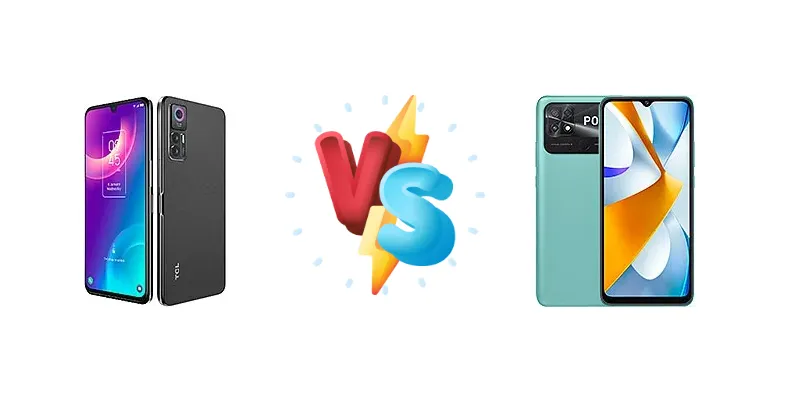
The budget smartphone market is fiercely competitive, offering incredible value for money. Today, we're pitting two contenders against each other: the TCL 30+ and the Xiaomi Poco C40. Both promise affordability, but which one delivers the better overall experience?
🏆 Quick Verdict
The Poco C40 edges out the TCL 30+ thanks to its larger battery and generally smoother performance despite a less powerful chipset. However, the TCL 30+ boasts a slightly better display and potentially more refined software experience, making it a close call depending on your priorities.
| Network |
|---|
| 2G bands | GSM 850 / 900 / 1800 / 1900 - SIM 1 & SIM 2 (dual-SIM) | GSM 850 / 900 / 1800 / 1900 |
| 3G bands | HSDPA 850 / 900 / 1900 / 2100 - EMEA/APAC | HSDPA 850 / 900 / 1700(AWS) / 1900 / 2100 |
| 4G bands | 1, 3, 5, 7, 8, 20, 28, 38, 40, 41 - EMEA | 1, 2, 3, 4, 5, 7, 8, 20, 28, 38, 40, 41 |
| Speed | HSPA 42.2/5.76 Mbps, LTE Cat4 150/50 Mbps | HSPA, LTE |
| Technology | GSM / HSPA / LTE | GSM / HSPA / LTE |
| | 2, 3, 4, 5, 7, 8, 12, 13, 17, 26, 28, 38, 40, 66 - LATAM | - |
| Launch |
|---|
| Announced | 2022, February 27 | 2022, June 06 |
| Status | Available. Released 2022, April 20 | Available. Released 2022, June 17 |
| Body |
|---|
| Build | Glass front, plastic frame, plastic back | - |
| Dimensions | 164.5 x 75.2 x 7.7 mm (6.48 x 2.96 x 0.30 in) | 169.6 x 76.6 x 9.2 mm (6.68 x 3.02 x 0.36 in) |
| SIM | Dual SIM (Nano-SIM, dual stand-by) | Nano-SIM + Nano-SIM |
| Weight | 184 g (6.49 oz) | 204 g (7.20 oz) |
| | - | Dust & splash resistant |
| Display |
|---|
| Protection | - | Corning Gorilla Glass |
| Resolution | 1080 x 2400 pixels, 20:9 ratio (~393 ppi density) | 720 x 1650 pixels (~268 ppi density) |
| Size | 6.7 inches, 108.4 cm2 (~87.6% screen-to-body ratio) | 6.71 inches, 106.5 cm2 (~82.0% screen-to-body ratio) |
| Type | AMOLED, 650 nits (typ), 900 nits (peak) | IPS LCD, 400 nits |
| Platform |
|---|
| CPU | Octa-core (4x2.3 GHz Cortex-A53 & 4x1.8 GHz Cortex-A53) | Octa-core (4x2.0 GHz Cortex-A55 & 4x1.5 GHz Cortex-A55) |
| Chipset | Mediatek MT6765V/CB Helio G37 (12 nm) | JLQ JR510 (11 nm) |
| GPU | PowerVR GE8320 | Mali-G57 MC1 |
| OS | Android 12, TCL UI 4.0 | Android 11, MIUI 13 for POCO |
| Memory |
|---|
| Card slot | microSDXC (dedicated slot) | microSDXC |
| Internal | 128GB 4GB RAM | 32GB 2GB RAM, 32GB 3GB RAM, 32GB 4GB RAM, 64GB 4GB RAM |
| | eMMC 5.1 | - |
| Main Camera |
|---|
| Dual | - | 13 MP, f/2.2, (wide), PDAF
Auxiliary lens |
| Features | LED flash, HDR, panorama | LED flash, HDR, panorama |
| Single | - | 5 MP, f/2.2 |
| Triple | 50 MP, f/1.9, 28mm (wide), 1/2.76", 0.64µm, PDAF
2 MP, f/2.4, (macro)
2 MP, f/2.4, (depth) | - |
| Video | 1080p@30fps | 1080p@30fps |
| Selfie camera |
|---|
| Features | HDR | HDR |
| Single | 13 MP, f/2.3, 19mm (ultrawide), 1/3", 1.12µm | 5 MP, f/2.2 |
| Video | 1080p@30fps | 1080p@30fps |
| Sound |
|---|
| 3.5mm jack | Yes | Yes |
| 35mm jack | - | Yes |
| Loudspeaker | Yes, with dual speakers | Yes |
| Comms |
|---|
| Bluetooth | 5.0, A2DP, LE | 5.0, A2DP, LE |
| Infrared port | - | Yes |
| NFC | Yes (T676K only) | Yes (market/region dependent) |
| Positioning | GPS, GLONASS, GALILEO, BDS | GPS, GLONASS, GALILEO, BDS |
| Radio | Unspecified | FM radio |
| USB | USB Type-C 2.0 | USB Type-C 2.0 |
| WLAN | Wi-Fi 802.11 b/g/n, Wi-Fi Direct | Wi-Fi 802.11 a/b/g/n/ac, dual-band, Wi-Fi Direct |
| Features |
|---|
| Sensors | Fingerprint (side-mounted), accelerometer, proximity, compass | Fingerprint (rear-mounted), accelerometer, proximity |
| Battery |
|---|
| Charging | 18W wired | 18W wired |
| Type | Li-Po 5010 mAh, non-removable | Li-Po 6000 mAh |
| Misc |
|---|
| Colors | Tech Black, Muse Blue | Power Black, Coral Green, Poco Yellow |
| Models | T676K, T676J | 220333QPG |
| Price | About 220 EUR | About 110 EUR |
TCL 30+
- Better display resolution
- Potentially cleaner software
- Slightly more powerful chipset
- Smaller battery
- Average camera performance
- Can feel slightly sluggish at times
Xiaomi Poco C40
- Exceptional battery life
- Smooth software experience
- Large display
- Lower display resolution
- Less powerful chipset
- Design may not appeal to everyone
Display Comparison
The TCL 30+ typically features a 6.7-inch FHD+ IPS display, offering vibrant colors and good viewing angles. The Poco C40 has a 6.71-inch HD+ IPS display. While both are large, the TCL's higher resolution provides a sharper image. The Poco C40's display is adequate but noticeably less crisp.
Camera Comparison
The TCL 30+ generally features a triple camera setup (50MP main, 2MP macro, 2MP depth) while the Poco C40 has a 50MP main camera, 2MP depth, and a 2MP macro. Image quality is comparable in good lighting, but the TCL 30+ might offer slightly better dynamic range. Low-light performance is average on both devices.
Performance
The TCL 30+’s Helio G37 offers a slight edge in raw processing power compared to the Poco C40’s JLQ JR510. However, the Poco C40’s 11nm process might lead to slightly better thermal management. Real-world performance is similar for basic tasks, but the Poco C40 feels a bit more responsive in some scenarios due to software optimization.
Battery Life
The Poco C40 shines in this category, packing a massive 6000mAh battery. This translates to exceptional battery life, easily lasting two days on a single charge. The TCL 30+ has a smaller 5000mAh battery, providing a solid day of use but not matching the Poco C40's endurance.
Buying Guide
The TCL 30+ is ideal for users prioritizing a decent display and a cleaner software experience. The Poco C40 is a better choice for those who need exceptional battery life and are willing to compromise slightly on performance.
Frequently Asked Questions
❓ Which phone is better for gaming?
The TCL 30+ has a slightly more powerful chipset, but neither phone is a gaming powerhouse. Both will handle basic games well, but demanding titles may struggle.
❓ What is the software experience like on each phone?
The TCL 30+ typically runs a more stock-like Android experience. The Poco C40 uses MIUI, which offers more features but can feel a bit cluttered to some users.