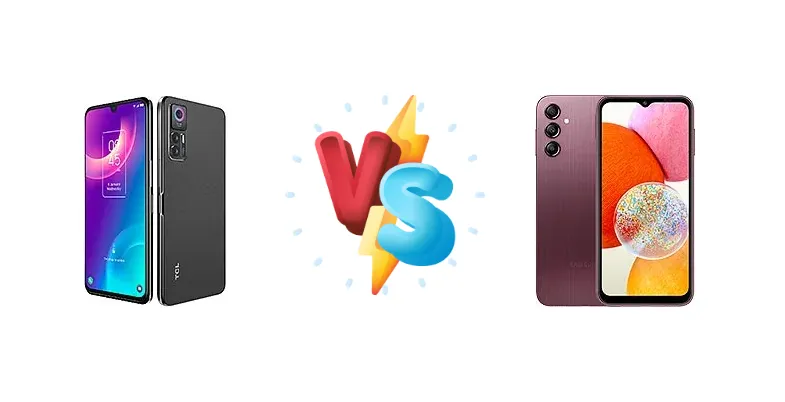
The budget smartphone market is fiercely competitive, and the TCL 30+ and Samsung Galaxy A14 are two strong contenders. Both offer compelling features at affordable prices, but which one delivers the best overall experience? Let's dive into a detailed comparison to help you make the right choice.
🏆 Quick Verdict
The Samsung Galaxy A14 edges out the TCL 30+ thanks to its more powerful processor (especially the Exynos version), slightly better camera capabilities, and the Samsung brand reputation. However, the TCL 30+ offers a competitive price and decent performance for everyday tasks.
| Network |
|---|
| 2G bands | GSM 850 / 900 / 1800 / 1900 - SIM 1 & SIM 2 (dual-SIM) | GSM 850 / 900 / 1800 / 1900 |
| 3G bands | HSDPA 850 / 900 / 1900 / 2100 - EMEA/APAC | HSDPA 850 / 900 / 2100 |
| 4G bands | 1, 3, 5, 7, 8, 20, 28, 38, 40, 41 - EMEA | 1, 3, 5, 7, 8, 20, 28, 38, 40, 41 |
| Speed | HSPA 42.2/5.76 Mbps, LTE Cat4 150/50 Mbps | HSPA, LTE |
| Technology | GSM / HSPA / LTE | GSM / HSPA / LTE |
| | 2, 3, 4, 5, 7, 8, 12, 13, 17, 26, 28, 38, 40, 66 - LATAM | - |
| Launch |
|---|
| Announced | 2022, February 27 | 2023, February 28 |
| Status | Available. Released 2022, April 20 | Available. Released 2023, March 27 |
| Body |
|---|
| Build | Glass front, plastic frame, plastic back | Glass front, plastic back, plastic frame |
| Dimensions | 164.5 x 75.2 x 7.7 mm (6.48 x 2.96 x 0.30 in) | 167.7 x 78 x 9.1 mm (6.60 x 3.07 x 0.36 in) |
| SIM | Dual SIM (Nano-SIM, dual stand-by) | · Nano-SIM· Nano-SIM + Nano-SIM |
| Weight | 184 g (6.49 oz) | 201 g (7.09 oz) |
| Display |
|---|
| Resolution | 1080 x 2400 pixels, 20:9 ratio (~393 ppi density) | 1080 x 2408 pixels, 20:9 ratio (~400 ppi density) |
| Size | 6.7 inches, 108.4 cm2 (~87.6% screen-to-body ratio) | 6.6 inches, 104.9 cm2 (~80.2% screen-to-body ratio) |
| Type | AMOLED, 650 nits (typ), 900 nits (peak) | PLS LCD |
| Platform |
|---|
| CPU | Octa-core (4x2.3 GHz Cortex-A53 & 4x1.8 GHz Cortex-A53) | Octa-core (2x2.0 GHz Cortex-A75 & 6x1.8 GHz Cortex-A55) - Version AOcta-core (4x2.0 GHz Cortex-A55 & 4x2.0 GHz Cortex-A55) - Version B |
| Chipset | Mediatek MT6765V/CB Helio G37 (12 nm) | Mediatek MT6769 Helio G80 (12 nm) - Version AExynos 850 (8 nm) - Version B |
| GPU | PowerVR GE8320 | Mali-G52 MC2 |
| OS | Android 12, TCL UI 4.0 | Android 13, upgradable to Android 15, One UI 7 |
| Memory |
|---|
| Card slot | microSDXC (dedicated slot) | microSDXC (dedicated slot) |
| Internal | 128GB 4GB RAM | 64GB 4GB RAM, 128GB 4GB RAM, 128GB 6GB RAM |
| | eMMC 5.1 | - |
| Main Camera |
|---|
| Features | LED flash, HDR, panorama | LED flash, panorama, HDR |
| Single | - | 13 MP, f/2.0, (wide) |
| Triple | 50 MP, f/1.9, 28mm (wide), 1/2.76", 0.64µm, PDAF
2 MP, f/2.4, (macro)
2 MP, f/2.4, (depth) | 50 MP, f/1.8, 26mm (wide), 1/2.75", 0.64µm, PDAF
5 MP, f/2.2, 17mm (ultrawide), 1/5.0", 1.12µm
2 MP (macro) |
| Video | 1080p@30fps | 1080p@30fps |
| Selfie camera |
|---|
| Features | HDR | - |
| Single | 13 MP, f/2.3, 19mm (ultrawide), 1/3", 1.12µm | 13 MP, f/2.0, 26mm (wide), 1/3.1", 1.12µm |
| Video | 1080p@30fps | 1080p@30fps |
| Sound |
|---|
| 3.5mm jack | Yes | Yes |
| 35mm jack | - | Yes |
| Loudspeaker | Yes, with dual speakers | Yes |
| Comms |
|---|
| Bluetooth | 5.0, A2DP, LE | 5.1 or 5.3, A2DP, LE |
| NFC | Yes (T676K only) | Yes (market/region dependent) |
| Positioning | GPS, GLONASS, GALILEO, BDS | GPS, GALILEO, GLONASS, BDS, QZSS |
| Radio | Unspecified | Unspecified |
| USB | USB Type-C 2.0 | USB Type-C 2.0 |
| WLAN | Wi-Fi 802.11 b/g/n, Wi-Fi Direct | Wi-Fi 802.11 a/b/g/n/ac, dual-band, Wi-Fi Direct |
| Features |
|---|
| Sensors | Fingerprint (side-mounted), accelerometer, proximity, compass | Fingerprint (side-mounted), accelerometer, proximity, compass |
| Battery |
|---|
| Charging | 18W wired | 15W wired |
| Type | Li-Po 5010 mAh, non-removable | Li-Po 5000 mAh |
| Misc |
|---|
| Colors | Tech Black, Muse Blue | Black, Dark Red, Silver, Green |
| Models | T676K, T676J | SM-A145F, SM-A145F/DSN, SM-A145M, SM-A145M/DS, SM-A145P, SM-A145R |
| Price | About 220 EUR | € 85.76 / $ 147.60 / £ 79.95 |
| SAR EU | - | 0.46 W/kg (head) 1.37 W/kg (body) |
TCL 30+
- Large Display
- Affordable Price
- Decent Battery Life
- Expandable Storage
- Weaker Processor
- Less Refined Camera
- Plastic Build Quality
- Slower Software Updates
Samsung Galaxy A14
- More Powerful Processor (especially Exynos version)
- Better Camera System
- Samsung Brand Reputation
- Potentially Longer Software Support
- Sleek Design
- Slower Charging
- Can be slightly more expensive
- LCD Display
Display Comparison
Both phones feature large displays, but the Galaxy A14 typically has a slightly higher resolution and potentially better color accuracy. The TCL 30+ often boasts a larger screen size, which can be appealing for media consumption. Expect both to be LCD panels, not OLED.
Camera Comparison
The Galaxy A14 generally offers a more versatile camera system with potentially better image quality, especially in low light. While both have multiple lenses, Samsung's image processing is typically more refined. Expect the A14 to have a higher resolution main sensor.
Performance
The Samsung Galaxy A14, particularly the Exynos 850 version, holds a significant advantage in performance. The Helio G80 is noticeably faster than the Helio G37, resulting in smoother multitasking and better gaming performance. The TCL 30+ will handle basic tasks adequately, but may struggle with demanding apps.
Battery Life
Battery life is expected to be comparable on both devices, likely lasting a full day with moderate usage. The TCL 30+ might have a slightly larger battery capacity, but the Galaxy A14's more efficient processor could offset this.
Buying Guide
The TCL 30+ is ideal for users prioritizing a large display and a budget-friendly price tag for basic tasks like browsing and social media. The Samsung Galaxy A14 is a better choice for those needing more processing power for gaming or multitasking, and who value a more established brand and potentially longer software support.
Frequently Asked Questions
❓ Which phone has better gaming performance?
The Samsung Galaxy A14, especially the Exynos 850 version, offers significantly better gaming performance due to its more powerful processor.
❓ Does the Samsung Galaxy A14 get more software updates?
Generally, Samsung provides longer software support and more frequent updates compared to TCL, making the Galaxy A14 a more future-proof choice.
❓ Which phone is better for taking photos?
The Samsung Galaxy A14 typically produces better photos, especially in low light, thanks to its more advanced camera hardware and image processing.
❓ Is the TCL 30+ worth considering if I'm on a very tight budget?
Yes, the TCL 30+ remains a viable option if you're prioritizing affordability and a large display for basic tasks.