
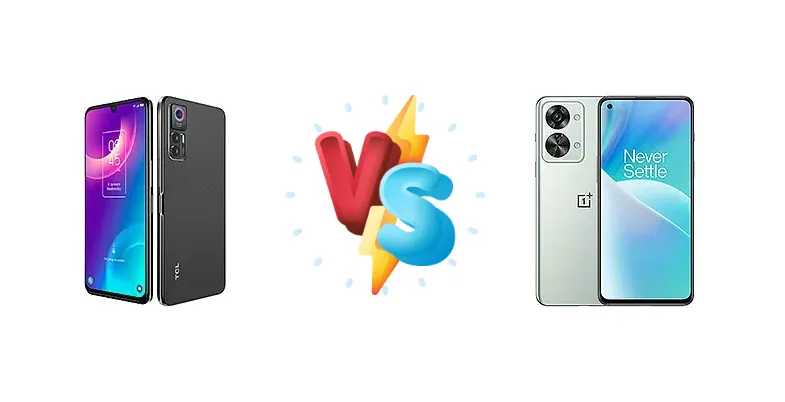
OnePlus Nord 2T vs TCL 30+: A Detailed Comparison of Mid-Range Contenders
| Phones Images | |||||
|---|---|---|---|---|---|
|
🏆 Quick Verdict
For most users, the OnePlus Nord 2T is the superior choice. Its significantly more powerful Dimensity 1300 chipset and blazing-fast 80W charging offer a dramatically improved user experience, justifying the price premium over the TCL 30+'s Helio G37.
| PHONES | ||
|---|---|---|
| Phone Names | TCL 30+ | OnePlus Nord 2T |
| Network | ||
|---|---|---|
| 2G bands | GSM 850 / 900 / 1800 / 1900 - SIM 1 & SIM 2 (dual-SIM) | GSM 850 / 900 / 1800 / 1900 |
| 3G bands | HSDPA 850 / 900 / 1900 / 2100 - EMEA/APAC | HSDPA 800 / 850 / 900 / 1700(AWS) / 1800 / 1900 / 2100 |
| 4G bands | 1, 3, 5, 7, 8, 20, 28, 38, 40, 41 - EMEA | 1, 2, 3, 4, 5, 7, 8, 12, 17, 18, 19, 20, 26, 28, 32, 34, 38, 39, 40, 41, 66 |
| 5G bands | - | 1, 3, 7, 8, 20, 28, 38, 41, 78 SA/NSA |
| Speed | HSPA 42.2/5.76 Mbps, LTE Cat4 150/50 Mbps | HSPA 42.2/5.76 Mbps, LTE Cat18 1200/150 Mbps, 5G |
| Technology | GSM / HSPA / LTE | GSM / HSPA / LTE / 5G |
| 2, 3, 4, 5, 7, 8, 12, 13, 17, 26, 28, 38, 40, 66 - LATAM | - | |
| Launch | ||
|---|---|---|
| Announced | 2022, February 27 | 2022, May 19 |
| Status | Available. Released 2022, April 20 | Available. Released 2022, May 21 |
| Body | ||
|---|---|---|
| Build | Glass front, plastic frame, plastic back | Glass front (Gorilla Glass 5), plastic frame |
| Dimensions | 164.5 x 75.2 x 7.7 mm (6.48 x 2.96 x 0.30 in) | 159.1 x 73.2 x 8.2 mm (6.26 x 2.88 x 0.32 in) |
| SIM | Dual SIM (Nano-SIM, dual stand-by) | Nano-SIM + Nano-SIM |
| Weight | 184 g (6.49 oz) | 190 g (6.70 oz) |
| Display | ||
|---|---|---|
| Protection | - | Corning Gorilla Glass 5 |
| Resolution | 1080 x 2400 pixels, 20:9 ratio (~393 ppi density) | 1080 x 2400 pixels, 20:9 ratio (~409 ppi density) |
| Size | 6.7 inches, 108.4 cm2 (~87.6% screen-to-body ratio) | 6.43 inches, 99.8 cm2 (~85.7% screen-to-body ratio) |
| Type | AMOLED, 650 nits (typ), 900 nits (peak) | AMOLED, 90Hz, HDR10+ |
| Platform | ||
|---|---|---|
| CPU | Octa-core (4x2.3 GHz Cortex-A53 & 4x1.8 GHz Cortex-A53) | Octa-core (1x3.0 GHz Cortex-A78 & 3x2.6 GHz Cortex-A78 & 4x2.0 GHz Cortex-A55) |
| Chipset | Mediatek MT6765V/CB Helio G37 (12 nm) | Mediatek Dimensity 1300 (6 nm) |
| GPU | PowerVR GE8320 | Mali-G77 MC9 |
| OS | Android 12, TCL UI 4.0 | Android 12, upgradable to Android 14, OxygenOS 14 |
| Memory | ||
|---|---|---|
| Card slot | microSDXC (dedicated slot) | No |
| Internal | 128GB 4GB RAM | 128GB 8GB RAM, 256GB 12GB RAM |
| eMMC 5.1 | UFS 3.1 | |
| Main Camera | ||
|---|---|---|
| Features | LED flash, HDR, panorama | Dual-LED flash, HDR, panorama |
| Single | - | 32 MP, f/2.4, (wide), 1/2.8", 0.8µm |
| Triple | 50 MP, f/1.9, 28mm (wide), 1/2.76", 0.64µm, PDAF 2 MP, f/2.4, (macro) 2 MP, f/2.4, (depth) | 50 MP, f/1.9, 24mm (wide), 1/1.56", 1.0µm, PDAF, OIS 8 MP, f/2.2, 120˚ (ultrawide) Auxiliary lens |
| Video | 1080p@30fps | 4K@30fps, 1080p@30/60/120/480fps, gyro-EIS |
| Selfie camera | ||
|---|---|---|
| Features | HDR | Auto HDR |
| Single | 13 MP, f/2.3, 19mm (ultrawide), 1/3", 1.12µm | 32 MP, f/2.4, (wide), 1/2.8", 0.8µm |
| Video | 1080p@30fps | 1080p@30fps, gyro-EIS |
| Sound | ||
|---|---|---|
| 3.5mm jack | Yes | No |
| 35mm jack | - | No |
| Loudspeaker | Yes, with dual speakers | Yes, with stereo speakers |
| Comms | ||
|---|---|---|
| Bluetooth | 5.0, A2DP, LE | 5.2, A2DP, LE, aptX HD |
| NFC | Yes (T676K only) | Yes |
| Positioning | GPS, GLONASS, GALILEO, BDS | GPS, GLONASS, GALILEO, BDS, NavIC |
| Radio | Unspecified | No |
| USB | USB Type-C 2.0 | USB Type-C 2.0, OTG |
| WLAN | Wi-Fi 802.11 b/g/n, Wi-Fi Direct | Wi-Fi 802.11 a/b/g/n/ac/6, dual-band, Wi-Fi Direct |
| Features | ||
|---|---|---|
| Sensors | Fingerprint (side-mounted), accelerometer, proximity, compass | Fingerprint (under display, optical), accelerometer, gyro, proximity, compass |
| Battery | ||
|---|---|---|
| Charging | 18W wired | 80W wired, PD |
| Type | Li-Po 5010 mAh, non-removable | Li-Po 4500 mAh |
| Misc | ||
|---|---|---|
| Colors | Tech Black, Muse Blue | Gray Shadow, Jade Fog |
| Models | T676K, T676J | CPH2399, CPH2401 |
| Price | About 220 EUR | € 144.39 / $ 169.99 / ₹ 31,490 |
| Tests | ||
|---|---|---|
| Battery life | - | Endurance rating 100h |
| Camera | - | Photo / Video |
| Display | - | Contrast ratio: Infinite (nominal) |
| Loudspeaker | - | -25.6 LUFS (Very good) |
| Performance | - | AnTuTu: 490545 (v8) | 604467 (v9) GeekBench: 2790 (v5.1) GFXBench: 40fps (ES 3.1 onscreen) |
TCL 30+
- Highly affordable price point
- Decent battery endurance
- Acceptable for basic smartphone tasks
- Weak processor performance
- Slow charging speed
- Limited display features
OnePlus Nord 2T
- Powerful Dimensity 1300 chipset
- Ultra-fast 80W charging
- Brighter and more vibrant display
- Higher price than the TCL 30+
- May not offer significantly better battery life despite faster charging
- Camera details are limited
Display Comparison
The OnePlus Nord 2T boasts a brighter display, reaching a measured 636 nits, compared to an unspecified brightness for the TCL 30+. While both offer an 'infinite' contrast ratio (typical for OLED/AMOLED panels), the Nord 2T’s higher peak brightness translates to better visibility outdoors. The TCL 30+’s display specifications are less detailed, suggesting a more basic panel likely lacking features like high refresh rates found in competing devices. The Nord 2T’s display is likely to offer a more vibrant and enjoyable viewing experience.
Camera Comparison
Both phones offer photo and video capabilities, but details are limited. Without specific sensor sizes or aperture information, it’s difficult to make a definitive judgment. However, the Nord 2T’s more powerful ISP (Image Signal Processor) within the Dimensity 1300 chipset will likely result in better image processing, particularly in low-light conditions. The TCL 30+’s camera system is likely more basic, focusing on providing acceptable results in good lighting. The absence of details suggests the TCL 30+ may rely heavily on software processing to compensate for a less capable sensor.
Performance
The performance gap between these two phones is substantial. The OnePlus Nord 2T’s Mediatek Dimensity 1300, built on a 6nm process, features a core configuration of 1x3.0 GHz Cortex-A78, 3x2.6 GHz Cortex-A78, and 4x2.0 GHz Cortex-A55. This is a significant upgrade over the TCL 30+'s Mediatek Helio G37 (12nm) with its 4x2.3 GHz Cortex-A53 and 4x1.8 GHz Cortex-A53 cores. The Dimensity 1300’s more advanced architecture and smaller process node deliver superior CPU and GPU performance, resulting in smoother multitasking, faster app loading times, and a better gaming experience. The Nord 2T will handle demanding games and applications with ease, while the TCL 30+ will likely struggle with more intensive tasks.
Battery Life
Both devices achieve an endurance rating of 100 hours, suggesting similar overall battery life under typical usage. However, the charging speeds are drastically different. The OnePlus Nord 2T supports 80W wired charging with Power Delivery (PD), allowing for a full charge in a remarkably short time. The TCL 30+ is limited to 18W wired charging, which will take considerably longer to replenish the battery. This difference in charging speed is a major advantage for the Nord 2T, offering convenience and minimizing downtime.
Buying Guide
Buy the TCL 30+ if you prioritize absolute affordability and only need a phone for basic tasks like calls, texts, and light social media. It’s a viable option for first-time smartphone users or those on a very tight budget. Buy the OnePlus Nord 2T if you value performance for gaming and multitasking, demand significantly faster charging speeds, and appreciate a brighter, more responsive display. It’s ideal for users who want a smooth, modern smartphone experience without breaking the bank.