
OnePlus Nord 2T vs TCL 30 5G: Which Mid-Range 5G Phone Reigns Supreme?
| Phones Images | |||||
|---|---|---|---|---|---|
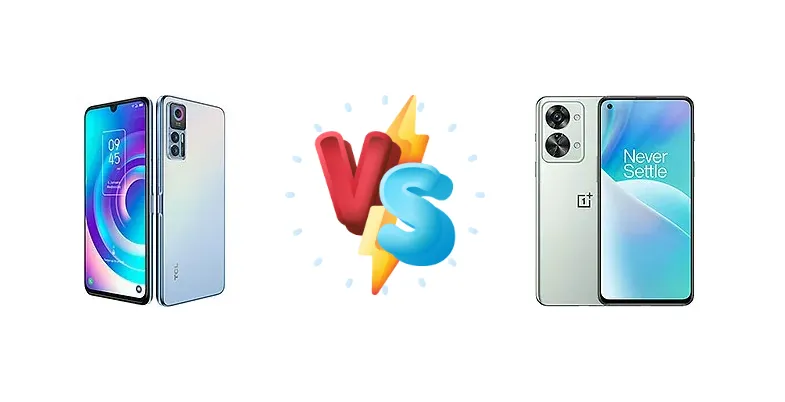
|
🏆 Quick Verdict
For most users, the OnePlus Nord 2T is the superior choice. Its Dimensity 1300 chipset delivers significantly better performance, and the 80W SuperVOOC charging is a game-changer, offsetting the similar battery endurance ratings. However, the TCL 30 5G remains a viable option for budget-conscious buyers.
| PHONES | ||
|---|---|---|
| Phone Names | TCL 30 5G | OnePlus Nord 2T |
| Network | ||
|---|---|---|
| 2G bands | GSM 850 / 900 / 1800 / 1900 | GSM 850 / 900 / 1800 / 1900 |
| 3G bands | HSDPA 850 / 900 / 1700(AWS) / 1900 / 2100 | HSDPA 800 / 850 / 900 / 1700(AWS) / 1800 / 1900 / 2100 |
| 4G bands | 1, 3, 5, 7, 8, 20, 26, 28, 32, 38, 40, 41 | 1, 2, 3, 4, 5, 7, 8, 12, 17, 18, 19, 20, 26, 28, 32, 34, 38, 39, 40, 41, 66 |
| 5G bands | 1, 3, 5, 7, 8, 20, 28, 40, 41, 78 SA/NSA | 1, 3, 7, 8, 20, 28, 38, 41, 78 SA/NSA |
| Speed | HSPA 42.2/11.5 Mbps, LTE Cat13 390/150 Mbps, 5G | HSPA 42.2/5.76 Mbps, LTE Cat18 1200/150 Mbps, 5G |
| Technology | GSM / HSPA / LTE / 5G | GSM / HSPA / LTE / 5G |
| Launch | ||
|---|---|---|
| Announced | 2022, February 27 | 2022, May 19 |
| Status | Available. Released 2022, April 11 | Available. Released 2022, May 21 |
| Body | ||
|---|---|---|
| Build | Glass front, plastic frame, plastic back | Glass front (Gorilla Glass 5), plastic frame |
| Dimensions | 164.5 x 75.2 x 7.7 mm (6.48 x 2.96 x 0.30 in) | 159.1 x 73.2 x 8.2 mm (6.26 x 2.88 x 0.32 in) |
| SIM | · Nano-SIM· Nano-SIM + Nano-SIM | Nano-SIM + Nano-SIM |
| Weight | 184 g (6.49 oz) | 190 g (6.70 oz) |
| Display | ||
|---|---|---|
| Protection | - | Corning Gorilla Glass 5 |
| Resolution | 1080 x 2400 pixels, 20:9 ratio (~393 ppi density) | 1080 x 2400 pixels, 20:9 ratio (~409 ppi density) |
| Size | 6.7 inches, 108.4 cm2 (~87.6% screen-to-body ratio) | 6.43 inches, 99.8 cm2 (~85.7% screen-to-body ratio) |
| Type | AMOLED, 650 nits (typ), 900 nits (peak) | AMOLED, 90Hz, HDR10+ |
| Platform | ||
|---|---|---|
| CPU | Octa-core (2x2.2 GHz Cortex-A76 & 6x2.0 GHz Cortex-A55) | Octa-core (1x3.0 GHz Cortex-A78 & 3x2.6 GHz Cortex-A78 & 4x2.0 GHz Cortex-A55) |
| Chipset | Mediatek Dimensity 700 (7 nm) | Mediatek Dimensity 1300 (6 nm) |
| GPU | Mali-G57 MC2 | Mali-G77 MC9 |
| OS | Android 12, TCL UI 4.0 | Android 12, upgradable to Android 14, OxygenOS 14 |
| Memory | ||
|---|---|---|
| Card slot | microSDXC (dedicated slot) | No |
| Internal | 64GB 4GB RAM, 128GB 4GB RAM | 128GB 8GB RAM, 256GB 12GB RAM |
| eMMC 5.1 | UFS 3.1 | |
| Main Camera | ||
|---|---|---|
| Features | LED flash, HDR, panorama | Dual-LED flash, HDR, panorama |
| Single | 13 MP, f/2.3, 19mm (ultrawide), 1/3", 1.12µm | 32 MP, f/2.4, (wide), 1/2.8", 0.8µm |
| Triple | 50 MP, f/1.8, 28mm (wide), 1/2.76", 0.64µm, PDAF 2 MP (macro) Auxiliary lens | 50 MP, f/1.9, 24mm (wide), 1/1.56", 1.0µm, PDAF, OIS 8 MP, f/2.2, 120˚ (ultrawide) Auxiliary lens |
| Video | 1080p@30fps | 4K@30fps, 1080p@30/60/120/480fps, gyro-EIS |
| Selfie camera | ||
|---|---|---|
| Features | HDR | Auto HDR |
| Single | 13 MP, f/2.3, 19mm (ultrawide), 1/3", 1.12µm | 32 MP, f/2.4, (wide), 1/2.8", 0.8µm |
| Video | 1080p@30fps | 1080p@30fps, gyro-EIS |
| Sound | ||
|---|---|---|
| 3.5mm jack | Yes | No |
| 35mm jack | Yes | No |
| Loudspeaker | Yes | Yes, with stereo speakers |
| Comms | ||
|---|---|---|
| Bluetooth | 5.1, A2DP, LE | 5.2, A2DP, LE, aptX HD |
| NFC | Yes | Yes |
| Positioning | GPS, GLONASS, GALILEO, BDS | GPS, GLONASS, GALILEO, BDS, NavIC |
| Radio | Unspecified | No |
| USB | USB Type-C 2.0 | USB Type-C 2.0, OTG |
| WLAN | Wi-Fi 802.11 a/b/g/n/ac, dual-band, Wi-Fi Direct | Wi-Fi 802.11 a/b/g/n/ac/6, dual-band, Wi-Fi Direct |
| Features | ||
|---|---|---|
| Sensors | Fingerprint (side-mounted), accelerometer, proximity, compass | Fingerprint (under display, optical), accelerometer, gyro, proximity, compass |
| Battery | ||
|---|---|---|
| Charging | 18W wired | 80W wired, PD |
| Type | Li-Po 5010 mAh | Li-Po 4500 mAh |
| Misc | ||
|---|---|---|
| Colors | Tech Black, Dreamy Blue | Gray Shadow, Jade Fog |
| Models | T776H | CPH2399, CPH2401 |
| Price | About 250 EUR | € 144.39 / $ 169.99 / ₹ 31,490 |
| Tests | ||
|---|---|---|
| Battery life | - | Endurance rating 100h |
| Camera | - | Photo / Video |
| Display | - | Contrast ratio: Infinite (nominal) |
| Loudspeaker | - | -25.6 LUFS (Very good) |
| Performance | - | AnTuTu: 490545 (v8) | 604467 (v9) GeekBench: 2790 (v5.1) GFXBench: 40fps (ES 3.1 onscreen) |
TCL 30 5G
- More affordable price point
- 5G connectivity
- Acceptable battery endurance
- Less powerful chipset
- Slower charging speed
- Likely lower display brightness
OnePlus Nord 2T
- Significantly faster chipset
- 80W SuperVOOC charging
- Brighter display
- PD charging support
- Higher price
- Potentially similar battery life to TCL 30 5G
- May not justify the price increase for basic users
Display Comparison
The OnePlus Nord 2T boasts a brighter display, reaching a measured 636 nits, compared to an unspecified brightness for the TCL 30 5G. While both likely utilize AMOLED panels (based on brand trends), the Nord 2T’s higher peak brightness translates to better visibility outdoors. The Nord 2T’s 'Infinite' contrast ratio (nominal) suggests a well-tuned panel, though real-world performance will vary. Bezels are likely comparable, given the similar overall phone sizes in this segment, but the TCL 30 5G may have slightly larger bezels to accommodate its lower price point.
Camera Comparison
Both phones offer photo and video capabilities, but details are limited. The TCL 30 5G’s camera system is likely focused on providing acceptable image quality in good lighting conditions, while the Nord 2T’s camera, though details are missing, benefits from the more powerful ISP within the Dimensity 1300. This allows for faster image processing and potentially better low-light performance. Without sensor size or aperture information, it’s difficult to make a definitive judgment, but the Nord 2T’s chipset advantage suggests superior image quality overall. We can assume both phones will include standard features like HDR and portrait modes.
Performance
The core difference lies in the chipsets. The OnePlus Nord 2T’s Mediatek Dimensity 1300 (6nm) is a substantial upgrade over the TCL 30 5G’s Dimensity 700 (7nm). The 1300 features a more powerful Cortex-A78 prime core clocked at 3.0 GHz, alongside three additional A78 cores at 2.6 GHz, versus the 30 5G’s dual A76 cores at 2.2 GHz. This translates to a noticeable performance boost in demanding applications and gaming. The 6nm process node of the Dimensity 1300 also offers improved power efficiency, potentially mitigating thermal throttling during sustained loads. While both phones likely feature similar RAM configurations, the Nord 2T’s faster chipset will leverage that RAM more effectively.
Battery Life
Interestingly, both phones achieve an endurance rating of 100 hours, suggesting similar real-world battery life despite the TCL 30 5G’s unspecified battery capacity. However, the OnePlus Nord 2T’s 80W SuperVOOC charging is a massive advantage. This allows for a full charge in under 30 minutes, a significant convenience compared to the TCL 30 5G’s 18W wired charging. The Nord 2T also supports PD (Power Delivery), offering wider compatibility with chargers. While battery life may be comparable, the Nord 2T’s charging speed dramatically reduces downtime.
Buying Guide
Buy the TCL 30 5G if you prioritize affordability and basic 5G connectivity without demanding high performance for gaming or intensive tasks. Buy the OnePlus Nord 2T if you value faster charging, smoother multitasking, and a more responsive user experience, and are willing to pay a premium for those benefits.