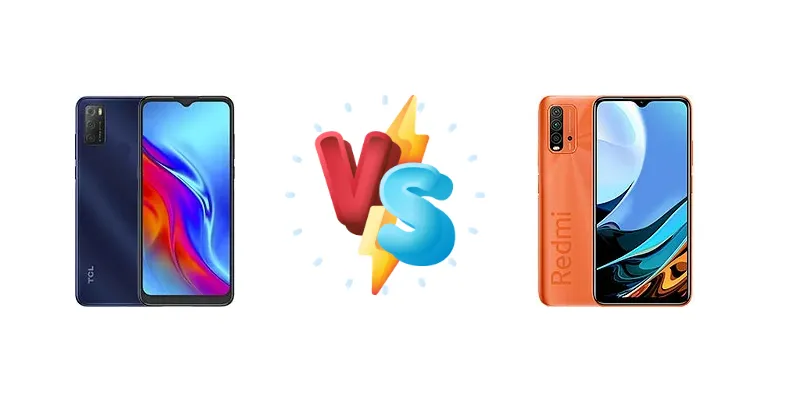
The TCL 20Y and Xiaomi Redmi 9T represent compelling options in the ultra-budget smartphone space. Both aim to deliver essential features at a low price point, but they take different approaches. The TCL 20Y relies on a Mediatek Helio P22 chipset, while the Redmi 9T opts for Qualcomm’s Snapdragon 662. This comparison dives deep into the specifics to determine which device offers the best value.
🏆 Quick Verdict
For most users, the Xiaomi Redmi 9T is the superior choice. Its Snapdragon 662 chipset provides a noticeable performance boost over the TCL 20Y’s Helio P22, and the 18W charging significantly reduces downtime. While both offer similar battery endurance ratings, the Redmi 9T’s faster charging is a key advantage.
| Network |
|---|
| 2G bands | GSM 850 / 900 / 1800 / 1900 | GSM 850 / 900 / 1800 / 1900 |
| 3G bands | HSDPA 850 / 900 / 1900 / 2100 | HSDPA 850 / 900 / 1700(AWS) / 1900 / 2100 |
| 4G bands | 1, 3, 7, 8, 20, 28 | 1, 2, 3, 4, 5, 7, 8, 20, 28, 38, 40, 41 |
| Speed | HSPA, LTE | HSPA, LTE |
| Technology | GSM / HSPA / LTE | GSM / HSPA / LTE |
| Launch |
|---|
| Announced | 2021, September 07 | 2021, January 08 |
| Status | Available. Released 2021, September 07 | Available. Released 2021, January 18 |
| Body |
|---|
| Build | Glass front, plastic frame, plastic back | Glass front (Gorilla Glass 3), plastic frame, plastic back |
| Dimensions | 165.6 x 75.6 x 8.8 mm (6.52 x 2.98 x 0.35 in) | 162.3 x 77.3 x 9.6 mm (6.39 x 3.04 x 0.38 in) |
| SIM | Nano-SIM + Nano-SIM | Nano-SIM + Nano-SIM |
| Weight | 194 g (6.84 oz) | 198 g (6.98 oz) |
| | - | Water-repellent coating |
| Display |
|---|
| Protection | - | Corning Gorilla Glass 3 |
| Resolution | 720 x 1600 pixels, 20:9 ratio (~269 ppi density) | 1080 x 2340 pixels, 19.5:9 ratio (~395 ppi density) |
| Size | 6.52 inches, 102.6 cm2 (~82.0% screen-to-body ratio) | 6.53 inches, 104.7 cm2 (~83.4% screen-to-body ratio) |
| Type | IPS LCD | IPS LCD, 400 nits (typ) |
| Platform |
|---|
| CPU | Octa-core (4x1.8 GHz Cortex-A53 & 4x1.5 GHz Cortex-A53) | Octa-core (4x2.0 GHz Kryo 260 Gold & 4x1.8 GHz Kryo 260 Silver) |
| Chipset | Mediatek MT6762D Helio P22 (12 nm) | Qualcomm SM6115 Snapdragon 662 (11 nm) |
| GPU | PowerVR GE8320 | Adreno 610 |
| OS | Android 11, TCL UI | Android 10, MIUI 12 |
| Memory |
|---|
| Card slot | microSDXC (uses shared SIM slot) | microSDXC (dedicated slot) |
| Internal | 64GB 4GB RAM | 64GB 4GB RAM, 128GB 4GB RAM, 128GB 6GB RAM |
| | - | UFS 2.1 - 64GB
UFS 2.2 - 128GB |
| Main Camera |
|---|
| Features | LED flash, HDR, panorama | LED flash, HDR, panorama |
| Quad | - | 48 MP, f/1.8, 26mm (wide), 1/2.0", 0.8µm, PDAF
8 MP, f/2.2, 120˚ (ultrawide), 1/4.0", 1.12µm
2 MP (macro)
Auxiliary lens |
| Triple | 48 MP, f/1.8, 26mm (wide) 1/2.0", 0.8µm, PDAF
2 MP (macro)
Auxiliary lens | - |
| Video | 1080p@30fps | 1080p@30fps |
| Selfie camera |
|---|
| Single | 8 MP, f/2.0, 26mm (wide) 1/4.0", 1.12µm | 8 MP, f/2.1, 27mm (wide), 1/4.0", 1.12µm |
| Video | 1080p@30fps | 1080p@30fps |
| Sound |
|---|
| 3.5mm jack | - | Yes |
| 35mm jack | Yes | Yes |
| Loudspeaker | Yes | Yes, with stereo speakers |
| | - | 24-bit/192kHz audio |
| Comms |
|---|
| Bluetooth | 5.0, A2DP, LE | 5.0, A2DP, LE |
| Infrared port | - | Yes |
| NFC | Yes | Yes (market/region dependent) |
| Positioning | GPS, GLONASS, GALILEO, BDS | GPS, GLONASS, GALILEO, BDS |
| Radio | Unspecified | FM radio |
| USB | microUSB 2.0, OTG | USB Type-C 2.0, OTG |
| WLAN | Wi-Fi 802.11 b/g/n | Wi-Fi 802.11 a/b/g/n/ac, dual-band, Wi-Fi Direct |
| Features |
|---|
| Sensors | Fingerprint (rear-mounted), accelerometer, proximity, compass | Fingerprint (side-mounted), accelerometer, proximity, compass |
| Battery |
|---|
| Charging | 10W wired | 18W wired
2.5W reverse wired |
| Type | Li-Po 4000 mAh | Li-Po 6000 mAh |
| Misc |
|---|
| Colors | Black, Blue | Carbon Gray, Twilight Blue, Sunrise Orange, Ocean Green |
| Models | 6156D | J19S, M2010J19SG, M2010J19SY |
| Price | About 130 EUR | € 87.56 |
| SAR | - | 1.09 W/kg (head) 1.00 W/kg (body) |
| SAR EU | - | 0.60 W/kg (head) 0.81 W/kg (body) |
| Pricing |
|---|
| 128GB 6GB RAM | - | Rp 2,272,000 |
| 64GB 4GB RAM | - | $ 168.78 |
| Tests |
|---|
| Battery life | - |
Endurance rating 150h
|
| Camera | - |
Photo / Video |
| Display | - |
Contrast ratio: 1594:1 |
| Loudspeaker | - |
-25.6 LUFS (Very good)
|
| Performance | - |
AnTuTu: 177917 (v8)
GeekBench: 1400 (v5.1)
GFXBench: 5.8fps (ES 3.1 onscreen) |
TCL 20Y
- Potentially lower upfront cost
- Acceptable battery life for basic use
- Functional for essential smartphone tasks
- Significantly slower performance
- Slower charging speeds
- Likely inferior display quality
Xiaomi Redmi 9T
- Faster and more responsive performance
- 18W fast charging for reduced downtime
- Brighter and potentially more accurate display
- Reverse wired charging capability
- Slightly higher price point
- May not be significantly better for extremely light usage
Display Comparison
The Xiaomi Redmi 9T boasts a measured peak brightness of 437 nits and a 1594:1 contrast ratio, offering a more visually engaging experience than the TCL 20Y, for which display specifications are not provided. While both share the same contrast ratio, the Redmi 9T’s higher brightness will be particularly beneficial in outdoor environments. Without detailed specs on the TCL 20Y’s panel, it’s difficult to assess color accuracy or viewing angles, but it’s reasonable to assume the Redmi 9T offers a superior display experience.
Camera Comparison
Both devices are listed as having Photo/Video capabilities, but detailed camera specifications are absent. Given the market positioning, it’s likely both feature basic camera setups. However, the Redmi 9T’s price point suggests a potentially more capable main sensor. Without specific megapixel counts or aperture information, it’s difficult to make a definitive judgment, but the Redmi 9T is likely to offer better image quality due to its more powerful image signal processor (ISP) integrated within the Snapdragon 662.
Performance
The core difference lies in the chipsets. The Xiaomi Redmi 9T’s Qualcomm Snapdragon 662 (11nm) is architecturally more advanced than the TCL 20Y’s Mediatek Helio P22 (12nm). The Snapdragon 662 utilizes a combination of 2.0 GHz Kryo 260 Gold and 1.8 GHz Kryo 260 Silver cores, offering a performance advantage over the Helio P22’s 1.8 GHz and 1.5 GHz Cortex-A53 cores. This translates to snappier app launches, smoother multitasking, and a more enjoyable gaming experience on the Redmi 9T. The 11nm process node of the Snapdragon 662 also contributes to better power efficiency, potentially offsetting the TCL 20Y’s slightly lower power draw from its less powerful chipset.
Battery Life
Both the TCL 20Y and Xiaomi Redmi 9T achieve an endurance rating of 150 hours, indicating comparable battery life under similar usage conditions. However, the Redmi 9T’s 18W wired charging capability is a significant advantage over the TCL 20Y’s 10W charging. This means the Redmi 9T can be charged from 0-100% much faster, minimizing downtime. The Redmi 9T also includes 2.5W reverse wired charging, a feature absent on the TCL 20Y, allowing it to top up other devices, albeit slowly.
Buying Guide
Buy the TCL 20Y if your primary need is a basic, functional smartphone for essential tasks like calls, texts, and light social media use, and you prioritize minimizing upfront cost. Buy the Xiaomi Redmi 9T if you want a smoother, more responsive experience for everyday tasks, enjoy occasional gaming, and value faster charging speeds for less interruption.
Frequently Asked Questions
❓ Is the Snapdragon 662 in the Redmi 9T capable of handling modern mobile games?
The Snapdragon 662 is capable of running many popular mobile games at medium settings. While it won't deliver flagship-level performance, it provides a significantly smoother gaming experience than the Helio P22 in the TCL 20Y, especially for titles like PUBG Mobile and Call of Duty: Mobile.
❓ How long does it realistically take to fully charge the Xiaomi Redmi 9T with the 18W charger?
Using the included 18W charger, the Xiaomi Redmi 9T can typically charge from 0% to 100% in approximately 2 hours and 30 minutes to 3 hours, depending on usage during charging. This is considerably faster than the TCL 20Y’s 10W charging, which would likely take over 4 hours.
❓ Does the TCL 20Y support software updates, and for how long?
TCL's software update policy for the 20Y is limited. Expect only essential security patches, and likely no major Android version upgrades beyond its initial release. Xiaomi generally offers more consistent software support for its Redmi series, though the 9T is nearing the end of its major update cycle.
❓ What type of USB port do both phones use?
Both the TCL 20Y and Xiaomi Redmi 9T utilize a USB-C port for charging and data transfer. This is a welcome feature at this price point, offering convenience and compatibility with a wide range of accessories.