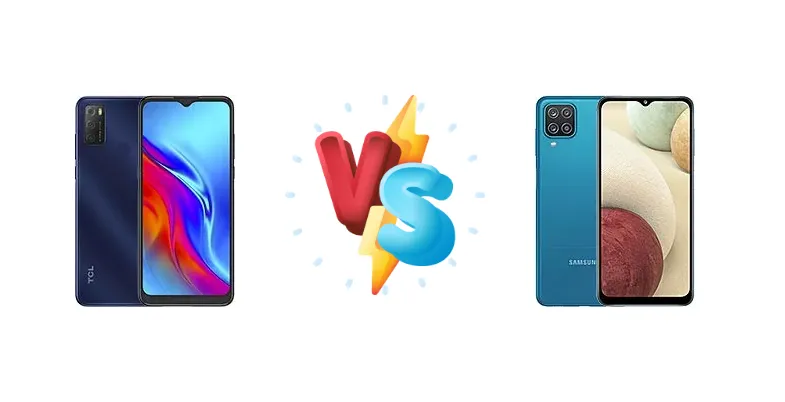
The sub-₹15,000 (approximately $180 USD) smartphone market in India is fiercely competitive. The Samsung Galaxy A12 and TCL 20Y both aim to deliver essential smartphone functionality at an accessible price point, but they take different approaches to achieving this. This comparison dives deep into their core specifications to determine which device offers the best value for your money.
🏆 Quick Verdict
For the average user prioritizing smoother multitasking and a slightly faster overall experience, the Samsung Galaxy A12 (India) is the better choice. Its Exynos 850 chipset, built on an 8nm process, provides a noticeable performance advantage over the TCL 20Y’s Helio P22, despite the TCL’s lower price.
| Network |
|---|
| 2G bands | GSM 850 / 900 / 1800 / 1900 | GSM 850 / 900 / 1800 / 1900 |
| 3G bands | HSDPA 850 / 900 / 1900 / 2100 | HSDPA 850 / 900 / 2100 |
| 4G bands | 1, 3, 7, 8, 20, 28 | 1, 3, 5, 7, 8, 20, 28, 38, 40, 41 |
| Speed | HSPA, LTE | HSPA 42.2/5.76 Mbps, LTE Cat4 150/50 Mbps |
| Technology | GSM / HSPA / LTE | GSM / HSPA / LTE |
| Launch |
|---|
| Announced | 2021, September 07 | 2021, August 12 |
| Status | Available. Released 2021, September 07 | Available. Released 2021, August 12 |
| Body |
|---|
| Build | Glass front, plastic frame, plastic back | Glass front, plastic back, plastic frame |
| Dimensions | 165.6 x 75.6 x 8.8 mm (6.52 x 2.98 x 0.35 in) | 164 x 75.8 x 8.9 mm (6.46 x 2.98 x 0.35 in) |
| SIM | Nano-SIM + Nano-SIM | · Nano-SIM· Nano-SIM + Nano-SIM |
| Weight | 194 g (6.84 oz) | 205 g (7.23 oz) |
| Display |
|---|
| Resolution | 720 x 1600 pixels, 20:9 ratio (~269 ppi density) | 720 x 1600 pixels, 20:9 ratio (~270 ppi density) |
| Size | 6.52 inches, 102.6 cm2 (~82.0% screen-to-body ratio) | 6.5 inches, 102.0 cm2 (~82.1% screen-to-body ratio) |
| Type | IPS LCD | PLS LCD |
| Platform |
|---|
| CPU | Octa-core (4x1.8 GHz Cortex-A53 & 4x1.5 GHz Cortex-A53) | Octa-core (4x2.0 GHz Cortex-A55 & 4x2.0 GHz Cortex-A55) |
| Chipset | Mediatek MT6762D Helio P22 (12 nm) | Exynos 850 (8 nm) |
| GPU | PowerVR GE8320 | Mali-G52 |
| OS | Android 11, TCL UI | Android 11, upgradable to Android 13, One UI 5.1 |
| Memory |
|---|
| Card slot | microSDXC (uses shared SIM slot) | microSDXC (dedicated slot) |
| Internal | 64GB 4GB RAM | 64GB 4GB RAM, 128GB 4GB RAM, 128GB 6GB RAM |
| | - | eMMC 5.1 |
| Main Camera |
|---|
| Features | LED flash, HDR, panorama | LED flash, panorama, HDR |
| Quad | - | 48 MP, f/2.0, 26mm (wide), AF
5 MP, f/2.2, 123˚ (ultrawide)
2 MP (macro)
Auxiliary lens |
| Triple | 48 MP, f/1.8, 26mm (wide) 1/2.0", 0.8µm, PDAF
2 MP (macro)
Auxiliary lens | - |
| Video | 1080p@30fps | 1080p@30fps |
| Selfie camera |
|---|
| Single | 8 MP, f/2.0, 26mm (wide) 1/4.0", 1.12µm | 8 MP, f/2.2 |
| Video | 1080p@30fps | 1080p@30fps |
| Sound |
|---|
| 3.5mm jack | - | Yes |
| 35mm jack | Yes | Yes |
| Loudspeaker | Yes | Yes |
| Comms |
|---|
| Bluetooth | 5.0, A2DP, LE | 5.0, A2DP, LE |
| NFC | Yes | No |
| Positioning | GPS, GLONASS, GALILEO, BDS | GPS, GLONASS, GALILEO, BDS |
| Radio | Unspecified | FM radio, RDS, recording |
| USB | microUSB 2.0, OTG | USB Type-C 2.0 |
| WLAN | Wi-Fi 802.11 b/g/n | Wi-Fi 802.11 b/g/n, Wi-Fi Direct |
| Features |
|---|
| Sensors | Fingerprint (rear-mounted), accelerometer, proximity, compass | Fingerprint (side-mounted), accelerometer |
| | - | Virtual proximity sensing |
| Battery |
|---|
| Charging | 10W wired | 15W wired |
| Type | Li-Po 4000 mAh | Li-Po 5000 mAh |
| Misc |
|---|
| Colors | Black, Blue | Black, Blue, White |
| Models | 6156D | SM-A127F, SM-A127F/DS |
| Price | About 130 EUR | About 160 EUR |
| SAR | - | 0.79 W/kg (head) |
TCL 20Y
- Lower price point makes it very accessible.
- Functional for basic smartphone tasks.
- Likely to have a longer standby time due to less powerful processor.
- Significantly slower performance compared to the Galaxy A12.
- 10W charging is noticeably slower.
- Older chipset architecture limits future software updates.
Samsung Galaxy A12 (India)
- Faster and more responsive performance with the Exynos 850.
- 15W fast charging reduces charging time.
- More efficient chipset for potentially better battery life.
- Slightly higher price point.
- May not offer a dramatically better camera experience.
- Still a budget device with inherent limitations.
Display Comparison
Neither device boasts a particularly impressive display. Both likely utilize LCD panels, a common cost-saving measure in this segment. However, details like peak brightness and color gamut coverage are unavailable. The focus here is on processing power, not visual fidelity. Bezels are expected to be substantial on both, contributing to a larger overall footprint. The TCL 20Y's display is likely to be less color accurate than the Samsung, given the latter's brand reputation for display technology.
Camera Comparison
Camera performance is likely to be similar in real-world usage, as both phones target the budget segment. Details on sensor sizes and lens apertures are missing, but it’s safe to assume both feature basic camera setups. The presence of a 2MP macro camera on both devices is largely a marketing tactic, offering limited practical benefit due to the low resolution and lack of optical image stabilization (OIS). Image processing will likely favor Samsung’s more refined algorithms, potentially resulting in slightly more pleasing photos in challenging lighting conditions. Expect both to struggle with low-light photography.
Performance
The core difference lies in the chipsets. The Samsung Galaxy A12’s Exynos 850, fabricated on an 8nm process, represents a significant architectural leap over the TCL 20Y’s MediaTek Helio P22 (12nm). The Exynos 850 utilizes newer Cortex-A55 cores clocked at 2.0 GHz, compared to the Helio P22’s older Cortex-A53 cores (1.8 GHz and 1.5 GHz). This translates to faster app loading times, smoother multitasking, and a more responsive user interface on the Samsung. While both are octa-core CPUs, the Exynos 850’s efficiency gains from the 8nm node also mean better thermal management under sustained load. The TCL 20Y will likely exhibit more noticeable slowdowns during prolonged use.
Battery Life
Battery capacity is not specified for either device, but both will likely fall in the 4000-5000 mAh range, typical for this price bracket. The Samsung Galaxy A12 has a clear advantage in charging speed with 15W wired charging, compared to the TCL 20Y’s slower 10W charging. This means the A12 will reach a full charge significantly faster, reducing downtime. While a larger battery capacity on the TCL 20Y could offset the slower charging, the Exynos 850’s greater power efficiency may result in comparable real-world battery life despite a potentially smaller battery.
Buying Guide
Buy the TCL 20Y if you need a truly minimal smartphone for basic communication and light tasks, and your budget is extremely tight. It’s a functional device for those who prioritize cost above all else. Buy the Samsung Galaxy A12 (India) if you prefer a more responsive user experience, slightly better gaming capabilities, and faster charging, even if it means spending a bit more. It’s a more versatile device for everyday use.
Frequently Asked Questions
❓ Does the Exynos 850 in the Galaxy A12 overheat during prolonged gaming sessions?
While the Exynos 850 isn't a high-end gaming chip, its 8nm process and efficient core design minimize thermal throttling. You can expect playable frame rates in most popular mobile games for moderate durations, but demanding titles at maximum settings may cause some heat buildup and frame drops. It's significantly better in this regard than the Helio P22.
❓ Is the 2MP macro camera on either phone actually useful for taking detailed close-up photos?
Unfortunately, the 2MP macro cameras on both the TCL 20Y and Samsung Galaxy A12 are largely marketing features. The low resolution and lack of autofocus result in images that are often soft, noisy, and lack detail. They are unlikely to provide a significant improvement over standard close-up shots taken with the main camera.
❓ Can the Samsung Galaxy A12 (India) handle 90fps gameplay in PUBG Mobile?
The Exynos 850 can likely run PUBG Mobile, but achieving a consistent 90fps frame rate is unlikely, even with graphics settings lowered. The chipset is not powerful enough to sustain that frame rate reliably, especially during intense firefights. Expect a more stable experience at 60fps.
❓ How long will it take to fully charge the TCL 20Y with its 10W charger?
Given the 10W charging speed and a likely 4000-5000 mAh battery, expect a full charge to take approximately 3-4 hours. This is significantly slower than the Samsung Galaxy A12's 15W charging.