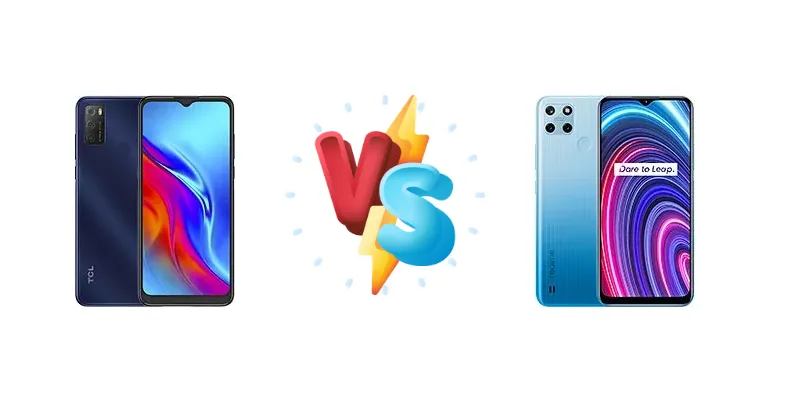
The TCL 20Y and Realme C25Y represent the fiercely competitive sub-$150 smartphone market. Both aim to deliver essential functionality at an accessible price, but they take different approaches to achieving this. The TCL 20Y relies on the established, if aging, MediaTek Helio P22, while the Realme C25Y opts for the newer Unisoc T610. This comparison dives deep into the architectural differences and real-world implications of these choices.
🏆 Quick Verdict
For the average user prioritizing responsiveness and faster charging, the Realme C25Y is the better choice. Its Unisoc T610 chipset, featuring Cortex-A75 cores, offers a noticeable performance uplift over the TCL 20Y’s Helio P22, and the 18W charging significantly reduces downtime compared to the TCL’s 10W.
| Network |
|---|
| 2G bands | GSM 850 / 900 / 1800 / 1900 | GSM 850 / 900 / 1800 / 1900 |
| 3G bands | HSDPA 850 / 900 / 1900 / 2100 | HSDPA 850 / 900 / 2100 |
| 4G bands | 1, 3, 7, 8, 20, 28 | 1, 3, 5, 8, 38, 40, 41 |
| Speed | HSPA, LTE | HSPA, LTE |
| Technology | GSM / HSPA / LTE | GSM / HSPA / LTE |
| Launch |
|---|
| Announced | 2021, September 07 | 2021, September 16 |
| Status | Available. Released 2021, September 07 | Available. Released 2021, September 30 |
| Body |
|---|
| Build | Glass front, plastic frame, plastic back | Glass front, plastic back, plastic frame |
| Dimensions | 165.6 x 75.6 x 8.8 mm (6.52 x 2.98 x 0.35 in) | 164.5 x 76 x 9.1 mm (6.48 x 2.99 x 0.36 in) |
| SIM | Nano-SIM + Nano-SIM | Nano-SIM + Nano-SIM |
| Weight | 194 g (6.84 oz) | 200 g (7.05 oz) |
| Display |
|---|
| Resolution | 720 x 1600 pixels, 20:9 ratio (~269 ppi density) | 720 x 1600 pixels, 20:9 ratio (~270 ppi density) |
| Size | 6.52 inches, 102.6 cm2 (~82.0% screen-to-body ratio) | 6.5 inches, 102.0 cm2 (~81.6% screen-to-body ratio) |
| Type | IPS LCD | IPS LCD, 420 nits (typ) |
| Platform |
|---|
| CPU | Octa-core (4x1.8 GHz Cortex-A53 & 4x1.5 GHz Cortex-A53) | Octa-core (2x1.8 GHz Cortex-A75 & 6x1.8 GHz Cortex-A55) |
| Chipset | Mediatek MT6762D Helio P22 (12 nm) | Unisoc T610 (12 nm) |
| GPU | PowerVR GE8320 | Mali-G52 MP2 |
| OS | Android 11, TCL UI | Android 11, Realme UI R |
| Memory |
|---|
| Card slot | microSDXC (uses shared SIM slot) | microSDXC (dedicated slot) |
| Internal | 64GB 4GB RAM | 64GB 4GB RAM, 128GB 4GB RAM, 128GB 6GB RAM |
| | - | eMMC 5.1 |
| Main Camera |
|---|
| Features | LED flash, HDR, panorama | LED flash, HDR, panorama |
| Single | - | 8 MP, f/2.0, 26mm (wide), 1/4.0", 1.12µm |
| Triple | 48 MP, f/1.8, 26mm (wide) 1/2.0", 0.8µm, PDAF
2 MP (macro)
Auxiliary lens | 50 MP, f/1.8, 26mm (wide), PDAF
2 MP (macro)
Auxiliary lens |
| Video | 1080p@30fps | 1080p@30fps |
| Selfie camera |
|---|
| Features | - | HDR |
| Single | 8 MP, f/2.0, 26mm (wide) 1/4.0", 1.12µm | 8 MP, f/2.0, 26mm (wide), 1/4.0", 1.12µm |
| Video | 1080p@30fps | 720p@30fps |
| Sound |
|---|
| 3.5mm jack | - | Yes |
| 35mm jack | Yes | Yes |
| Loudspeaker | Yes | Yes |
| Comms |
|---|
| Bluetooth | 5.0, A2DP, LE | 5.0, A2DP, LE |
| NFC | Yes | No |
| Positioning | GPS, GLONASS, GALILEO, BDS | GPS, GLONASS, BDS |
| Radio | Unspecified | Unspecified |
| USB | microUSB 2.0, OTG | microUSB 2.0 |
| WLAN | Wi-Fi 802.11 b/g/n | Wi-Fi 802.11 b/g/n |
| Features |
|---|
| Sensors | Fingerprint (rear-mounted), accelerometer, proximity, compass | Fingerprint (rear-mounted), accelerometer, proximity, compass |
| Battery |
|---|
| Charging | 10W wired | 18W wired |
| Type | Li-Po 4000 mAh | 5000 mAh |
| Misc |
|---|
| Colors | Black, Blue | Glacier Blue, Metal Gray |
| Models | 6156D | RMX3265, RMX3268, RMX3269 |
| Price | About 130 EUR | About 140 EUR |
TCL 20Y
- Potentially longer software support from TCL.
- Simple and reliable for basic tasks.
- Established brand reputation.
- Outdated Helio P22 chipset.
- Slow 10W charging.
- Less responsive user experience.
Realme C25Y
- More powerful Unisoc T610 chipset.
- Faster 18W charging.
- Improved multitasking performance.
- Unisoc chipset may have limited software support.
- Realme’s software can be heavily customized.
- Build quality may be slightly lower than TCL.
Display Comparison
Neither TCL nor Realme provide detailed display specifications beyond resolution. However, given the price point, both likely utilize IPS LCD panels. The focus here is on performance, not display fidelity. Bezels are expected to be substantial on both devices, and color accuracy will likely be standard for this segment. Without further data, a clear winner cannot be determined.
Camera Comparison
Both phones likely feature a multi-camera setup, but detailed sensor information is scarce. It’s safe to assume both will include a primary camera and potentially depth/macro sensors. Given the price bracket, image quality will be heavily reliant on software processing. Without specific sensor sizes or aperture details, a direct comparison is difficult. The presence of a 2MP macro lens on either device is largely a marketing tactic and offers limited practical benefit. The Realme C25Y may have a slight edge due to potentially more advanced image processing algorithms, but this is speculative.
Performance
The core difference lies in the chipsets. The TCL 20Y’s MediaTek Helio P22 utilizes eight Cortex-A53 cores, split into two clusters running at 1.8 GHz and 1.5 GHz. This is a relatively old architecture. The Realme C25Y’s Unisoc T610, also a 12nm chip, features a more modern configuration: two Cortex-A75 cores at 1.8 GHz and six Cortex-A55 cores at 1.8 GHz. The A75 cores represent a significant architectural improvement over the A53, offering better single-core performance and improved efficiency. This translates to snappier app launches and smoother multitasking on the Realme C25Y. While both have 3GB of RAM (assumed based on market segment), the Unisoc T610 will manage that memory more effectively.
Battery Life
Battery capacity is not specified, but both devices likely house around a 5000mAh battery, typical for this price range. However, the charging speeds differ significantly. The TCL 20Y is limited to 10W wired charging, meaning a full charge will take a considerable amount of time. The Realme C25Y supports 18W wired charging, which will substantially reduce charging times. This difference is crucial for users who rely heavily on their phones throughout the day and need quick top-ups.
Buying Guide
Buy the TCL 20Y if your primary need is a simple, reliable device for basic tasks like calls, texts, and light social media, and you prioritize a potentially longer software support lifecycle from a more established brand. Buy the Realme C25Y if you want a more responsive experience for multitasking, occasional gaming, and appreciate the convenience of faster charging, even if it means potentially shorter software support.
Frequently Asked Questions
❓ Will the Unisoc T610 in the Realme C25Y struggle with demanding games like PUBG Mobile?
While the Unisoc T610 isn't a gaming powerhouse, it's capable of running PUBG Mobile at medium settings with reasonable frame rates. Expect some occasional stuttering, especially in intense firefights. The TCL 20Y’s Helio P22 will likely offer a less smooth experience, even at lower settings.
❓ How much faster is the 18W charging on the Realme C25Y compared to the 10W charging on the TCL 20Y?
The 18W charging on the Realme C25Y will significantly reduce charging times. While exact 0-100% times depend on usage, expect the C25Y to charge roughly 40-50% faster than the TCL 20Y. This means less time tethered to a charger and more time using your phone.
❓ Does the Realme C25Y's software (Realme UI) have a lot of bloatware?
Realme UI is known for including pre-installed apps (bloatware). However, many of these can be uninstalled. While it's not a completely clean Android experience, the performance benefits of the T610 chipset generally outweigh the minor inconvenience of removing unwanted apps.