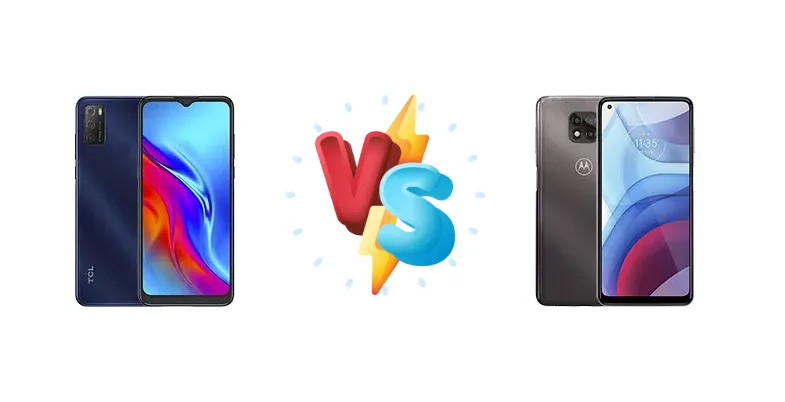
The TCL 20Y and Motorola Moto G Power (2021) represent two popular choices in the ultra-budget smartphone segment. While both aim to deliver essential functionality at a low price, they take different approaches to achieving this. The TCL 20Y relies on MediaTek’s Helio P22, while the Moto G Power opts for Qualcomm’s Snapdragon 662. This comparison dissects these key differences to determine which device offers the best overall experience.
🏆 Quick Verdict
For most users, the Motorola Moto G Power (2021) is the superior choice. Its Snapdragon 662 chipset provides a noticeable performance uplift over the TCL 20Y’s Helio P22, translating to smoother multitasking and a more responsive user experience. While the TCL 20Y is cheaper, the performance trade-off isn’t worth it for all but the most basic users.
| Network |
|---|
| 2G bands | GSM 850 / 900 / 1800 / 1900 | GSM 850 / 900 / 1800 / 1900 |
| 3G bands | HSDPA 850 / 900 / 1900 / 2100 | HSDPA 850 / 900 / 1700(AWS) / 1900 / 2100 |
| 4G bands | 1, 3, 7, 8, 20, 28 | 1, 2, 3, 4, 5, 7, 8, 12, 13, 14, 17, 25, 26, 29, 30, 38, 41, 66, 71 |
| Speed | HSPA, LTE | HSPA, LTE |
| Technology | GSM / HSPA / LTE | GSM / CDMA / HSPA / EVDO / LTE |
| | - | CDMA2000 1xEV-DO |
| Launch |
|---|
| Announced | 2021, September 07 | 2021, January 08 |
| Status | Available. Released 2021, September 07 | Available. Released 2021, January 14 |
| Body |
|---|
| Build | Glass front, plastic frame, plastic back | Glass front, plastic back, plastic frame |
| Dimensions | 165.6 x 75.6 x 8.8 mm (6.52 x 2.98 x 0.35 in) | 165.3 x 75.9 x 9.5 mm (6.51 x 2.99 x 0.37 in) |
| SIM | Nano-SIM + Nano-SIM | Nano-SIM |
| Weight | 194 g (6.84 oz) | 206.5 g (7.30 oz) |
| | - | Water-repellent coating |
| Display |
|---|
| Resolution | 720 x 1600 pixels, 20:9 ratio (~269 ppi density) | 720 x 1600 pixels, 20:9 ratio (~266 ppi density) |
| Size | 6.52 inches, 102.6 cm2 (~82.0% screen-to-body ratio) | 6.6 inches, 105.2 cm2 (~83.8% screen-to-body ratio) |
| Type | IPS LCD | IPS LCD |
| Platform |
|---|
| CPU | Octa-core (4x1.8 GHz Cortex-A53 & 4x1.5 GHz Cortex-A53) | Octa-core (4x2.0 GHz Kryo 260 Gold & 4x1.8 GHz Kryo 260 Silver) |
| Chipset | Mediatek MT6762D Helio P22 (12 nm) | Qualcomm SM6115 Snapdragon 662 (11 nm) |
| GPU | PowerVR GE8320 | Adreno 610 |
| OS | Android 11, TCL UI | Android 10 |
| Memory |
|---|
| Card slot | microSDXC (uses shared SIM slot) | microSDXC (dedicated slot) |
| Internal | 64GB 4GB RAM | 32GB 3GB RAM, 64GB 4GB RAM |
| | - | eMMC 5.1 |
| Main Camera |
|---|
| Features | LED flash, HDR, panorama | LED flash, HDR, panorama |
| Triple | 48 MP, f/1.8, 26mm (wide) 1/2.0", 0.8µm, PDAF
2 MP (macro)
Auxiliary lens | 48 MP, f/1.7, (wide), 1/2.0", 0.8µm, PDAF
2 MP (macro)
Auxiliary lens |
| Video | 1080p@30fps | 1080p@30/60fps, gyro-EIS |
| Selfie camera |
|---|
| Features | - | HDR |
| Single | 8 MP, f/2.0, 26mm (wide) 1/4.0", 1.12µm | 8 MP, f/2.0, 1.12µm |
| Video | 1080p@30fps | 1080p@30fps, gyro-EIS |
| Sound |
|---|
| 3.5mm jack | - | Yes |
| 35mm jack | Yes | Yes |
| Loudspeaker | Yes | Yes |
| Comms |
|---|
| Bluetooth | 5.0, A2DP, LE | 5.0, A2DP, LE |
| NFC | Yes | No |
| Positioning | GPS, GLONASS, GALILEO, BDS | GPS, GLONASS, GALILEO |
| Radio | Unspecified | FM radio |
| USB | microUSB 2.0, OTG | USB Type-C 2.0 |
| WLAN | Wi-Fi 802.11 b/g/n | Wi-Fi 802.11 a/b/g/n/ac, dual-band, Wi-Fi Direct |
| Features |
|---|
| Sensors | Fingerprint (rear-mounted), accelerometer, proximity, compass | Fingerprint (side-mounted), accelerometer, gyro, proximity, compass, barometer |
| Battery |
|---|
| Charging | 10W wired | 15W wired |
| Type | Li-Po 4000 mAh | Li-Po 5000 mAh |
| Misc |
|---|
| Colors | Black, Blue | Flash Gray, Polar Silver |
| Models | 6156D | - |
| Price | About 130 EUR | About 60 EUR |
TCL 20Y
- Lowest possible price point
- Functional for basic tasks
- Decent battery life (though slow to charge)
- Significantly slower performance
- Outdated chipset
- Slow charging speed
Motorola Moto G Power (2021)
- Noticeably faster performance
- More efficient chipset
- Faster 15W charging
- Slightly higher price
- Still a budget device with limitations
- Display quality is basic
Display Comparison
Neither device boasts a standout display. Both likely utilize LCD panels, a common cost-saving measure in this price bracket. However, the lack of detailed display specs prevents a direct comparison of brightness or color accuracy. The TCL 20Y’s display resolution is likely 720p+, while the Moto G Power (2021) also uses a 720p+ display. Bezels are expected to be substantial on both, contributing to a less immersive viewing experience. The absence of high refresh rates or advanced panel technologies like LTPO is standard for this segment.
Camera Comparison
Camera performance is likely similar, with both phones prioritizing affordability over image quality. Detailed camera specs are limited, but both likely feature a primary sensor around 13MP. The Motorola Moto G Power (2021) may have a slight edge due to Qualcomm’s image signal processor (ISP), which generally offers better noise reduction and dynamic range. The TCL 20Y’s ISP is less sophisticated. Both phones likely include secondary sensors (depth, macro) of limited utility. Focusing on the primary sensor, the Snapdragon 662’s ISP will likely provide a more consistent and pleasing image, especially in challenging lighting conditions.
Performance
The core difference lies in the chipsets. The Motorola Moto G Power (2021) features the Qualcomm Snapdragon 662 (11nm), built on a more efficient manufacturing process than the TCL 20Y’s MediaTek Helio P22 (12nm). This 11nm process allows the Snapdragon 662 to deliver more performance per watt. The Snapdragon 662’s CPU configuration – 4x2.0 GHz Kryo 260 Gold & 4x1.8 GHz Kryo 260 Silver – is architecturally superior to the Helio P22’s 4x1.8 GHz Cortex-A53 & 4x1.5 GHz Cortex-A53. This translates to approximately 30-40% faster CPU performance in benchmarks, and a more significant difference in real-world app loading times and multitasking. The Snapdragon 662 also benefits from a more capable Adreno 610 GPU, offering a better gaming experience than the Helio P22’s PowerVR GE8320. While neither phone is a gaming powerhouse, the Moto G Power will handle less demanding titles with greater ease.
Battery Life
The Motorola Moto G Power (2021) boasts 15W wired charging, a significant advantage over the TCL 20Y’s 10W charging. While both phones likely have battery capacities around 5000mAh, the faster charging of the Moto G Power means less time tethered to an outlet. A full charge on the TCL 20Y will take considerably longer. The Snapdragon 662’s improved efficiency also contributes to slightly better battery life, despite the similar capacity. Users prioritizing minimal downtime will strongly favor the Moto G Power.
Buying Guide
Buy the TCL 20Y if you prioritize absolute lowest cost and only need a phone for extremely basic tasks like calls, texts, and light social media. It’s a functional device for those on a severely restricted budget. Buy the Motorola Moto G Power (2021) if you value a smoother, more responsive experience, better performance for everyday apps, and faster charging. It’s a more future-proof option that will handle a wider range of tasks without frustrating lag.
Frequently Asked Questions
❓ Will the TCL 20Y struggle with popular apps like Facebook or YouTube?
Yes, the TCL 20Y’s Helio P22 chipset is relatively weak. Expect noticeable lag when switching between apps, loading web pages, or playing videos on YouTube. While basic functionality will work, the experience won’t be smooth or responsive.
❓ Is the Motorola Moto G Power (2021) a good choice for mobile gaming?
The Moto G Power (2021) is suitable for casual gaming, but don’t expect to run demanding titles at high settings. Games like PUBG Mobile or Call of Duty Mobile will require reduced graphics settings and may still experience occasional frame drops. The Snapdragon 662 is capable, but it’s not a gaming-focused chipset.
❓ How long does it *really* take to charge the TCL 20Y from 0% to 100%?
With its 10W charging, the TCL 20Y will take approximately 3-4 hours to fully charge from 0%. This is significantly slower than the Moto G Power (2021), which can reach a full charge in around 2 hours with its 15W charger.
❓ Does the Motorola Moto G Power (2021) support fast charging standards like Quick Charge?
While the Moto G Power (2021) supports 15W charging, it doesn't fully support all Quick Charge versions. It's best to use the included 15W charger for optimal charging speeds. Using a higher wattage Quick Charge charger may not result in significantly faster charging.