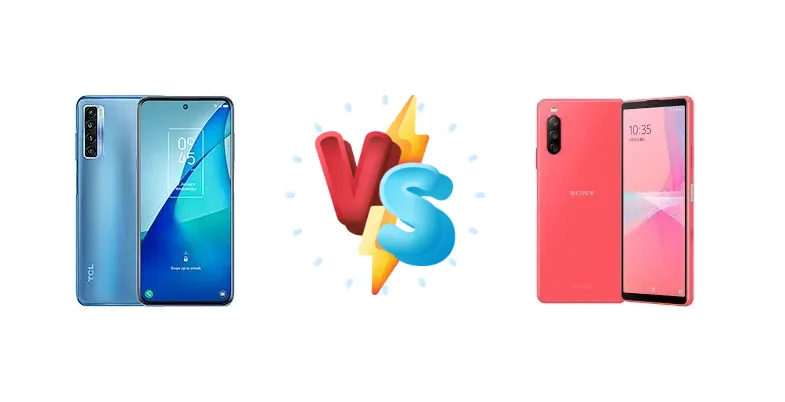
The TCL 20S and Sony Xperia 10 III Lite represent distinct approaches to the budget smartphone market. The TCL 20S, leveraging the Snapdragon 665, aims for affordability, while the Sony Xperia 10 III Lite, with its Snapdragon 690 5G, prioritizes connectivity and a slight performance boost. This comparison dissects their key differences to determine which device offers the best value.
🏆 Quick Verdict
For the average user prioritizing future-proofing and faster data speeds, the Sony Xperia 10 III Lite is the better choice. Its Snapdragon 690 offers a noticeable performance uplift and 5G connectivity, while the 30W charging significantly reduces downtime. However, the TCL 20S remains a viable option for those on a tighter budget.
| Network |
|---|
| 2G bands | GSM 850 / 900 / 1800 / 1900 | GSM 850 / 900 / 1800 / 1900 |
| 3G bands | HSDPA 850 / 900 / 1700(AWS) / 1900 / 2100 | HSDPA 850 / 1900 |
| 4G bands | LTE | 1, 3, 4, 12, 18, 19, 38, 41 |
| 5G bands | - | 77, 78 SA/NSA |
| Speed | HSPA, LTE | HSPA, LTE, 5G |
| Technology | GSM / HSPA / LTE | GSM / HSPA / LTE / 5G |
| Launch |
|---|
| Announced | 2021, April 14 | 2021, August 20 |
| Status | Available. Released 2021, May 20 | Available. Released 2021, August 27 |
| Body |
|---|
| Build | - | Glass front (Gorilla Glass 6), glass back (Gorilla Glass 6), plastic frame |
| Dimensions | 166.2 x 76.9 x 9.1 mm (6.54 x 3.03 x 0.36 in) | 154 x 68 x 8.3 mm (6.06 x 2.68 x 0.33 in) |
| SIM | Nano-SIM | Nano-SIM + eSIM |
| Weight | 199 g (7.02 oz) | 169 g (5.96 oz) |
| Display |
|---|
| Protection | - | Corning Gorilla Glass 6 |
| Resolution | 1080 x 2400 pixels, 20:9 ratio (~395 ppi density) | 1080 x 2520 pixels, 21:9 ratio (~457 ppi density) |
| Size | 6.67 inches, 107.4 cm2 (~84.0% screen-to-body ratio) | 6.0 inches, 84.1 cm2 (~80.3% screen-to-body ratio) |
| Type | IPS LCD | OLED, 1B colors, HDR |
| Platform |
|---|
| CPU | Octa-core (4x2.0 GHz Kryo 260 Gold & 4x1.8 GHz Kryo 260 Silver) | Octa-core (2x2.0 GHz Kryo 560 Gold & 6x1.7 GHz Kryo 560 Silver) |
| Chipset | Qualcomm SM6125 Snapdragon 665 (11 nm) | Qualcomm SM6350 Snapdragon 690 5G (8 nm) |
| GPU | Adreno 610 | Adreno 619 |
| OS | Android 11, TCL UI | Android 11 |
| Memory |
|---|
| Card slot | microSDXC (uses shared SIM slot) | microSDXC (uses shared SIM slot) |
| Internal | 128GB 4GB RAM, 256GB 6GB RAM | 64GB 6GB RAM |
| Main Camera |
|---|
| Features | LED flash, HDR, panorama | LED flash, HDR, panorama |
| Quad | 64 MP, f/1.8, 26mm (wide), 0.7µm, PDAF
8 MP, f/2.2, 13mm (ultrawide), 1/4.0", 1.12µm
2 MP (macro)
Auxiliary lens | - |
| Triple | - | 12 MP, f/1.8, 27mm (wide), 1/2.8", PDAF
8 MP, f/2.4, 54mm (telephoto), 1/4.0", PDAF, 2x optical zoom
8 MP, f/2.2, 16mm, 120˚ (ultrawide), 1/4.0" |
| Video | 4K@30fps, 1080p@30/120fps | 4K@30fps, 1080p@30fps |
| Selfie camera |
|---|
| Features | - | HDR |
| Single | 16 MP, f/2.2, 28mm (wide), 1/3.06", 1.0µm | 8 MP, f/2.0, 24mm (wide), 1/4.0" |
| Video | 1080p@30fps | 1080p@30fps |
| Sound |
|---|
| 3.5mm jack | - | Yes |
| 35mm jack | Yes | Yes |
| Loudspeaker | Yes | Yes |
| Comms |
|---|
| Bluetooth | 5.0, A2DP, LE, aptX | 5.1, A2DP, LE, aptX HD |
| NFC | Yes | Yes |
| Positioning | GPS | GPS, GLONASS, GALILEO, BDS, QZSS |
| Radio | No | No |
| USB | USB Type-C 2.0, OTG | USB Type-C 3.1, OTG, video output |
| WLAN | Wi-Fi 802.11 a/b/g/n/ac, dual-band, Wi-Fi Direct | Wi-Fi 802.11 a/b/g/n/ac, dual-band, Wi-Fi Direct |
| Features |
|---|
| Sensors | Fingerprint (side-mounted), accelerometer, proximity, compass | Fingerprint (side-mounted), accelerometer, proximity, compass |
| Battery |
|---|
| Charging | - | 30W wired, PD, QC |
| Type | Li-Po 5000 mAh | Li-Po 4500 mAh |
| Misc |
|---|
| Colors | Milky Way Gray, North Star Blue | Black, White, Blue, Pink |
| Models | T773O | XQ-BT44 |
| Price | About 210 EUR | About 370 EUR |
TCL 20S
- More affordable price point
- Potentially longer battery life (depending on capacity)
- Functional and reliable for basic tasks
- Older Snapdragon 665 chipset
- No 5G connectivity
- Slower charging speeds
Sony Xperia 10 III Lite
- Faster Snapdragon 690 5G chipset
- 30W fast charging with PD/QC
- Potential for better camera image processing
- Higher price compared to TCL 20S
- Battery life may be slightly shorter due to 5G and faster processor
- May require a separate charger for full 30W speed
Display Comparison
Neither TCL nor Sony provide display specs beyond resolution in their marketing materials. However, given the market positioning, both likely utilize IPS LCD panels. The key difference lies in the chipset's manufacturing process; the Snapdragon 690's 8nm process suggests potentially better power efficiency, which *could* translate to slightly improved display-on battery life. Bezels are likely comparable, typical of this price bracket. Color accuracy is expected to be standard for both, requiring calibration for professional use.
Camera Comparison
Detailed camera specs are lacking for both devices. However, the market segment suggests both will rely on multi-camera setups with a primary sensor, ultrawide, and potentially a depth or macro lens. The Sony Xperia 10 III Lite likely benefits from Sony’s image processing expertise, potentially delivering more refined images, particularly in challenging lighting conditions. The Snapdragon 690’s ISP (Image Signal Processor) is also more advanced than the 665’s, enabling faster image processing and potentially better dynamic range. Without specific sensor size information, it’s difficult to definitively declare a winner, but Sony’s brand reputation in camera technology gives it an edge.
Performance
The core distinction here is the chipset. The Sony Xperia 10 III Lite’s Snapdragon 690 (8nm) represents a significant architectural leap over the TCL 20S’s Snapdragon 665 (11nm). The 690 features Kryo 560 cores, offering improved performance per watt compared to the 665’s Kryo 260 cores. While both are octa-core CPUs, the 690’s configuration (2x2.0 GHz Gold + 6x1.7 GHz Silver) is optimized for sustained performance. The 8nm process also contributes to better thermal management, reducing the likelihood of throttling during prolonged use. This benefits users who engage in moderate gaming or multitasking.
Battery Life
Battery capacity isn't specified for either device. However, the Sony Xperia 10 III Lite’s 30W wired charging with Power Delivery (PD) and Quick Charge (QC) support is a major advantage. This allows for significantly faster charging times compared to the TCL 20S, which likely utilizes a slower charging standard. While a larger battery capacity on the TCL 20S could offset this, the convenience of rapid charging on the Sony is a substantial benefit for users who frequently need to top up their device.
Buying Guide
Buy the TCL 20S if you need a functional, everyday smartphone with a focus on cost-effectiveness and aren't concerned with 5G or demanding applications. Buy the Sony Xperia 10 III Lite if you value 5G connectivity, faster performance for multitasking and light gaming, and quicker charging speeds, even if it means spending a bit more.
Frequently Asked Questions
❓ Does the Snapdragon 690 in the Xperia 10 III Lite offer a noticeable performance improvement over the 665 in the TCL 20S for everyday tasks like browsing and social media?
Yes, the Snapdragon 690 provides a tangible performance boost. While both chips handle basic tasks adequately, the 690’s more efficient architecture and faster cores result in smoother multitasking, quicker app loading times, and a more responsive user experience, even when running multiple applications simultaneously.
❓ How much faster is the 30W charging on the Xperia 10 III Lite compared to the TCL 20S, and what real-world impact does this have?
The Xperia 10 III Lite’s 30W charging can significantly reduce charging times. While the TCL 20S likely supports a standard 10-15W charging rate, the Sony can potentially charge from 0-50% in around 30 minutes, and reach a full charge in approximately 60-75 minutes. This is crucial for users who need to quickly top up their phone before leaving the house or during short breaks.
❓ Is the 5G connectivity on the Xperia 10 III Lite worth the extra cost if I don't currently have access to a 5G network?
Even without immediate 5G access, the Xperia 10 III Lite’s 5G modem future-proofs the device. As 5G networks expand, you’ll be ready to take advantage of faster data speeds without needing to upgrade your phone. Furthermore, the 5G modem often includes improvements to 4G connectivity as well, potentially offering better performance even on existing networks.