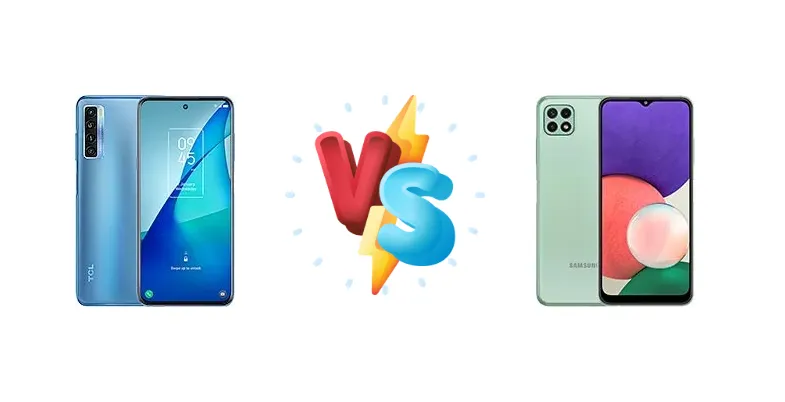
The TCL 20S and Samsung Galaxy A22 5G represent compelling options in the increasingly competitive budget 5G smartphone market. While both aim to deliver 5G connectivity at an accessible price point, they take fundamentally different approaches to achieving this, particularly in their chipset choices. This comparison dissects those differences to determine which device offers the best value for your money.
🏆 Quick Verdict
For most users, the Samsung Galaxy A22 5G emerges as the stronger choice. Its Mediatek Dimensity 700 chipset, built on a more efficient 7nm process, provides a noticeable performance advantage over the TCL 20S’s Snapdragon 665, translating to smoother multitasking and a better gaming experience. While battery life is comparable, the A22 5G’s 5G capabilities and overall responsiveness give it the edge.
| Network |
|---|
| 2G bands | GSM 850 / 900 / 1800 / 1900 | GSM 850 / 900 / 1800 / 1900 |
| 3G bands | HSDPA 850 / 900 / 1700(AWS) / 1900 / 2100 | HSDPA 850 / 900 / 1900 / 2100 |
| 4G bands | LTE | 1, 2, 3, 5, 7, 8, 20, 28, 38, 40, 41 |
| 5G bands | - | 1, 3, 5, 7, 8, 20, 28, 38, 40, 41, 78, 79 SA/NSA/Sub6 |
| Speed | HSPA, LTE | HSPA, LTE, 5G |
| Technology | GSM / HSPA / LTE | GSM / HSPA / LTE / 5G |
| Launch |
|---|
| Announced | 2021, April 14 | 2021, June 03 |
| Status | Available. Released 2021, May 20 | Available. Released 2021, June 24 |
| Body |
|---|
| Build | - | Glass front, plastic frame, plastic back |
| Dimensions | 166.2 x 76.9 x 9.1 mm (6.54 x 3.03 x 0.36 in) | 167.2 x 76.4 x 9 mm (6.58 x 3.01 x 0.35 in) |
| SIM | Nano-SIM | · Nano-SIM· Nano-SIM + Nano-SIM |
| Weight | 199 g (7.02 oz) | 203 g (7.16 oz) |
| Display |
|---|
| Resolution | 1080 x 2400 pixels, 20:9 ratio (~395 ppi density) | 1080 x 2400 pixels, 20:9 ratio (~399 ppi density) |
| Size | 6.67 inches, 107.4 cm2 (~84.0% screen-to-body ratio) | 6.6 inches, 105.2 cm2 (~82.3% screen-to-body ratio) |
| Type | IPS LCD | TFT LCD, 90Hz |
| Platform |
|---|
| CPU | Octa-core (4x2.0 GHz Kryo 260 Gold & 4x1.8 GHz Kryo 260 Silver) | Octa-core (2x2.2 GHz Cortex-A76 & 6x2.0 GHz Cortex-A55) |
| Chipset | Qualcomm SM6125 Snapdragon 665 (11 nm) | Mediatek Dimensity 700 (7 nm) |
| GPU | Adreno 610 | Mali-G57 MC2 |
| OS | Android 11, TCL UI | Android 11, upgradable to Android 13, One UI core 5 |
| Memory |
|---|
| Card slot | microSDXC (uses shared SIM slot) | microSDXC (dedicated slot) |
| Internal | 128GB 4GB RAM, 256GB 6GB RAM | 64GB 4GB RAM, 128GB 4GB RAM, 128GB 6GB RAM, 128GB 8GB RAM |
| Main Camera |
|---|
| Features | LED flash, HDR, panorama | LED flash, panorama, HDR |
| Quad | 64 MP, f/1.8, 26mm (wide), 0.7µm, PDAF
8 MP, f/2.2, 13mm (ultrawide), 1/4.0", 1.12µm
2 MP (macro)
Auxiliary lens | - |
| Single | - | 8 MP, f/2.0, (wide) |
| Triple | - | 48 MP, f/1.8, (wide), PDAF
5 MP, f/2.2, 115˚ (ultrawide), 1/5.0", 1.12µm
Auxiliary lens |
| Video | 4K@30fps, 1080p@30/120fps | 1152p@30fps |
| Selfie camera |
|---|
| Single | 16 MP, f/2.2, 28mm (wide), 1/3.06", 1.0µm | 8 MP, f/2.0, (wide) |
| Video | 1080p@30fps | 1080p@30fps |
| Sound |
|---|
| 3.5mm jack | - | Yes |
| 35mm jack | Yes | Yes |
| Loudspeaker | Yes | Yes |
| Comms |
|---|
| Bluetooth | 5.0, A2DP, LE, aptX | 5.0, A2DP, LE |
| NFC | Yes | Yes (market/region dependent) |
| Positioning | GPS | GPS, GLONASS, GALILEO, BDS |
| Radio | No | FM radio |
| USB | USB Type-C 2.0, OTG | USB Type-C 2.0 |
| WLAN | Wi-Fi 802.11 a/b/g/n/ac, dual-band, Wi-Fi Direct | Wi-Fi 802.11 a/b/g/n/ac, dual-band, Wi-Fi Direct |
| Features |
|---|
| Sensors | Fingerprint (side-mounted), accelerometer, proximity, compass | Fingerprint (side-mounted), accelerometer, gyro, proximity, compass |
| Battery |
|---|
| Charging | - | 15W wired |
| Type | Li-Po 5000 mAh | Li-Po 5000 mAh |
| Misc |
|---|
| Colors | Milky Way Gray, North Star Blue | Gray, White, Mint, Violet |
| Models | T773O | SM-A226B, SM-A226B/DS, SM-A226B/DSN, SM-A226BR, SM-A226BR/N, SM-A226L, SC-56B |
| Price | About 210 EUR | £ 92.00 / € 125.99 |
| SAR EU | - | 0.73 W/kg (head) 1.23 W/kg (body) |
| Tests |
|---|
| Battery life | - |
Endurance rating 118h
|
| Camera | - |
Photo / Video |
| Display | - |
Contrast ratio: 1631:1 (nominal) |
| Loudspeaker | - |
-28.5 LUFS (Average)
|
| Performance | - |
AnTuTu: 242155 (v8), 223188 (v9)
GeekBench: 6913 (v4.4), 1719 (v5.1)
GFXBench: 12fps (ES 3.1 onscreen) |
TCL 20S
- Potentially lower price point
- Acceptable performance for basic tasks
- Comparable battery endurance
- Older, less efficient Snapdragon 665 chipset
- Likely inferior gaming performance
- Limited information on display quality
Samsung Galaxy A22 5G
- More powerful and efficient Dimensity 700 chipset
- Brighter display for better outdoor visibility
- 5G connectivity for faster data speeds
- May be slightly more expensive
- 15W charging is relatively slow
- Camera performance likely limited by budget sensors
Display Comparison
Both the TCL 20S and Samsung Galaxy A22 5G share a contrast ratio of 1631:1, suggesting similar levels of black depth and color vibrancy. However, the A22 5G boasts a measured peak brightness of 385 nits, which is crucial for outdoor visibility. While neither display is expected to feature high refresh rates or advanced panel technologies like LTPO, the brighter screen on the A22 5G provides a more usable experience in bright conditions. The lack of detailed display specs for the TCL 20S makes a direct comparison difficult, but the A22 5G’s measured brightness is a clear advantage.
Camera Comparison
Both devices offer 'Photo / Video' capabilities, but lack specific details regarding sensor size, aperture, or image stabilization. Given the budget nature of these phones, it’s unlikely either will excel in low-light photography. The presence of a 2MP macro camera on both devices is largely a marketing gimmick, offering limited practical benefit due to the small sensor size and lack of optical image stabilization. Without further specifications, it’s difficult to definitively declare a camera winner, but the A22 5G’s image processing algorithms, typical of Samsung’s mid-range devices, may offer slightly more refined results.
Performance
The core difference between these phones lies in their chipsets. The Samsung Galaxy A22 5G’s Mediatek Dimensity 700 (7nm) significantly outperforms the TCL 20S’s Qualcomm Snapdragon 665 (11nm). The 7nm process node allows for greater transistor density and improved power efficiency, resulting in better sustained performance and less heat generation. The Dimensity 700’s CPU configuration – 2x2.2 GHz Cortex-A76 and 6x2.0 GHz Cortex-A55 – is architecturally superior to the Snapdragon 665’s 4x2.0 GHz Kryo 260 Gold & 4x1.8 GHz Kryo 260 Silver. This translates to faster app loading times, smoother multitasking, and a more responsive user interface on the A22 5G. Gamers will particularly benefit from the A22 5G’s more capable GPU.
Battery Life
Both the TCL 20S and Samsung Galaxy A22 5G achieve an endurance rating of 118 hours, indicating comparable battery life under similar usage conditions. However, the Dimensity 700’s superior power efficiency could translate to slightly longer real-world usage on the A22 5G, especially when utilizing 5G connectivity. The A22 5G supports 15W wired charging, while charging speed information for the TCL 20S is unavailable. The similar endurance ratings suggest that battery life won’t be a deciding factor for most users, but the A22 5G’s more efficient chipset provides a slight advantage.
Buying Guide
Buy the TCL 20S if you prioritize a potentially lower upfront cost and are primarily focused on basic smartphone tasks like calling, texting, and light social media use. The Snapdragon 665 is adequate for these scenarios. Buy the Samsung Galaxy A22 5G if you want a more future-proof device with better performance for gaming, streaming, and utilizing 5G networks. The Dimensity 700 offers a significant step up in processing power and efficiency.
Frequently Asked Questions
❓ Does the Mediatek Dimensity 700 in the A22 5G get hot during extended gaming sessions?
The Dimensity 700 is built on a 7nm process, which is more efficient than the 11nm Snapdragon 665 in the TCL 20S. This means it generates less heat under load. While some throttling is inevitable during prolonged gaming, the A22 5G is better equipped to maintain consistent performance over longer periods compared to the TCL 20S.
❓ Is the 5G connectivity on the Samsung Galaxy A22 5G actually useful, or is it just a marketing feature?
The usefulness of 5G depends on your location and carrier coverage. However, the A22 5G supports 5G networks, offering significantly faster download and upload speeds where available. Even if 5G isn't readily accessible, the phone will fall back to 4G LTE, providing a future-proofed experience.
❓ How does the Snapdragon 665 in the TCL 20S handle multitasking compared to the Dimensity 700?
The Snapdragon 665 is a capable processor for basic multitasking, but the Dimensity 700’s more powerful CPU and GPU provide a noticeably smoother experience when switching between multiple apps or running demanding applications. The A22 5G is less likely to exhibit lag or slowdowns during heavy multitasking.