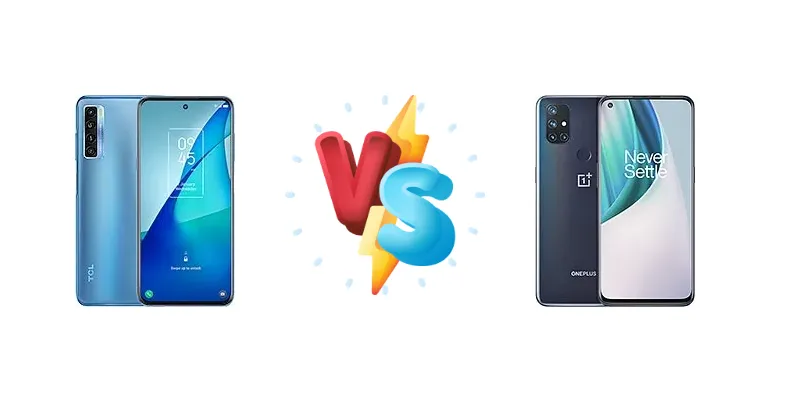
The TCL 20S and OnePlus Nord N10 5G represent compelling options in the sub-$250 smartphone market. While both aim to deliver value, they take different approaches. The TCL 20S focuses on a balanced feature set, while the Nord N10 5G prioritizes 5G connectivity and faster charging, making this a crucial comparison for budget-conscious buyers.
🏆 Quick Verdict
For most users, the OnePlus Nord N10 5G is the better choice. Its Snapdragon 690 chipset offers a noticeable performance uplift over the TCL 20S’s Snapdragon 665, and the inclusion of 5G connectivity future-proofs the device. The 30W charging is a significant advantage, offsetting the identical endurance ratings.
| Network |
|---|
| 2G bands | GSM 850 / 900 / 1800 / 1900 | GSM 850 / 900 / 1800 / 1900 |
| 3G bands | HSDPA 850 / 900 / 1700(AWS) / 1900 / 2100 | HSDPA 850 / 900 / 1700(AWS) / 1900 / 2100 |
| 4G bands | LTE | 1, 2, 3, 4, 5, 7, 8, 12, 17, 20, 28, 38, 39, 40, 41, 66 - International |
| 5G bands | - | 1, 3, 7, 28, 41, 66, 78 SA/NSA - International |
| Speed | HSPA, LTE | HSPA 42.2/5.76 Mbps, LTE Cat18 1024/150 Mbps, 5G |
| Technology | GSM / HSPA / LTE | GSM / CDMA / HSPA / LTE / 5G |
| | - | 2, 5, 25, 41, 66, 71 SA/NSA - USA |
| Launch |
|---|
| Announced | 2021, April 14 | 2020, October 26 |
| Status | Available. Released 2021, May 20 | Available. Released 2020, November 21 |
| Body |
|---|
| Build | - | Glass front (Gorilla Glass 3), plastic back, plastic frame |
| Dimensions | 166.2 x 76.9 x 9.1 mm (6.54 x 3.03 x 0.36 in) | 163 x 74.7 x 9 mm (6.42 x 2.94 x 0.35 in) |
| SIM | Nano-SIM | Nano-SIM + Nano-SIM |
| Weight | 199 g (7.02 oz) | 190 g (6.70 oz) |
| Display |
|---|
| Protection | - | Corning Gorilla Glass 3 |
| Resolution | 1080 x 2400 pixels, 20:9 ratio (~395 ppi density) | 1080 x 2400 pixels, 20:9 ratio (~406 ppi density) |
| Size | 6.67 inches, 107.4 cm2 (~84.0% screen-to-body ratio) | 6.49 inches, 101.7 cm2 (~83.5% screen-to-body ratio) |
| Type | IPS LCD | IPS LCD, 90Hz |
| Platform |
|---|
| CPU | Octa-core (4x2.0 GHz Kryo 260 Gold & 4x1.8 GHz Kryo 260 Silver) | Octa-core (2x2.0 GHz Kryo 560 Gold & 6x1.7 GHz Kryo 560 Silver) |
| Chipset | Qualcomm SM6125 Snapdragon 665 (11 nm) | Qualcomm SM6350 Snapdragon 690 5G (8 nm) |
| GPU | Adreno 610 | Adreno 619L |
| OS | Android 11, TCL UI | Android 10, OxygenOS 10.5 |
| Memory |
|---|
| Card slot | microSDXC (uses shared SIM slot) | microSDXC |
| Internal | 128GB 4GB RAM, 256GB 6GB RAM | 128GB 6GB RAM |
| | - | UFS 2.1 |
| Main Camera |
|---|
| Features | LED flash, HDR, panorama | LED flash, HDR, panorama |
| Quad | 64 MP, f/1.8, 26mm (wide), 0.7µm, PDAF
8 MP, f/2.2, 13mm (ultrawide), 1/4.0", 1.12µm
2 MP (macro)
Auxiliary lens | 64 MP, f/1.8, (wide), 1/1.72", 0.8µm, PDAF
8 MP, f/2.3, 119˚ (ultrawide)
2 MP (macro)
Auxiliary lens |
| Video | 4K@30fps, 1080p@30/120fps | 4K@30fps, 1080p@30/60/120fps; gyro-EIS |
| Selfie camera |
|---|
| Features | - | HDR |
| Single | 16 MP, f/2.2, 28mm (wide), 1/3.06", 1.0µm | 16 MP, f/2.1 |
| Video | 1080p@30fps | 1080p@30/60fps, gyro-EIS |
| Sound |
|---|
| 3.5mm jack | - | Yes |
| 35mm jack | Yes | Yes |
| Loudspeaker | Yes | Yes, with dual speakers |
| Comms |
|---|
| Bluetooth | 5.0, A2DP, LE, aptX | 5.1, A2DP, LE |
| NFC | Yes | Yes |
| Positioning | GPS | GPS (L1+L5), GLONASS, GALILEO, BDS |
| Radio | No | No |
| USB | USB Type-C 2.0, OTG | USB Type-C 2.0, OTG |
| WLAN | Wi-Fi 802.11 a/b/g/n/ac, dual-band, Wi-Fi Direct | Wi-Fi 802.11 a/b/g/n/ac, dual-band, Wi-Fi Direct |
| Features |
|---|
| Sensors | Fingerprint (side-mounted), accelerometer, proximity, compass | Fingerprint (rear-mounted), accelerometer, gyro, proximity, compass |
| Battery |
|---|
| Charging | - | 30W wired |
| Type | Li-Po 5000 mAh | Li-Po 4300 mAh |
| Misc |
|---|
| Colors | Milky Way Gray, North Star Blue | Midnight Ice |
| Models | T773O | BE2029, BE2025, BE2026, BE2028 |
| Price | About 210 EUR | About 250 EUR |
| Tests |
|---|
| Battery life | - |
Endurance rating 99h
|
| Camera | - |
Photo / Video |
| Loudspeaker | - |
-25.8 LUFS (Very good)
|
| Performance | - |
AnTuTu: 279579 (v8)
GeekBench: 1848 (v5.1)
GFXBench: 13fps (ES 3.1 onscreen) |
TCL 20S
- Balanced feature set for everyday use
- Potentially lower price point
- Solid build quality (based on TCL's reputation)
- Older Snapdragon 665 chipset
- Lacks 5G connectivity
- Slower charging speeds
OnePlus Nord N10 5G
- Faster Snapdragon 690 5G chipset
- 5G connectivity for future-proofing
- 30W fast charging
- May be slightly more expensive
- Potentially less optimized software (OnePlus's budget line)
- Display brightness could be better
Display Comparison
The OnePlus Nord N10 5G boasts a measured peak brightness of 440 nits and a 1447:1 contrast ratio, suggesting a more vibrant and visible display in bright conditions compared to the TCL 20S, for which display specs are not provided. While the TCL 20S likely offers a decent viewing experience, the Nord N10 5G’s higher contrast ratio will result in deeper blacks and more dynamic visuals. The absence of refresh rate information for the TCL 20S suggests it likely operates at the standard 60Hz, while the Nord N10 5G's display is optimized for responsiveness.
Camera Comparison
Both phones offer photo and video capabilities, but detailed sensor information is lacking for both. However, the Snapdragon 690 in the Nord N10 5G includes an improved image signal processor (ISP) compared to the 665 in the TCL 20S, resulting in better image processing, particularly in low-light conditions. Without specific sensor size or aperture data, it’s difficult to definitively declare a winner, but the chipset advantage leans towards the OnePlus.
Performance
The core difference lies in the chipsets: the TCL 20S utilizes the Qualcomm Snapdragon 665 (11nm), while the OnePlus Nord N10 5G features the Snapdragon 690 5G (8nm). The 8nm process node of the 690 is more efficient, leading to better thermal management and sustained performance. The CPU configuration also favors the Nord N10 5G with its 2x2.0 GHz Kryo 560 Gold cores versus the TCL 20S’s 4x2.0 GHz Kryo 260 Gold cores; the 690’s architecture is a generation newer and more capable. This translates to faster app loading times and smoother multitasking on the OnePlus device.
Battery Life
Both the TCL 20S and OnePlus Nord N10 5G achieve an endurance rating of 99 hours, indicating similar overall battery life. However, the Nord N10 5G’s 30W wired charging capability is a game-changer. This allows for significantly faster top-ups compared to the TCL 20S, which likely supports a slower charging standard. While both will last a full day for moderate users, the Nord N10 5G offers convenience for those who need to quickly replenish their battery.
Buying Guide
Buy the TCL 20S if you prioritize a consistently smooth experience for everyday tasks and aren't concerned with 5G or rapid charging. It's a solid all-rounder for basic smartphone needs. Buy the OnePlus Nord N10 5G if you want faster performance, 5G connectivity for future network upgrades, and significantly quicker charging times – ideal for users who stream a lot of video or play mobile games.
Frequently Asked Questions
❓ Does the Snapdragon 690 in the Nord N10 5G offer a noticeable gaming improvement over the Snapdragon 665 in the TCL 20S?
Yes, the Snapdragon 690 provides a significant performance boost in gaming. Its newer architecture and more powerful GPU allow for higher frame rates and smoother gameplay in demanding titles. While neither phone is a dedicated gaming device, the Nord N10 5G will handle games like PUBG Mobile and Call of Duty Mobile with more consistent performance.
❓ How much faster is the 30W charging on the OnePlus Nord N10 5G compared to the TCL 20S?
While the TCL 20S's charging speed isn't officially specified, it's likely around 10-15W. The Nord N10 5G's 30W charging can take the battery from 0% to approximately 60-70% in just 30 minutes, whereas the TCL 20S would likely take over an hour to reach the same level. This is a substantial difference for users who frequently need to top up their battery quickly.
❓ Is the 5G connectivity on the Nord N10 5G useful if 5G isn't widely available in my area yet?
Even if 5G coverage is limited now, the Nord N10 5G's 5G modem future-proofs the device. As 5G networks expand, you'll be ready to take advantage of faster data speeds without needing to upgrade your phone. Furthermore, the 5G modem often provides improved 4G LTE performance as well.