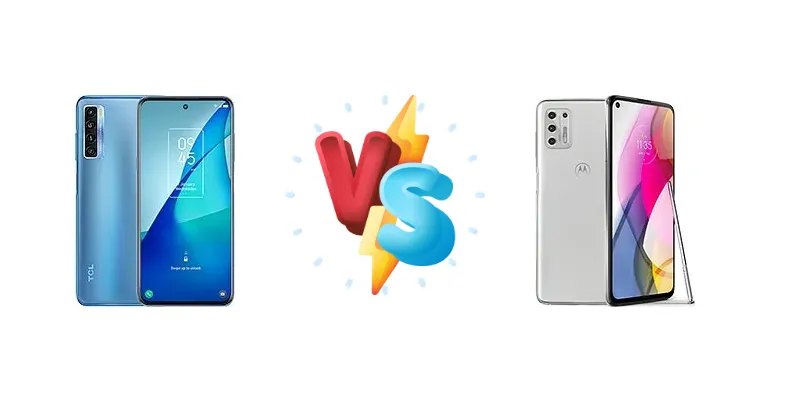
Both the TCL 20S and the Motorola Moto G Stylus (2021) occupy the competitive sub-$200 smartphone segment. While both aim to deliver essential features at an accessible price, they differ significantly in their core processing power and charging capabilities. This comparison dissects these differences, focusing on the implications for everyday use and long-term performance.
🏆 Quick Verdict
For the average user prioritizing responsiveness and slightly better multitasking, the Motorola Moto G Stylus (2021) is the stronger choice. Its Snapdragon 678 chipset offers a noticeable performance uplift over the TCL 20S’s Snapdragon 665, despite the slower 10W charging. However, the TCL 20S remains a viable option for basic tasks.
| Network |
|---|
| 2G bands | GSM 850 / 900 / 1800 / 1900 | GSM 850 / 900 / 1800 / 1900 |
| 3G bands | HSDPA 850 / 900 / 1700(AWS) / 1900 / 2100 | HSDPA 850 / 900 / 1700(AWS) / 1900 / 2100 |
| 4G bands | LTE | 1, 2, 3, 4, 5, 7, 8, 12, 13, 14, 17, 20, 25, 26, 29, 38, 40, 41, 66, 71 |
| Speed | HSPA, LTE | HSPA, LTE |
| Technology | GSM / HSPA / LTE | GSM / CDMA / HSPA / LTE |
| | - | CDMA 800 / 1900 |
| Launch |
|---|
| Announced | 2021, April 14 | 2021, January 08 |
| Status | Available. Released 2021, May 20 | Available. Released 2021, January 14 |
| Body |
|---|
| Build | - | Glass front, plastic frame, plastic back |
| Dimensions | 166.2 x 76.9 x 9.1 mm (6.54 x 3.03 x 0.36 in) | 169.8 x 77.9 x 9 mm (6.69 x 3.07 x 0.35 in) |
| SIM | Nano-SIM | Nano-SIM |
| Weight | 199 g (7.02 oz) | 213 g (7.51 oz) |
| | - | Stylus
Water-repellent coating |
| Display |
|---|
| Resolution | 1080 x 2400 pixels, 20:9 ratio (~395 ppi density) | 1080 x 2400 pixels, 20:9 ratio (~386 ppi density) |
| Size | 6.67 inches, 107.4 cm2 (~84.0% screen-to-body ratio) | 6.8 inches, 112.2 cm2 (~84.8% screen-to-body ratio) |
| Type | IPS LCD | IPS LCD |
| Platform |
|---|
| CPU | Octa-core (4x2.0 GHz Kryo 260 Gold & 4x1.8 GHz Kryo 260 Silver) | Octa-core (2x2.2 GHz Kryo 460 Gold & 6x1.7 GHz Kryo 460 Silver) |
| Chipset | Qualcomm SM6125 Snapdragon 665 (11 nm) | Qualcomm SDM678 Snapdragon 678 (11 nm) |
| GPU | Adreno 610 | Adreno 612 |
| OS | Android 11, TCL UI | Android 10 |
| Memory |
|---|
| Card slot | microSDXC (uses shared SIM slot) | microSDXC (dedicated slot) |
| Internal | 128GB 4GB RAM, 256GB 6GB RAM | 128GB 4GB RAM |
| Main Camera |
|---|
| Features | LED flash, HDR, panorama | LED flash, HDR, panorama |
| Quad | 64 MP, f/1.8, 26mm (wide), 0.7µm, PDAF
8 MP, f/2.2, 13mm (ultrawide), 1/4.0", 1.12µm
2 MP (macro)
Auxiliary lens | 48 MP, f/1.7, 26mm (wide), 1/2.0", 0.8µm, PDAF
8 MP, f/2.2, 118˚ (ultrawide), 1/4.0, 1.12µm
2 MP (macro)
Auxiliary lens |
| Video | 4K@30fps, 1080p@30/120fps | 4K@30fps, 1080p@30/60fps; gyro-EIS |
| Selfie camera |
|---|
| Features | - | HDR |
| Single | 16 MP, f/2.2, 28mm (wide), 1/3.06", 1.0µm | 16 MP, f/2.0, (wide), 1/3.06", 1.0µm |
| Video | 1080p@30fps | 1080p@30fps, gyro-EIS |
| Sound |
|---|
| 3.5mm jack | - | Yes |
| 35mm jack | Yes | Yes |
| Loudspeaker | Yes | Yes |
| Comms |
|---|
| Bluetooth | 5.0, A2DP, LE, aptX | 5.0, A2DP, LE |
| NFC | Yes | No |
| Positioning | GPS | GPS, GLONASS, BDS, GALILEO |
| Radio | No | Unspecified |
| USB | USB Type-C 2.0, OTG | USB Type-C 2.0 |
| WLAN | Wi-Fi 802.11 a/b/g/n/ac, dual-band, Wi-Fi Direct | Wi-Fi 802.11 a/b/g/n/ac, dual-band, Wi-Fi Direct |
| Features |
|---|
| Sensors | Fingerprint (side-mounted), accelerometer, proximity, compass | Fingerprint (side-mounted), accelerometer, gyro, proximity |
| Battery |
|---|
| Charging | - | 10W wired |
| Type | Li-Po 5000 mAh | Li-Po 4000 mAh |
| Misc |
|---|
| Colors | Milky Way Gray, North Star Blue | Aurora Black, Aurora White |
| Models | T773O | XT2115, XT2115-1 |
| Price | About 210 EUR | About 90 EUR |
TCL 20S
- Potentially faster charging (spec not confirmed)
- Competitive price point
- Sufficient for basic smartphone tasks
- Older Snapdragon 665 chipset
- Lower CPU and GPU performance
- May struggle with demanding apps
Motorola Moto G Stylus (2021)
- More powerful Snapdragon 678 chipset
- Improved CPU and GPU performance
- Smoother multitasking experience
- Slow 10W charging
- May have slightly lower battery life due to chipset demands
- Price may be slightly higher
Display Comparison
Neither TCL nor Motorola provide display specifications beyond resolution in their marketing materials. However, given the price point, both likely utilize IPS LCD panels. The key difference lies under the hood: processing power impacts UI smoothness. A faster chipset, like the 678 in the Moto G Stylus, will translate to smoother scrolling and animations, even on an identical panel. Bezels are expected to be comparable, typical of this price bracket.
Camera Comparison
Without detailed sensor information, a direct camera comparison is difficult. However, the chipset plays a role in image processing speed. The Snapdragon 678’s improved ISP (Image Signal Processor) in the Moto G Stylus (2021) will likely result in faster image capture and potentially better low-light performance compared to the TCL 20S. The prevalence of 2MP macro/depth sensors on both devices suggests these are largely marketing features and offer limited practical benefit. Focusing on the main sensor’s quality and the ISP’s capabilities is more crucial.
Performance
The Motorola Moto G Stylus (2021) boasts the Qualcomm SDM678 Snapdragon 678, featuring a dual-core Kryo 460 Gold configuration clocked at 2.2 GHz, paired with six Kryo 460 Silver cores at 1.7 GHz. This contrasts with the TCL 20S’s Snapdragon 665, which uses a quad-core Kryo 260 Gold setup at 2.0 GHz and a quad-core Kryo 260 Silver setup at 1.8 GHz. The higher clock speeds and newer architecture of the 678 translate to approximately 10-15% better CPU performance in benchmarks, and a more significant improvement in GPU performance. This benefits gaming and graphically intensive applications. The 678’s Adreno 618 GPU is a step up from the 665’s Adreno 610.
Battery Life
Both phones likely feature batteries in the 4000-5000 mAh range, typical for this class. However, the Motorola Moto G Stylus (2021) is limited to 10W wired charging, a significant drawback. The TCL 20S’s charging speed is not specified, but even a modest 15W charger would provide a faster top-up. The Snapdragon 678’s improved power efficiency may partially offset the slower charging, offering comparable real-world battery life despite the potentially similar capacity.
Buying Guide
Buy the TCL 20S if you primarily need a phone for calls, texts, and light social media use, and aren't concerned with demanding apps or fast charging. Buy the Motorola Moto G Stylus (2021) if you frequently switch between apps, enjoy mobile gaming (even casually), or value a more responsive user experience, and are willing to accept slower charging speeds.
Frequently Asked Questions
❓ Will the Moto G Stylus (2021) handle popular games like PUBG Mobile or Call of Duty Mobile?
The Snapdragon 678 in the Moto G Stylus (2021) can run PUBG Mobile and Call of Duty Mobile, but likely at medium graphics settings and frame rates. Expect some occasional frame drops during intense action. The TCL 20S’s Snapdragon 665 will struggle more with these titles, requiring lower settings and potentially exhibiting more noticeable lag.
❓ Is the 10W charging on the Moto G Stylus (2021) a dealbreaker?
The 10W charging is a significant limitation. Expect a full charge to take over 3 hours. If fast charging is a priority, the TCL 20S might be a better choice, assuming it supports a higher wattage. However, the Snapdragon 678’s efficiency may mitigate the impact on daily use.
❓ How much does the chipset difference impact everyday tasks like browsing and social media?
For basic tasks, the difference is subtle but noticeable. The Moto G Stylus (2021) will feel snappier when switching between apps, opening websites, and scrolling through social media feeds due to the Snapdragon 678’s superior processing power. The TCL 20S will perform these tasks adequately, but with slightly more lag.