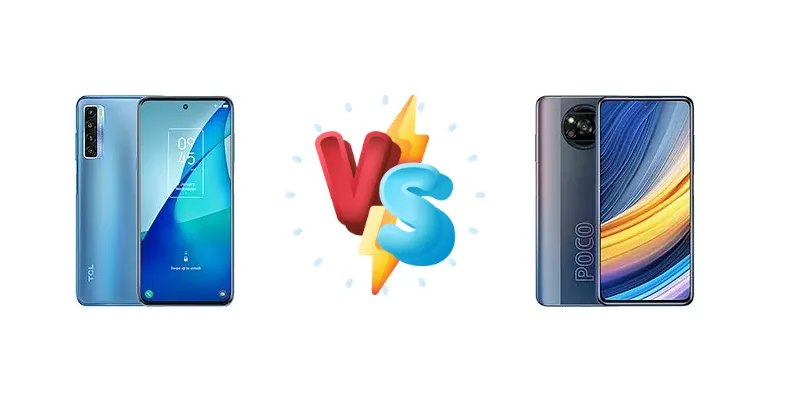
The TCL 20L+ and Xiaomi Poco X3 Pro represent distinct approaches to the budget smartphone market. The TCL aims for a well-rounded experience, while the Poco X3 Pro aggressively prioritizes performance, particularly for gaming. This comparison dissects their key differences to help you determine which aligns with your needs.
🏆 Quick Verdict
For most users, the Xiaomi Poco X3 Pro is the superior choice. Its Snapdragon 860 chipset provides a substantial performance leap over the TCL 20L+'s Snapdragon 662, making it ideal for gaming and demanding applications. While the TCL offers a more balanced package, the Poco’s raw power is hard to ignore.
| Network |
|---|
| 2G bands | GSM 850 / 900 / 1800 / 1900 | GSM 850 / 900 / 1800 / 1900 |
| 3G bands | HSDPA 850 / 900 / 1900 / 2100 - EU/MEA/APAC | HSDPA 850 / 900 / 1700(AWS) / 1900 / 2100 |
| 4G bands | 1, 3, 5, 7, 8, 20, 28, 38, 40, 41 - EU/MEA/APAC | 1, 2, 3, 4, 5, 7, 8, 20, 28, 38, 40, 41 - International |
| Speed | HSPA 42.2/5.76 Mbps, LTE Cat6 300/50 Mbps | HSPA, LTE |
| Technology | GSM / HSPA / LTE | GSM / HSPA / LTE |
| | - | 1, 2, 3, 5, 8, 38, 40, 41 - India |
| Launch |
|---|
| Announced | 2021, April 14 | 2021, March 22 |
| Status | Available. Released 2021, April 14 | Available. Released 2021, March 24 |
| Body |
|---|
| Build | Glass front, plastic back, plastic frame | Glass front (Gorilla Glass 6), plastic back |
| Dimensions | 166.2 x 76.9 x 9.1 mm (6.54 x 3.03 x 0.36 in) | 165.3 x 76.8 x 9.4 mm (6.51 x 3.02 x 0.37 in) |
| SIM | · Nano-SIM· Nano-SIM + Nano-SIM | Nano-SIM + Nano-SIM |
| Weight | 199 g (7.02 oz) | 215 g (7.58 oz) |
| | - | IP53, dust and splash resistant |
| Display |
|---|
| Protection | - | Corning Gorilla Glass 6 |
| Resolution | 1080 x 2400 pixels, 20:9 ratio (~395 ppi density) | 1080 x 2400 pixels, 20:9 ratio (~395 ppi density) |
| Size | 6.67 inches, 107.4 cm2 (~84.0% screen-to-body ratio) | 6.67 inches, 107.4 cm2 (~84.6% screen-to-body ratio) |
| Type | IPS LCD, 500 nits (peak) | IPS LCD, 120Hz, 2404Hz PWM, HDR10, 450 nits (typ) |
| Platform |
|---|
| CPU | Octa-core (4x2.0 GHz Kryo 260 Gold & 4x1.8 GHz Kryo 260 Silver) | Octa-core (1x2.96 GHz Kryo 485 Gold & 3x2.42 GHz Kryo 485 Gold & 4x1.78 GHz Kryo 485 Silver) |
| Chipset | Qualcomm SM6115 Snapdragon 662 (11 nm) | Qualcomm Snapdragon 860 (7 nm) |
| GPU | Adreno 610 | Adreno 640 |
| OS | Android 11, TCL UI | Android 11, upgradable to Android 12, MIUI 13 for POCO |
| Memory |
|---|
| Card slot | microSDXC (uses shared SIM slot) | microSDXC (uses shared SIM slot) |
| Internal | 256GB 6GB RAM | 128GB 6GB RAM, 128GB 8GB RAM, 256GB 6GB RAM, 256GB 8GB RAM |
| | - | UFS 3.1 |
| Main Camera |
|---|
| Features | LED flash, HDR, panorama | Dual-LED flash, HDR, panorama |
| Quad | 64 MP, f/1.8, 26mm (wide), 1/2.0", 0.7µm, PDAF
8 MP, f/2.2, 13mm, 118˚ (ultrawide), 1/4.0", 1.12µm
2 MP (macro)
Auxiliary lens | 48 MP, f/1.8, (wide), 1/2.0", 0.8µm, PDAF
8 MP, f/2.2, 119˚ (ultrawide), 1.0µm
2 MP (macro)
Auxiliary lens |
| Single | - | 20 MP, f/2.2, (wide), 1/3.4", 0.8µm |
| Video | 1080p@30/60fps | 4K@30fps, 1080p@30/60/120/240fps, 1080p@960fps, gyro-EIS |
| Selfie camera |
|---|
| Features | HDR | HDR, panorama |
| Single | 16 MP, f/2.2, 28mm (wide), 1/3.06", 1.0µm | 20 MP, f/2.2, (wide), 1/3.4", 0.8µm |
| Video | 1080p@30/60fps | 1080p@30fps |
| Sound |
|---|
| 3.5mm jack | - | Yes |
| 35mm jack | Yes | Yes |
| Loudspeaker | Yes | Yes, with stereo speakers |
| | - | 24-bit/192kHz audio |
| Comms |
|---|
| Bluetooth | 5.0, A2DP, LE, aptX | 5.0, A2DP, LE |
| Infrared port | - | Yes |
| NFC | Yes | Yes (market/region dependent) |
| Positioning | GPS, GLONASS, GALILEO, BDS | GPS, GLONASS, GALILEO, BDS |
| Radio | Unspecified | FM radio, recording |
| USB | USB Type-C 2.0, OTG | USB Type-C 2.0, OTG |
| WLAN | Wi-Fi 802.11 a/b/g/n/ac, dual-band, Wi-Fi Direct | Wi-Fi 802.11 a/b/g/n/ac, dual-band, Wi-Fi Direct |
| Features |
|---|
| Sensors | Fingerprint (side-mounted), accelerometer, gyro, proximity, compass | Fingerprint (side-mounted), accelerometer, gyro, proximity, compass |
| Battery |
|---|
| Charging | 18W wired | 33W wired, 59% in 30 min, 100% in 59 min |
| Type | Li-Po 5000 mAh | Li-Po 5160 mAh |
| Misc |
|---|
| Colors | Milky Way Gray, North Star Blue | Phantom Black, Frost Blue, Metal Bronze |
| Models | T775H, T775B | M2102J20SG, M2102J20SI |
| Price | About 270 EUR | $ 128.04 / £ 249.99 |
| SAR | - | 0.99 W/kg (head) 0.67 W/kg (body) |
| SAR EU | - | 0.57 W/kg (head) 0.90 W/kg (body) |
| Tests |
|---|
| Battery life | - |
Endurance rating 112h
|
| Camera | - |
Photo / Video |
| Display | - |
Contrast ratio: 1401:1 (nominal) |
| Loudspeaker | - |
-26.1 LUFS (Good)
|
| Performance | - |
AnTuTu: 453223 (v8)
GeekBench: 2574 (v5.1)
GFXBench: 38fps (ES 3.1 onscreen) |
TCL 20L+
- Potentially more refined software experience (TCL)
- Balanced feature set for everyday use
- Adequate performance for basic tasks
- Significantly weaker performance compared to Poco X3 Pro
- Slower charging speed (18W)
- Limited gaming capabilities
Xiaomi Poco X3 Pro
- Exceptional performance for the price (Snapdragon 860)
- Fast charging (33W)
- Excellent gaming capabilities
- Potentially more aggressive software (Xiaomi)
- May prioritize performance over battery optimization
- Camera details are unknown
Display Comparison
Both devices share a nominal contrast ratio of 1401:1, suggesting similar visual pop. However, detailed display specs like peak brightness and panel type are missing for the TCL 20L+. Given the Poco X3 Pro’s focus on gaming, it’s likely to have a higher peak brightness for better outdoor visibility. The TCL’s display quality will likely be adequate for everyday use, but the Poco has the potential for a more vibrant and engaging viewing experience.
Camera Comparison
Both phones are listed as having Photo/Video capabilities, but specific details are absent. Without sensor size or aperture information, a direct comparison is difficult. However, given the Poco X3 Pro’s overall focus on delivering value, it’s reasonable to assume it will offer a more capable camera system, potentially with larger sensors and more advanced image processing. The TCL 20L+ will likely provide acceptable image quality in good lighting conditions, but may struggle in low-light scenarios.
Performance
The performance gap is the most significant differentiator. The Poco X3 Pro’s Snapdragon 860 (7nm) is a substantial upgrade over the TCL 20L+'s Snapdragon 662 (11nm). The 860 features a Kryo 485 core clocked at 2.96 GHz, compared to the 662’s 2.0 GHz Kryo 260 Gold core. This translates to significantly faster app loading times, smoother multitasking, and a far superior gaming experience. The 7nm process also contributes to better thermal efficiency, potentially reducing throttling during extended gaming sessions. The TCL 20L+ will handle basic tasks adequately, but will struggle with graphically intensive games.
Battery Life
Both devices boast an endurance rating of 112 hours, suggesting comparable battery life under similar usage patterns. However, the Poco X3 Pro’s 33W wired charging (59% in 30 min, 100% in 59 min) is a significant advantage over the TCL 20L+'s 18W charging. This means the Poco can be quickly topped up, minimizing downtime. While both offer similar longevity, the Poco’s faster charging provides greater convenience.
Buying Guide
Buy the TCL 20L+ if you prioritize a balanced, everyday experience with adequate performance for social media, browsing, and light tasks, and value a potentially more refined software experience. Buy the Xiaomi Poco X3 Pro if you are a mobile gamer, frequently use demanding apps, or simply want the fastest possible performance for the price, and are willing to accept a potentially more aggressive software approach.
Frequently Asked Questions
❓ Is the Poco X3 Pro's Snapdragon 860 likely to throttle during extended gaming sessions?
While the Snapdragon 860 is a powerful chip, throttling is always a possibility during prolonged, demanding tasks. However, the 7nm process node and the Poco X3 Pro’s cooling system are designed to mitigate this. Expect some performance reduction after extended gaming, but it should remain playable.
❓ Does the TCL 20L+ have a headphone jack?
While not explicitly stated in the provided specs, TCL generally includes a 3.5mm headphone jack in their budget and mid-range devices. It's highly probable the 20L+ also features one, offering convenience for users with wired headphones.
❓ What kind of software experience can I expect from the Poco X3 Pro?
The Poco X3 Pro runs Xiaomi's MIUI, which is known for its extensive customization options and feature set. However, it also includes pre-installed apps (bloatware) and can be more aggressive with notifications. It's a feature-rich experience, but may not appeal to those who prefer a cleaner Android interface.