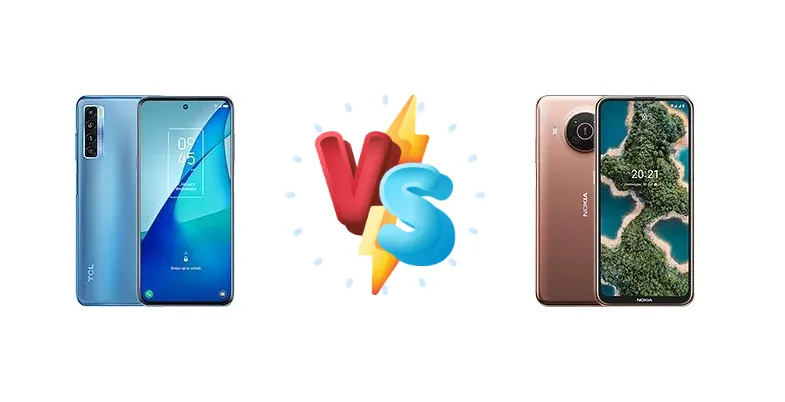
The TCL 20L+ and Nokia X20 represent a growing segment of affordable 5G smartphones. Both aim to deliver connectivity without breaking the bank, but they achieve this with different Qualcomm Snapdragon chipsets. This comparison dissects the core differences between the Snapdragon 662 in the TCL 20L+ and the Snapdragon 480 in the Nokia X20, revealing which phone offers the better balance of performance, efficiency, and value.
🏆 Quick Verdict
For the average user prioritizing consistent performance and a slightly more refined experience, the TCL 20L+ emerges as the winner. While the Nokia X20 boasts 5G connectivity thanks to the Snapdragon 480, the Snapdragon 662 in the TCL 20L+ provides a more responsive user interface and better sustained performance in demanding tasks.
| Network |
|---|
| 2G bands | GSM 850 / 900 / 1800 / 1900 | GSM 850 / 900 / 1800 / 1900 |
| 3G bands | HSDPA 850 / 900 / 1900 / 2100 - EU/MEA/APAC | HSDPA 850 / 900 / 1700(AWS) / 1900 / 2100 |
| 4G bands | 1, 3, 5, 7, 8, 20, 28, 38, 40, 41 - EU/MEA/APAC | 1, 2, 3, 4, 5, 7, 8, 12, 20, 28, 66, 38, 39, 40, 41 |
| 5G bands | - | 1, 2, 3, 5, 7, 28, 38, 41, 66, 78 SA/NSA/Sub6 |
| Speed | HSPA 42.2/5.76 Mbps, LTE Cat6 300/50 Mbps | HSPA, LTE, 5G |
| Technology | GSM / HSPA / LTE | GSM / HSPA / LTE / 5G |
| Launch |
|---|
| Announced | 2021, April 14 | 2021, April 08 |
| Status | Available. Released 2021, April 14 | Available. Released 2021, May 12 |
| Body |
|---|
| Build | Glass front, plastic back, plastic frame | - |
| Dimensions | 166.2 x 76.9 x 9.1 mm (6.54 x 3.03 x 0.36 in) | 168.9 x 79.7 x 9.1 mm (6.65 x 3.14 x 0.36 in) |
| SIM | · Nano-SIM· Nano-SIM + Nano-SIM | · Nano-SIM· Nano-SIM + Nano-SIM |
| Weight | 199 g (7.02 oz) | 220 g (7.76 oz) |
| Display |
|---|
| Protection | - | Corning Gorilla Glass 5 |
| Resolution | 1080 x 2400 pixels, 20:9 ratio (~395 ppi density) | 1080 x 2400 pixels, 20:9 ratio (~395 ppi density) |
| Size | 6.67 inches, 107.4 cm2 (~84.0% screen-to-body ratio) | 6.67 inches, 107.4 cm2 (~79.8% screen-to-body ratio) |
| Type | IPS LCD, 500 nits (peak) | IPS LCD, 450 nits (typ) |
| Platform |
|---|
| CPU | Octa-core (4x2.0 GHz Kryo 260 Gold & 4x1.8 GHz Kryo 260 Silver) | Octa-core (2x2.0 GHz Kryo 460 & 6x1.8 GHz Kryo 460) |
| Chipset | Qualcomm SM6115 Snapdragon 662 (11 nm) | Qualcomm SM4350 Snapdragon 480 5G (8 nm) |
| GPU | Adreno 610 | Adreno 619 |
| OS | Android 11, TCL UI | Android 11, upgradable to Android 14 |
| Memory |
|---|
| Card slot | microSDXC (uses shared SIM slot) | microSDXC (uses shared SIM slot) |
| Internal | 256GB 6GB RAM | 128GB 6GB RAM, 128GB 8GB RAM |
| Main Camera |
|---|
| Features | LED flash, HDR, panorama | Zeiss optics, LED flash, HDR, panorama |
| Quad | 64 MP, f/1.8, 26mm (wide), 1/2.0", 0.7µm, PDAF
8 MP, f/2.2, 13mm, 118˚ (ultrawide), 1/4.0", 1.12µm
2 MP (macro)
Auxiliary lens | 64 MP, (wide), PDAF
5 MP, (ultrawide)
2 MP (macro)
Auxiliary lens |
| Single | - | 32 MP, (wide) |
| Video | 1080p@30/60fps | 1080p@30/60fps |
| Selfie camera |
|---|
| Features | HDR | - |
| Single | 16 MP, f/2.2, 28mm (wide), 1/3.06", 1.0µm | 32 MP, (wide) |
| Video | 1080p@30/60fps | 1080p@30fps |
| Sound |
|---|
| 3.5mm jack | - | Yes |
| 35mm jack | Yes | Yes |
| Loudspeaker | Yes | Yes |
| Comms |
|---|
| Bluetooth | 5.0, A2DP, LE, aptX | 5.0, A2DP, LE, aptX HD |
| NFC | Yes | Yes |
| Positioning | GPS, GLONASS, GALILEO, BDS | GPS, GLONASS, GALILEO |
| Radio | Unspecified | FM radio |
| USB | USB Type-C 2.0, OTG | USB Type-C 2.0, OTG |
| WLAN | Wi-Fi 802.11 a/b/g/n/ac, dual-band, Wi-Fi Direct | Wi-Fi 802.11 a/b/g/n/ac, dual-band, Wi-Fi Direct |
| Features |
|---|
| Sensors | Fingerprint (side-mounted), accelerometer, gyro, proximity, compass | Fingerprint (side-mounted), accelerometer, gyro, proximity |
| Battery |
|---|
| Charging | 18W wired | 18W wired |
| Type | Li-Po 5000 mAh | Li-Po 4470 mAh |
| Misc |
|---|
| Colors | Milky Way Gray, North Star Blue | Midnight Sun, Nordic Blue |
| Models | T775H, T775B | TA-1341, TA-1344 |
| Price | About 270 EUR | About 130 EUR |
| SAR | - | 1.04 W/kg (head) 0.62 W/kg (body) |
| SAR EU | - | 0.51 W/kg (head) 1.29 W/kg (body) |
TCL 20L+
- More consistent performance with Snapdragon 662
- Potentially better graphics performance for gaming
- Refined image processing from mature ISP
- Lacks 5G connectivity
- Older manufacturing process (11nm)
Nokia X20
- 5G connectivity for faster data speeds
- Newer manufacturing process (8nm)
- Nokia's software update commitment
- Less consistent CPU performance
- Potentially lower graphics performance
- May exhibit more thermal throttling under sustained load
Display Comparison
Neither TCL nor Nokia provided display specs in the context data. However, given the price points, both likely utilize LCD panels. The TCL 20L+’s Snapdragon 662, being a more mature chipset, may benefit from better display driver optimization, potentially resulting in slightly more accurate color reproduction. The Nokia X20’s Snapdragon 480, while newer, may have less refined display calibration at this price point.
Camera Comparison
Without detailed camera sensor information, a direct comparison is difficult. However, the Snapdragon 662’s image signal processor (ISP) has been refined over more generations, potentially leading to better image processing in the TCL 20L+. The Snapdragon 480’s ISP is newer, but its overall processing power is lower. Both phones likely feature similar budget camera setups, so software optimization will be crucial. Expect similar performance in good lighting conditions, but the TCL 20L+ may have a slight advantage in low-light scenarios.
Performance
The core difference lies in the chipsets. The TCL 20L+ features the Qualcomm SM6115 Snapdragon 662 (11 nm), while the Nokia X20 uses the SM4350 Snapdragon 480 5G (8 nm). While the 8nm process of the Snapdragon 480 *should* offer better power efficiency, the Snapdragon 662’s CPU configuration – 4x2.0 GHz Kryo 260 Gold & 4x1.8 GHz Kryo 260 Silver – is architecturally more balanced than the Nokia X20’s 2x2.0 GHz Kryo 460 & 6x1.8 GHz Kryo 460. This translates to more consistent performance across multiple cores, benefiting multitasking and app loading times. The Snapdragon 662’s Adreno 610 GPU also provides a slight edge in graphics performance over the Adreno 619 in the Snapdragon 480, making the TCL 20L+ better suited for casual gaming.
Battery Life
Both devices feature 18W wired charging, suggesting similar charging speeds. Battery capacity isn’t specified, but the Snapdragon 662’s greater efficiency, despite being on an 11nm process, could translate to slightly longer battery life in the TCL 20L+. The Snapdragon 480’s 8nm process is more efficient *per clock cycle*, but the TCL 20L+’s more balanced CPU architecture may allow it to spend more time in lower-power states.
Buying Guide
Buy the TCL 20L+ if you need a phone that feels consistently smooth for everyday tasks, social media, and light gaming. Its Snapdragon 662 offers a more polished experience. Buy the Nokia X20 if 5G connectivity is your absolute top priority and you're willing to accept potential performance trade-offs. The Nokia X20 also appeals to users who value Nokia's commitment to software updates and build quality.
Frequently Asked Questions
❓ Will the Nokia X20's 5G actually make a noticeable difference in my daily use?
The benefit of 5G on the Nokia X20 depends heavily on your location and carrier coverage. In areas with strong 5G signals, you'll experience significantly faster download and upload speeds. However, in areas with limited or no 5G coverage, you'll fall back to 4G, negating the advantage. The Snapdragon 662 in the TCL 20L+ provides a consistently good 4G experience.
❓ Does the Snapdragon 480 in the Nokia X20 tend to overheat during prolonged gaming sessions?
The Snapdragon 480, while efficient, can exhibit thermal throttling under sustained load due to its relatively limited cooling capacity in this price range. While it can handle casual gaming, demanding titles may experience frame drops or reduced performance after extended play. The TCL 20L+'s Snapdragon 662 is better equipped to maintain consistent performance for longer periods.
❓ How does Nokia's software update policy compare to TCL's for these devices?
Nokia is known for its commitment to providing timely software updates and security patches, often guaranteeing several years of support. TCL's update policy is less consistent, and updates may be slower to arrive. This is a significant advantage for the Nokia X20, ensuring your device remains secure and up-to-date for a longer period.