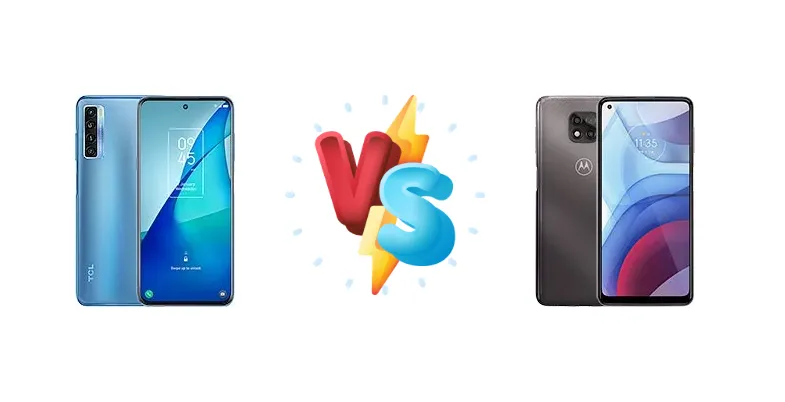
Both the TCL 20L+ and the Motorola Moto G Power (2021) target the highly competitive budget smartphone market. While both leverage the Qualcomm Snapdragon 662 chipset, they diverge in charging capabilities and potentially, overall user experience. This comparison dissects these differences to help you determine which device offers the best value for your needs.
🏆 Quick Verdict
For the average user prioritizing faster charging and potentially a slightly more refined software experience, the TCL 20L+ emerges as the winner. Its 18W charging, while not groundbreaking, offers a noticeable advantage over the Moto G Power’s 15W charging, especially for those frequently topping up their battery throughout the day.
| Network |
|---|
| 2G bands | GSM 850 / 900 / 1800 / 1900 | GSM 850 / 900 / 1800 / 1900 |
| 3G bands | HSDPA 850 / 900 / 1900 / 2100 - EU/MEA/APAC | HSDPA 850 / 900 / 1700(AWS) / 1900 / 2100 |
| 4G bands | 1, 3, 5, 7, 8, 20, 28, 38, 40, 41 - EU/MEA/APAC | 1, 2, 3, 4, 5, 7, 8, 12, 13, 14, 17, 25, 26, 29, 30, 38, 41, 66, 71 |
| Speed | HSPA 42.2/5.76 Mbps, LTE Cat6 300/50 Mbps | HSPA, LTE |
| Technology | GSM / HSPA / LTE | GSM / CDMA / HSPA / EVDO / LTE |
| | - | CDMA2000 1xEV-DO |
| Launch |
|---|
| Announced | 2021, April 14 | 2021, January 08 |
| Status | Available. Released 2021, April 14 | Available. Released 2021, January 14 |
| Body |
|---|
| Build | Glass front, plastic back, plastic frame | Glass front, plastic back, plastic frame |
| Dimensions | 166.2 x 76.9 x 9.1 mm (6.54 x 3.03 x 0.36 in) | 165.3 x 75.9 x 9.5 mm (6.51 x 2.99 x 0.37 in) |
| SIM | · Nano-SIM· Nano-SIM + Nano-SIM | Nano-SIM |
| Weight | 199 g (7.02 oz) | 206.5 g (7.30 oz) |
| | - | Water-repellent coating |
| Display |
|---|
| Resolution | 1080 x 2400 pixels, 20:9 ratio (~395 ppi density) | 720 x 1600 pixels, 20:9 ratio (~266 ppi density) |
| Size | 6.67 inches, 107.4 cm2 (~84.0% screen-to-body ratio) | 6.6 inches, 105.2 cm2 (~83.8% screen-to-body ratio) |
| Type | IPS LCD, 500 nits (peak) | IPS LCD |
| Platform |
|---|
| CPU | Octa-core (4x2.0 GHz Kryo 260 Gold & 4x1.8 GHz Kryo 260 Silver) | Octa-core (4x2.0 GHz Kryo 260 Gold & 4x1.8 GHz Kryo 260 Silver) |
| Chipset | Qualcomm SM6115 Snapdragon 662 (11 nm) | Qualcomm SM6115 Snapdragon 662 (11 nm) |
| GPU | Adreno 610 | Adreno 610 |
| OS | Android 11, TCL UI | Android 10 |
| Memory |
|---|
| Card slot | microSDXC (uses shared SIM slot) | microSDXC (dedicated slot) |
| Internal | 256GB 6GB RAM | 32GB 3GB RAM, 64GB 4GB RAM |
| | - | eMMC 5.1 |
| Main Camera |
|---|
| Features | LED flash, HDR, panorama | LED flash, HDR, panorama |
| Quad | 64 MP, f/1.8, 26mm (wide), 1/2.0", 0.7µm, PDAF
8 MP, f/2.2, 13mm, 118˚ (ultrawide), 1/4.0", 1.12µm
2 MP (macro)
Auxiliary lens | - |
| Triple | - | 48 MP, f/1.7, (wide), 1/2.0", 0.8µm, PDAF
2 MP (macro)
Auxiliary lens |
| Video | 1080p@30/60fps | 1080p@30/60fps, gyro-EIS |
| Selfie camera |
|---|
| Features | HDR | HDR |
| Single | 16 MP, f/2.2, 28mm (wide), 1/3.06", 1.0µm | 8 MP, f/2.0, 1.12µm |
| Video | 1080p@30/60fps | 1080p@30fps, gyro-EIS |
| Sound |
|---|
| 3.5mm jack | - | Yes |
| 35mm jack | Yes | Yes |
| Loudspeaker | Yes | Yes |
| Comms |
|---|
| Bluetooth | 5.0, A2DP, LE, aptX | 5.0, A2DP, LE |
| NFC | Yes | No |
| Positioning | GPS, GLONASS, GALILEO, BDS | GPS, GLONASS, GALILEO |
| Radio | Unspecified | FM radio |
| USB | USB Type-C 2.0, OTG | USB Type-C 2.0 |
| WLAN | Wi-Fi 802.11 a/b/g/n/ac, dual-band, Wi-Fi Direct | Wi-Fi 802.11 a/b/g/n/ac, dual-band, Wi-Fi Direct |
| Features |
|---|
| Sensors | Fingerprint (side-mounted), accelerometer, gyro, proximity, compass | Fingerprint (side-mounted), accelerometer, gyro, proximity, compass, barometer |
| Battery |
|---|
| Charging | 18W wired | 15W wired |
| Type | Li-Po 5000 mAh | Li-Po 5000 mAh |
| Misc |
|---|
| Colors | Milky Way Gray, North Star Blue | Flash Gray, Polar Silver |
| Models | T775H, T775B | - |
| Price | About 270 EUR | About 60 EUR |
TCL 20L+
- Faster 18W charging for quicker top-ups.
- Potential for slightly better display quality due to TCL’s expertise.
- May offer a more refined software experience.
- Battery capacity likely smaller than the Moto G Power.
- Camera performance is unconfirmed and may not be significantly better.
Motorola Moto G Power (2021)
- Likely larger battery capacity for extended usage.
- Near-stock Android experience for a clean and bloatware-free interface.
- Strong reputation for long-lasting battery life.
- Slower 15W charging takes longer to fully recharge.
- Software updates may be less frequent compared to TCL.
Display Comparison
Both devices likely feature LCD panels, common in this price bracket. However, specific details like resolution and peak brightness are missing. The TCL 20L+ may benefit from TCL’s display expertise, potentially offering slightly better color accuracy, but without concrete data, this remains speculative. Bezels are expected to be similar, prioritizing affordability over ultra-thin designs. The absence of high refresh rate panels is standard for this segment.
Camera Comparison
Camera performance is difficult to assess without detailed sensor information. Both phones likely feature a multi-camera setup, but the quality of the main sensor is paramount. The TCL 20L+ may leverage TCL’s image processing algorithms for potentially more vibrant photos, but this is speculative. The presence of low-resolution auxiliary cameras (often 2MP macro or depth sensors) on both devices is likely, and their contribution to overall image quality will be minimal. Focusing on the main sensor’s megapixel count and aperture is key.
Performance
Both the TCL 20L+ and the Motorola Moto G Power (2021) are powered by the Qualcomm SM6115 Snapdragon 662 (11 nm) chipset, featuring an octa-core CPU configuration with 4x2.0 GHz Kryo 260 Gold and 4x1.8 GHz Kryo 260 Silver cores. This means performance will be nearly identical for everyday tasks like browsing, social media, and light gaming. The GPU performance will also be the same. Thermal management will likely depend on the phone’s chassis design and software optimization, but neither device is expected to exhibit significant throttling under moderate loads. RAM configurations are crucial, but unspecified; more RAM will benefit multitasking.
Battery Life
The Motorola Moto G Power (2021) traditionally prioritizes battery life, and while the exact capacity isn't specified, it's likely larger than the TCL 20L+. However, the TCL 20L+ compensates with 18W wired charging, compared to the Moto G Power’s 15W charging. This translates to a faster 0-100% charge time for the TCL 20L+, potentially shaving off 30-60 minutes. The trade-off is that the Moto G Power may offer longer overall usage time on a single charge, but requires more patience to replenish.
Buying Guide
Buy the TCL 20L+ if you value quicker charging speeds and appreciate a potentially more polished software experience. This phone suits users who don't want to wait as long for a full charge and are willing to potentially trade a bit of battery capacity for that convenience. Buy the Motorola Moto G Power (2021) if maximizing battery life is your absolute top priority and you prefer a simpler, near-stock Android experience. This is the phone for users who want to go days between charges and don't mind slower charging speeds.
Frequently Asked Questions
❓ Will the Snapdragon 662 in the Moto G Power struggle with demanding games like PUBG Mobile?
The Snapdragon 662 is capable of running PUBG Mobile, but you'll likely need to lower the graphics settings to medium or low to achieve a smooth frame rate. Expect some occasional stuttering during intense firefights. Both phones share the same chipset, so gaming performance will be comparable.
❓ How long will it take to fully charge the TCL 20L+ with the 18W charger?
While a precise time is unavailable, the 18W charging should take approximately 2-2.5 hours to fully charge the TCL 20L+ from 0%. This is noticeably faster than the Moto G Power’s 15W charging, which could take closer to 3 hours.
❓ Does the Motorola Moto G Power (2021) receive regular software updates?
Motorola's update schedule for budget devices is typically less frequent than brands like Samsung or Google. Expect a limited number of major Android updates and security patches, but don't rely on prompt updates.
❓ Is the TCL 20L+ a good choice for someone who frequently uses their phone for video streaming?
The TCL 20L+ may offer a slightly better viewing experience due to potential display optimizations from TCL, but without specific screen specs, it's hard to say definitively. Battery life will be a consideration, and the faster charging could be beneficial for longer streaming sessions.