
TCL 20L+ vs Google Pixel 4a 5G: Which Budget 5G Phone Reigns Supreme?
| Phones Images | |||||
|---|---|---|---|---|---|
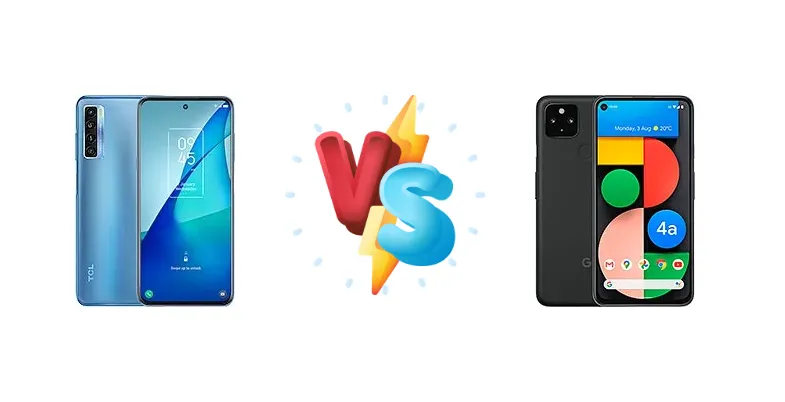
|
🏆 Quick Verdict
For the average user prioritizing a smooth software experience and consistently good camera performance, the Google Pixel 4a 5G is the better choice. Its Snapdragon 765G offers a noticeable performance uplift over the TCL 20L+'s Snapdragon 662, and Google's software optimization delivers a more refined user experience. However, the TCL 20L+ offers a competitive price point.
| PHONES | ||
|---|---|---|
| Phone Names | TCL 20L+ | Google Pixel 4a 5G |
| Network | ||
|---|---|---|
| 2G bands | GSM 850 / 900 / 1800 / 1900 | GSM 850 / 900 / 1800 / 1900 |
| 3G bands | HSDPA 850 / 900 / 1900 / 2100 - EU/MEA/APAC | HSDPA 850 / 900 / 1700(AWS) / 1900 / 2100 |
| 4G bands | 1, 3, 5, 7, 8, 20, 28, 38, 40, 41 - EU/MEA/APAC | 1, 2, 3, 4, 5, 7, 8, 12, 13, 14, 17, 18, 19, 20, 25, 26, 28, 29, 30, 32, 38, 39, 40, 41, 42, 46, 48, 66, 71 |
| 5G bands | - | 1, 2, 3, 5, 7, 8, 12, 28, 41, 66, 71, 77, 78 Sub6, mmWave (market dependant) |
| Speed | HSPA 42.2/5.76 Mbps, LTE Cat6 300/50 Mbps | HSPA, LTE, 5G |
| Technology | GSM / HSPA / LTE | GSM / HSPA / LTE / 5G |
| Launch | ||
|---|---|---|
| Announced | 2021, April 14 | 2020, September 30 |
| Status | Available. Released 2021, April 14 | Available. Released 2020, November 05 |
| Body | ||
|---|---|---|
| Build | Glass front, plastic back, plastic frame | Glass front (Gorilla Glass 3), plastic back, plastic frame |
| Dimensions | 166.2 x 76.9 x 9.1 mm (6.54 x 3.03 x 0.36 in) | 153.9 x 74 x 8.2 mm (Sub-6) or 8.5 mm (Sub-6 and mmWave) |
| SIM | · Nano-SIM· Nano-SIM + Nano-SIM | Nano-SIM + eSIM |
| Weight | 199 g (7.02 oz) | 168 g (5G Sub-6); 171 g ( 5G Sub-6 and mmWave) (5.93 oz) |
| Display | ||
|---|---|---|
| Protection | - | Corning Gorilla Glass 3 |
| Resolution | 1080 x 2400 pixels, 20:9 ratio (~395 ppi density) | 1080 x 2340 pixels, 19.5:9 ratio (~413 ppi density) |
| Size | 6.67 inches, 107.4 cm2 (~84.0% screen-to-body ratio) | 6.2 inches, 95.7 cm2 (~84.1% screen-to-body ratio) |
| Type | IPS LCD, 500 nits (peak) | OLED, HDR |
| - | Always-on display | |
| Platform | ||
|---|---|---|
| CPU | Octa-core (4x2.0 GHz Kryo 260 Gold & 4x1.8 GHz Kryo 260 Silver) | Octa-core (1x2.4 GHz Kryo 475 Prime & 1x2.2 GHz Kryo 475 Gold & 6x1.8 GHz Kryo 475 Silver) |
| Chipset | Qualcomm SM6115 Snapdragon 662 (11 nm) | Qualcomm SM7250 Snapdragon 765G 5G (7 nm) |
| GPU | Adreno 610 | Adreno 620 |
| OS | Android 11, TCL UI | Android 11, upgradable to Android 14 |
| Memory | ||
|---|---|---|
| Card slot | microSDXC (uses shared SIM slot) | No |
| Internal | 256GB 6GB RAM | 128GB 6GB RAM |
| - | UFS 2.1 | |
| Main Camera | ||
|---|---|---|
| Dual | - | 12.2 MP, f/1.7, 27mm (wide), 1/2.55", 1.4µm, dual pixel PDAF, OIS 16 MP, f/2.2, 107˚ (ultrawide), 1.0µm |
| Features | LED flash, HDR, panorama | LED flash, Pixel Shift, Auto-HDR, panorama |
| Quad | 64 MP, f/1.8, 26mm (wide), 1/2.0", 0.7µm, PDAF 8 MP, f/2.2, 13mm, 118˚ (ultrawide), 1/4.0", 1.12µm 2 MP (macro) Auxiliary lens | - |
| Video | 1080p@30/60fps | 4K@30/60fps, 1080p@30/60/120/240fps; gyro-EIS |
| Selfie camera | ||
|---|---|---|
| Features | HDR | HDR |
| Single | 16 MP, f/2.2, 28mm (wide), 1/3.06", 1.0µm | 8 MP, f/2.0, 24mm (wide), 1/4.0", 1.12µm |
| Video | 1080p@30/60fps | 1080p@30fps |
| Sound | ||
|---|---|---|
| 3.5mm jack | - | Yes |
| 35mm jack | Yes | Yes |
| Loudspeaker | Yes | Yes, with stereo speakers |
| Comms | ||
|---|---|---|
| Bluetooth | 5.0, A2DP, LE, aptX | 5.0, A2DP, LE, aptX HD |
| NFC | Yes | Yes |
| Positioning | GPS, GLONASS, GALILEO, BDS | GPS, GLONASS, GALILEO, QZSS, BDS |
| Radio | Unspecified | No |
| USB | USB Type-C 2.0, OTG | USB Type-C 3.1 |
| WLAN | Wi-Fi 802.11 a/b/g/n/ac, dual-band, Wi-Fi Direct | Wi-Fi 802.11 a/b/g/n/ac, dual-band, Wi-Fi Direct |
| Features | ||
|---|---|---|
| Sensors | Fingerprint (side-mounted), accelerometer, gyro, proximity, compass | Fingerprint (rear-mounted), accelerometer, gyro, proximity, compass, barometer |
| Battery | ||
|---|---|---|
| Charging | 18W wired | 18W wired, PD2.0 |
| Type | Li-Po 5000 mAh | Li-Po 3885 mAh |
| Misc | ||
|---|---|---|
| Colors | Milky Way Gray, North Star Blue | Just Black, Clearly White |
| Models | T775H, T775B | GD1YQ, G025I, G025E, G025H, G6QU3 |
| Price | About 270 EUR | About 140 EUR |
TCL 20L+
- More affordable price point
- 5G connectivity
- Acceptable performance for basic tasks
- Less powerful Snapdragon 662 chipset
- Inferior camera performance
- Less refined software experience
Google Pixel 4a 5G
- More powerful Snapdragon 765G chipset
- Superior camera quality with Google’s software
- USB-PD 2.0 fast charging
- Guaranteed software updates
- Higher price than the TCL 20L+
- May not be significantly faster in all real-world scenarios
Display Comparison
Neither TCL nor Google provided detailed display specs beyond resolution. However, the Pixel 4a 5G benefits from the more powerful ISP within the Snapdragon 765G, which likely contributes to better image processing for the display. The TCL 20L+’s panel, while adequate, is likely to exhibit less vibrant colors and dynamic range compared to the Pixel. Bezels are comparable, suggesting neither phone prioritizes an edge-to-edge display experience.
Camera Comparison
While megapixel counts aren't provided, the Pixel 4a 5G leverages Google’s renowned computational photography capabilities, powered by the Snapdragon 765G’s image signal processor (ISP). This results in superior dynamic range, detail, and low-light performance. The TCL 20L+’s camera system, while functional, lacks the software optimization and processing power to compete. The Pixel 4a 5G’s ISP is also more likely to support advanced features like HDR+ and Night Sight, enhancing image quality in challenging conditions. The TCL 20L+ likely relies more on hardware alone, limiting its ability to overcome sensor limitations.
Performance
The core difference lies in the chipsets. The Google Pixel 4a 5G’s Snapdragon 765G, fabricated on a 7nm process, offers a significant advantage over the TCL 20L+'s Snapdragon 662 (11nm). The 765G’s Kryo 475 Prime core, clocked at 2.4GHz, provides a substantial boost in single-core performance, crucial for app launch speeds and general responsiveness. The 662’s Kryo 260 Gold cores, at 2.0GHz, are less efficient and deliver lower peak performance. This translates to smoother multitasking and better gaming performance on the Pixel 4a 5G. While both phones likely feature similar RAM configurations, the 765G’s superior processing power will make better use of it.
Battery Life
Both phones feature 18W wired charging, but the Pixel 4a 5G adds support for USB Power Delivery 2.0 (PD2.0), offering potentially faster and more efficient charging with compatible chargers. While battery capacity isn't specified, the Snapdragon 765G’s 7nm process is more power-efficient than the 662’s 11nm process. This means the Pixel 4a 5G is likely to achieve comparable or better battery life despite potentially having a similar or smaller battery capacity. The PD2.0 support on the Pixel also allows for more flexible charging options.
Buying Guide
Buy the TCL 20L+ if you need a very affordable 5G phone and are comfortable with a less polished software experience. It's a good option for users who primarily use their phone for basic tasks like calling, texting, and social media. Buy the Google Pixel 4a 5G if you prioritize a smoother, more responsive user experience, a better camera, and guaranteed software updates, even if it means spending a bit more.