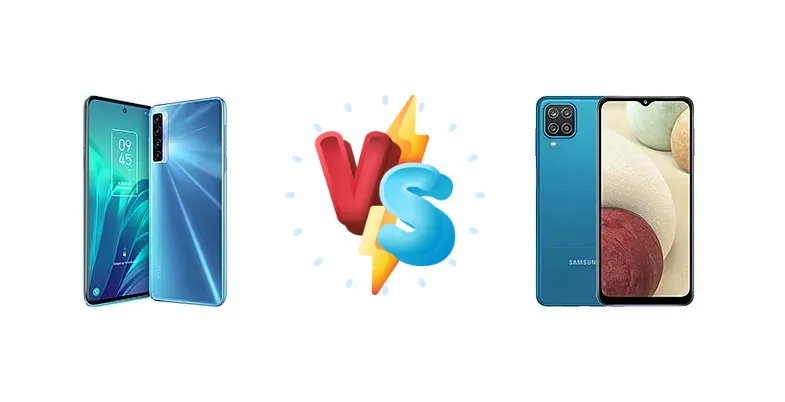
The TCL 20L and Samsung Galaxy A12 (India) represent compelling options in the fiercely competitive budget smartphone market. Both aim to deliver essential features at an accessible price point, but they take different approaches under the hood. This comparison dissects their core components – from chipsets to charging – to determine which device offers the best value for your money.
🏆 Quick Verdict
For the average user prioritizing consistent performance and a slightly faster charging experience, the TCL 20L emerges as the better choice. Its Snapdragon 662, built on an 11nm process, offers a more refined architecture than the Exynos 850, translating to smoother multitasking and potentially better gaming performance, despite the Exynos' 8nm node.
| Network |
|---|
| 2G bands | GSM 850 / 900 / 1800 / 1900 | GSM 850 / 900 / 1800 / 1900 |
| 3G bands | HSDPA 850 / 900 / 1900 / 2100 - EU/MEA/APAC | HSDPA 850 / 900 / 2100 |
| 4G bands | 1, 3, 5, 7, 8, 20, 28, 38, 40, 41 - EU/MEA/APAC | 1, 3, 5, 7, 8, 20, 28, 38, 40, 41 |
| Speed | HSPA 42.2/5.76 Mbps, LTE Cat6 300/50 Mbps | HSPA 42.2/5.76 Mbps, LTE Cat4 150/50 Mbps |
| Technology | GSM / HSPA / LTE | GSM / HSPA / LTE |
| Launch |
|---|
| Announced | 2021, April 14 | 2021, August 12 |
| Status | Available. Released 2021, April 14 | Available. Released 2021, August 12 |
| Body |
|---|
| Build | Glass front, plastic back, plastic frame | Glass front, plastic back, plastic frame |
| Dimensions | 166.2 x 76.9 x 9.1 mm (6.54 x 3.03 x 0.36 in) | 164 x 75.8 x 8.9 mm (6.46 x 2.98 x 0.35 in) |
| SIM | · Nano-SIM· Nano-SIM + Nano-SIM | · Nano-SIM· Nano-SIM + Nano-SIM |
| Weight | 199 g (7.02 oz) | 205 g (7.23 oz) |
| Display |
|---|
| Resolution | 1080 x 2400 pixels, 20:9 ratio (~395 ppi density) | 720 x 1600 pixels, 20:9 ratio (~270 ppi density) |
| Size | 6.67 inches, 107.4 cm2 (~84.0% screen-to-body ratio) | 6.5 inches, 102.0 cm2 (~82.1% screen-to-body ratio) |
| Type | IPS LCD, 500 nits (peak) | PLS LCD |
| Platform |
|---|
| CPU | Octa-core (4x2.0 GHz Kryo 260 Gold & 4x1.8 GHz Kryo 260 Silver) | Octa-core (4x2.0 GHz Cortex-A55 & 4x2.0 GHz Cortex-A55) |
| Chipset | Qualcomm SM6115 Snapdragon 662 (11 nm) | Exynos 850 (8 nm) |
| GPU | Adreno 610 | Mali-G52 |
| OS | Android 11, TCL UI | Android 11, upgradable to Android 13, One UI 5.1 |
| Memory |
|---|
| Card slot | microSDXC (uses shared SIM slot) | microSDXC (dedicated slot) |
| Internal | 128GB 4GB RAM, 128GB 6GB RAM | 64GB 4GB RAM, 128GB 4GB RAM, 128GB 6GB RAM |
| | - | eMMC 5.1 |
| Main Camera |
|---|
| Features | LED flash, HDR, panorama | LED flash, panorama, HDR |
| Quad | 48 MP, f/2.0, 26mm (wide), 1/2.0", 0.8µm, PDAF
8 MP, f/2.2, 13mm, 118˚ (ultrawide), 1/4.0", 1.12µm
2 MP (macro)
Auxiliary lens | 48 MP, f/2.0, 26mm (wide), AF
5 MP, f/2.2, 123˚ (ultrawide)
2 MP (macro)
Auxiliary lens |
| Video | 1080p@30/60fps | 1080p@30fps |
| Selfie camera |
|---|
| Features | HDR | - |
| Single | 16 MP, f/2.2, 28mm (wide), 1/3.06", 1.0µm | 8 MP, f/2.2 |
| Video | 1080p@30/60fps | 1080p@30fps |
| Sound |
|---|
| 3.5mm jack | - | Yes |
| 35mm jack | Yes | Yes |
| Loudspeaker | Yes | Yes |
| Comms |
|---|
| Bluetooth | 5.0, A2DP, LE, aptX | 5.0, A2DP, LE |
| NFC | Yes | No |
| Positioning | GPS, GLONASS, GALILEO, BDS | GPS, GLONASS, GALILEO, BDS |
| Radio | Unspecified | FM radio, RDS, recording |
| USB | USB Type-C 2.0, OTG | USB Type-C 2.0 |
| WLAN | Wi-Fi 802.11 a/b/g/n/ac, dual-band, Wi-Fi Direct | Wi-Fi 802.11 b/g/n, Wi-Fi Direct |
| Features |
|---|
| Sensors | Fingerprint (side-mounted), accelerometer, gyro, proximity, compass | Fingerprint (side-mounted), accelerometer |
| | - | Virtual proximity sensing |
| Battery |
|---|
| Charging | 18W wired | 15W wired |
| Type | Li-Po 5000 mAh | Li-Po 5000 mAh |
| Misc |
|---|
| Colors | Eclipse Black, Luna Blue | Black, Blue, White |
| Models | T774H, T774B | SM-A127F, SM-A127F/DS |
| Price | About 180 EUR | About 160 EUR |
| SAR | - | 0.79 W/kg (head) |
TCL 20L
- Faster 18W charging for quicker top-ups.
- Snapdragon 662 offers better CPU performance for smoother multitasking.
- Potentially more efficient chipset leading to slightly better battery life.
- Brand recognition isn't as strong as Samsung.
- Software updates may be less frequent compared to Samsung.
Samsung Galaxy A12 (India)
- Strong brand reputation and established service network.
- Samsung's One UI offers a feature-rich software experience.
- Potentially better sustained performance in less demanding tasks.
- Slower 15W charging.
- Exynos 850 CPU is less powerful than the Snapdragon 662.
- Cortex-A55 cores may struggle with more demanding applications.
Display Comparison
Neither TCL nor Samsung provide display specs beyond resolution in the provided data. However, given the price bracket, both likely utilize LCD panels. The key difference lies in the processing power needed to drive them. The Snapdragon 662's slightly more efficient GPU may translate to marginally better graphics rendering, but without knowing panel characteristics (brightness, color gamut), it's difficult to quantify. Bezels are likely comparable, typical of this segment.
Camera Comparison
Without detailed sensor information, a direct camera comparison is limited. Both phones likely feature a multi-camera setup with a primary sensor and supporting lenses (potentially including a 2MP macro, which offers limited practical benefit). The image processing algorithms will heavily influence the final image quality. Samsung generally leans towards vibrant, saturated colors, while TCL often aims for a more natural look. The Snapdragon 662’s ISP (Image Signal Processor) is generally considered capable, but the Exynos 850’s ISP is also adequate for this price range. Without knowing sensor sizes and apertures, it’s impossible to declare a clear winner.
Performance
The core battleground is the chipset. The TCL 20L’s Qualcomm Snapdragon 662 (11nm) features a Kryo CPU architecture, designed for a balance of performance and efficiency. The Samsung Galaxy A12 (India) utilizes the Exynos 850 (8nm) with Cortex-A55 cores. While the 8nm process *should* theoretically offer better efficiency, the architectural differences are crucial. The Snapdragon 662’s Kryo cores, even at a slightly larger node, are generally more performant than the Cortex-A55s in the Exynos 850. This means the TCL 20L will likely exhibit smoother app launches and better responsiveness during multitasking. The Exynos 850's strength lies in its sustained performance, potentially avoiding thermal throttling in prolonged, less demanding tasks.
Battery Life
Battery capacity isn't specified, but both phones likely house batteries in the 4000-5000 mAh range, typical for this segment. The TCL 20L’s 18W wired charging offers a tangible advantage over the Samsung Galaxy A12 (India)’s 15W charging. This translates to a faster 0-100% charge time, reducing downtime. While battery life will ultimately depend on usage patterns, the Snapdragon 662’s potentially better efficiency could contribute to slightly longer screen-on time.
Buying Guide
Buy the TCL 20L if you need a phone that handles everyday tasks and light gaming with a bit more fluidity, and if faster charging is a priority. Buy the Samsung Galaxy A12 (India) if you prefer the Samsung brand ecosystem, potentially benefit from wider service availability, and prioritize a potentially more optimized software experience, even if it means sacrificing some raw processing power.
Frequently Asked Questions
❓ Does the Exynos 850 in the Galaxy A12 (India) overheat during prolonged gaming sessions?
While the Exynos 850's 8nm process is relatively efficient, its Cortex-A55 cores aren't designed for intensive gaming. It may experience thermal throttling during extended gaming, leading to reduced performance. The TCL 20L's Snapdragon 662, with its Kryo cores, is better equipped to handle sustained gaming loads, though it's still a budget chipset.
❓ Is the 2MP macro camera on either phone actually useful for taking detailed close-up photos?
Generally, 2MP macro cameras on budget phones offer limited practical benefit. The low resolution results in images lacking detail and sharpness. They are often included as a marketing feature rather than a genuinely useful photographic tool. Expect soft, grainy results, and don't rely on it for critical close-up photography.
❓ Can either of these phones reliably run PUBG Mobile at 60fps?
Running PUBG Mobile at 60fps on either the TCL 20L or Samsung Galaxy A12 (India) is unlikely to be a consistently smooth experience. Both chipsets will likely require graphics settings to be lowered to medium or even low to achieve playable frame rates. The TCL 20L has a slight edge due to its more powerful CPU and GPU, but don't expect a flagship-level gaming experience.
❓ Which phone is likely to receive more software updates and security patches?
Samsung generally provides more consistent and longer-term software support for its devices, even in the budget segment. While TCL has improved its software update cadence, Samsung is likely to offer more frequent security patches and potentially one major Android version update compared to the TCL 20L.