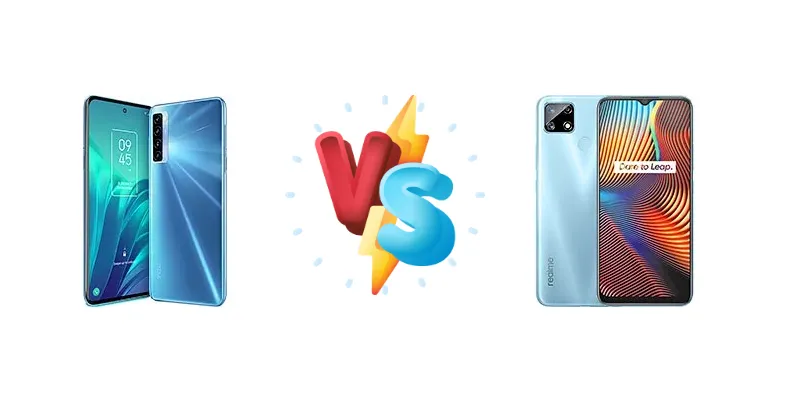
The TCL 20L and Realme 7i represent compelling options in the crowded sub-$200 smartphone market. Both aim to deliver essential features without breaking the bank, but they take different approaches to achieving this. The TCL 20L leverages Qualcomm's Snapdragon 662, while the Realme 7i opts for MediaTek's Helio G85. This comparison will dissect their key differences to help you choose the right device.
🏆 Quick Verdict
For the average user prioritizing sustained performance and a potentially smoother software experience, the TCL 20L emerges as the better choice. While both phones offer 18W charging, the Snapdragon 662's more efficient 11nm process and architectural advantages provide a slight edge in everyday tasks and light gaming.
| Network |
|---|
| 2G bands | GSM 850 / 900 / 1800 / 1900 | GSM 850 / 900 / 1800 / 1900 |
| 3G bands | HSDPA 850 / 900 / 1900 / 2100 - EU/MEA/APAC | HSDPA 850 / 900 / 1700(AWS) / 1900 / 2100 |
| 4G bands | 1, 3, 5, 7, 8, 20, 28, 38, 40, 41 - EU/MEA/APAC | 1, 2, 3, 4, 5, 7, 8, 20, 28, 38, 40, 41 |
| Speed | HSPA 42.2/5.76 Mbps, LTE Cat6 300/50 Mbps | HSPA, LTE |
| Technology | GSM / HSPA / LTE | GSM / HSPA / LTE |
| Launch |
|---|
| Announced | 2021, April 14 | 2020, December 22. Released 2020, December 23 |
| Status | Available. Released 2021, April 14 | Discontinued |
| Body |
|---|
| Build | Glass front, plastic back, plastic frame | - |
| Dimensions | 166.2 x 76.9 x 9.1 mm (6.54 x 3.03 x 0.36 in) | 164.5 x 75.9 x 9.8 mm (6.48 x 2.99 x 0.39 in) |
| SIM | · Nano-SIM· Nano-SIM + Nano-SIM | Nano-SIM + Nano-SIM |
| Weight | 199 g (7.02 oz) | 208 g (7.34 oz) |
| Display |
|---|
| Resolution | 1080 x 2400 pixels, 20:9 ratio (~395 ppi density) | 720 x 1600 pixels, 20:9 ratio (~270 ppi density) |
| Size | 6.67 inches, 107.4 cm2 (~84.0% screen-to-body ratio) | 6.5 inches, 102.0 cm2 (~81.7% screen-to-body ratio) |
| Type | IPS LCD, 500 nits (peak) | IPS LCD, 450 nits (typ), 560 nits (peak) |
| Platform |
|---|
| CPU | Octa-core (4x2.0 GHz Kryo 260 Gold & 4x1.8 GHz Kryo 260 Silver) | Octa-core (2x2.0 GHz Cortex-A75 & 6x1.8 GHz Cortex-A55) |
| Chipset | Qualcomm SM6115 Snapdragon 662 (11 nm) | Mediatek MT6769Z Helio G85 (12 nm) |
| GPU | Adreno 610 | Mali-G52 MC2 |
| OS | Android 11, TCL UI | Android 10, Realme UI |
| Memory |
|---|
| Card slot | microSDXC (uses shared SIM slot) | microSDXC (dedicated slot) |
| Internal | 128GB 4GB RAM, 128GB 6GB RAM | 64GB 4GB RAM |
| | - | eMMC 5.1 |
| Main Camera |
|---|
| Features | LED flash, HDR, panorama | LED flash, HDR, panorama |
| Quad | 48 MP, f/2.0, 26mm (wide), 1/2.0", 0.8µm, PDAF
8 MP, f/2.2, 13mm, 118˚ (ultrawide), 1/4.0", 1.12µm
2 MP (macro)
Auxiliary lens | - |
| Triple | - | 48 MP, f/1.8, 26mm (wide), 1/2.0", 0.8µm, PDAF
8 MP, f/2.3, 16mm, 119˚ (ultrawide), 1/4.0", 1.12µm
2 MP (macro) |
| Video | 1080p@30/60fps | 1080p@30/60fps |
| Selfie camera |
|---|
| Features | HDR | HDR, panorama |
| Single | 16 MP, f/2.2, 28mm (wide), 1/3.06", 1.0µm | 8 MP, f/2.0, 26mm (wide), 1/4.0", 1.12µm |
| Video | 1080p@30/60fps | 1080p@30fps |
| Sound |
|---|
| 3.5mm jack | - | Yes |
| 35mm jack | Yes | Yes |
| Loudspeaker | Yes | Yes |
| Comms |
|---|
| Bluetooth | 5.0, A2DP, LE, aptX | 5.0, A2DP, LE, aptX HD |
| NFC | Yes | No |
| Positioning | GPS, GLONASS, GALILEO, BDS | GPS, GLONASS, BDS |
| Radio | Unspecified | FM radio |
| USB | USB Type-C 2.0, OTG | USB Type-C 2.0, OTG |
| WLAN | Wi-Fi 802.11 a/b/g/n/ac, dual-band, Wi-Fi Direct | Wi-Fi 802.11 a/b/g/n/ac, dual-band, Wi-Fi Direct |
| Features |
|---|
| Sensors | Fingerprint (side-mounted), accelerometer, gyro, proximity, compass | Fingerprint (rear-mounted), accelerometer, proximity, compass |
| Battery |
|---|
| Charging | 18W wired | 18W wired
5W reverse wired |
| Type | Li-Po 5000 mAh | 6000 mAh |
| Misc |
|---|
| Colors | Eclipse Black, Luna Blue | Glory Silver, Victory Blue |
| Models | T774H, T774B | - |
| Price | About 180 EUR | About 190 EUR |
TCL 20L
- More efficient Snapdragon 662 chipset
- Potentially smoother software experience
- Better sustained performance due to thermal efficiency
- Lacks reverse charging functionality
- Likely standard 60Hz display refresh rate
Realme 7i (Global)
- Includes 5W reverse wired charging
- Potentially higher GPU performance in short bursts
- May feature a 90Hz display (marketing dependent)
- Less efficient Helio G85 chipset
- Potential for thermal throttling under sustained load
- Software optimization may be less refined
Display Comparison
Neither TCL nor Realme provide display specifications beyond resolution in the provided data. However, given the price point, both likely utilize IPS LCD panels. The Realme 7i's marketing often highlights its 90Hz refresh rate (not present in the provided data, but a common feature), which would provide a smoother scrolling experience compared to the standard 60Hz expected on the TCL 20L. Without detailed color accuracy or brightness data, it's difficult to definitively declare a winner, but the potential for a higher refresh rate gives the Realme 7i a possible advantage.
Camera Comparison
Without detailed camera sensor information, a direct comparison is limited. Both phones likely feature a multi-camera setup, but the quality will heavily depend on the primary sensor and image processing algorithms. Given the market segment, it's reasonable to assume both utilize budget-friendly sensors. The absence of Optical Image Stabilization (OIS) on either device suggests image stabilization will rely on software algorithms. The Realme 7i's marketing often emphasizes its camera capabilities, but without specific sensor details, it's difficult to assess its advantage over the TCL 20L.
Performance
The core difference lies in the chipsets. The TCL 20L's Snapdragon 662 (11nm) features a Kryo CPU architecture with a focus on efficiency. Its octa-core configuration (4x2.0 GHz Kryo 260 Gold & 4x1.8 GHz Kryo 260 Silver) balances performance and power consumption. The Realme 7i's Helio G85 (12nm) utilizes a more traditional Cortex-A75/A55 arrangement. While the G85 boasts a slightly higher clock speed on its prime cores (2x2.0 GHz Cortex-A75), the 12nm process is less efficient than the Snapdragon's 11nm node. This means the G85 is likely to generate more heat under sustained load, potentially leading to thermal throttling. The Snapdragon 662's architecture is generally better optimized for consistent performance, making it preferable for users who frequently multitask or play games for extended periods.
Battery Life
Both the TCL 20L and Realme 7i support 18W wired charging, offering similar charging speeds. However, the Realme 7i adds the convenience of 5W reverse wired charging, allowing it to act as a power bank for other devices. While battery capacity isn't specified, the Snapdragon 662's superior efficiency in the TCL 20L could translate to slightly longer battery life despite potentially having a similar capacity to the Realme 7i. The reverse charging feature is a unique benefit of the Realme 7i, appealing to users who frequently need to top up accessories like wireless earbuds.
Buying Guide
Buy the TCL 20L if you need a phone that handles multitasking and everyday apps with a bit more fluidity, and if you value Qualcomm's generally well-optimized software support. Buy the Realme 7i (Global) if you prioritize reverse charging functionality and potentially slightly better raw GPU performance in short bursts, though at the cost of potentially more thermal throttling during extended use.
Frequently Asked Questions
❓ Will the Realme 7i overheat while playing demanding games like PUBG Mobile?
The Helio G85 in the Realme 7i is capable of handling PUBG Mobile, but its 12nm process is less efficient than the Snapdragon 662. Expect potential thermal throttling after extended gaming sessions, which could lead to frame rate drops and a less consistent experience. The TCL 20L is likely to maintain more stable performance over longer periods.
❓ Is the 5W reverse charging on the Realme 7i useful for everyday accessories?
The 5W reverse charging is primarily useful for topping up small accessories like wireless earbuds or a smartwatch. It won't rapidly charge a smartphone, but it provides a convenient way to share power in a pinch. The TCL 20L lacks this feature entirely.
❓ Which phone is better for multitasking between several apps?
The TCL 20L, with its Snapdragon 662, is better suited for multitasking. The Snapdragon's architecture and efficiency allow it to handle multiple apps running simultaneously with less lag and smoother transitions compared to the Realme 7i's Helio G85.
❓ Does either phone support fast charging protocols beyond 18W?
Neither TCL nor Realme explicitly advertise support for faster charging protocols beyond 18W for these models. While they might be compatible with some generic PD chargers, don't expect significantly faster charging speeds than what the included 18W charger provides.