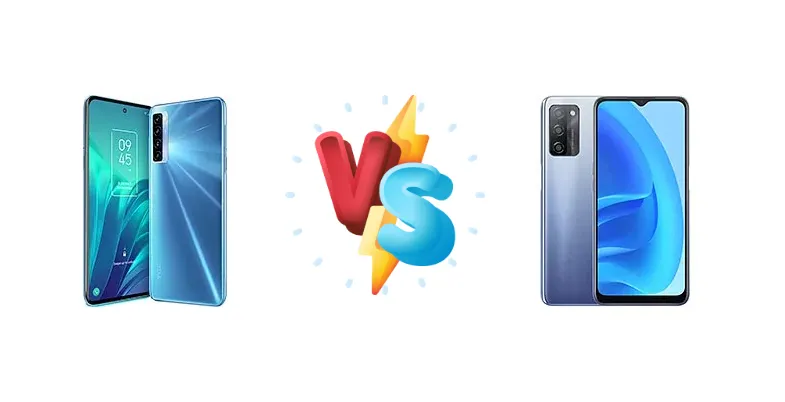
The TCL 20L and Oppo A55s represent compelling options in the crowded budget smartphone market. While both aim to deliver essential features at an accessible price point, they take fundamentally different approaches to core components, particularly their chipsets. This comparison will dissect the strengths and weaknesses of each device, focusing on real-world performance implications for the average user.
🏆 Quick Verdict
For most users, the Oppo A55s emerges as the stronger choice. Its Mediatek Dimensity 700, built on a more efficient 7nm process, provides a noticeable performance uplift over the TCL 20L’s Snapdragon 662, especially in demanding tasks. While the TCL 20L offers slightly faster wired charging, the A55s’ superior processing power makes it the better all-rounder.
| Network |
|---|
| 2G bands | GSM 850 / 900 / 1800 / 1900 | GSM 850 / 900 / 1800 / 1900 |
| 3G bands | HSDPA 850 / 900 / 1900 / 2100 - EU/MEA/APAC | HSDPA 800 / 850 / 900 / 1700(AWS) / 1900 / 2100 |
| 4G bands | 1, 3, 5, 7, 8, 20, 28, 38, 40, 41 - EU/MEA/APAC | 1, 3, 5, 8, 34, 38, 39, 40, 41 |
| 5G bands | - | 1, 28, 41, 77, 78 |
| Speed | HSPA 42.2/5.76 Mbps, LTE Cat6 300/50 Mbps | HSPA, LTE |
| Technology | GSM / HSPA / LTE | GSM / CDMA / HSPA / LTE / 5G |
| | - | CDMA 800 |
| Launch |
|---|
| Announced | 2021, April 14 | 2022, April 18 |
| Status | Available. Released 2021, April 14 | Available. Released 2022, April 18 |
| Body |
|---|
| Build | Glass front, plastic back, plastic frame | - |
| Dimensions | 166.2 x 76.9 x 9.1 mm (6.54 x 3.03 x 0.36 in) | 163.9 x 75.7 x 8.4 mm (6.45 x 2.98 x 0.33 in) |
| SIM | · Nano-SIM· Nano-SIM + Nano-SIM | Nano-SIM + Nano-SIM |
| Weight | 199 g (7.02 oz) | 186 g (6.56 oz) |
| Display |
|---|
| Resolution | 1080 x 2400 pixels, 20:9 ratio (~395 ppi density) | 720 x 1600 pixels, 20:9 ratio (~270 ppi density) |
| Size | 6.67 inches, 107.4 cm2 (~84.0% screen-to-body ratio) | 6.5 inches, 102.0 cm2 (~82.2% screen-to-body ratio) |
| Type | IPS LCD, 500 nits (peak) | IPS LCD, 480 nits (peak) |
| Platform |
|---|
| CPU | Octa-core (4x2.0 GHz Kryo 260 Gold & 4x1.8 GHz Kryo 260 Silver) | Octa-core (2x2.2 GHz Cortex-A76 & 6x2.0 GHz Cortex-A55) |
| Chipset | Qualcomm SM6115 Snapdragon 662 (11 nm) | Mediatek Dimensity 700 (7 nm) |
| GPU | Adreno 610 | Mali-G57 MC2 |
| OS | Android 11, TCL UI | Android 11, ColorOS 11.1 |
| Memory |
|---|
| Card slot | microSDXC (uses shared SIM slot) | microSDXC |
| Internal | 128GB 4GB RAM, 128GB 6GB RAM | 128GB 6GB RAM, 128GB 8GB RAM |
| Main Camera |
|---|
| Features | LED flash, HDR, panorama | LED flash, HDR, panorama |
| Quad | 48 MP, f/2.0, 26mm (wide), 1/2.0", 0.8µm, PDAF
8 MP, f/2.2, 13mm, 118˚ (ultrawide), 1/4.0", 1.12µm
2 MP (macro)
Auxiliary lens | - |
| Single | - | 8 MP, f/2.0, (wide) |
| Triple | - | 13 MP, f/2.2, 25mm (wide), 1/3.06", 1.12µm, PDAF
2 MP (macro)
Auxiliary lens |
| Video | 1080p@30/60fps | 1080p@30fps |
| Selfie camera |
|---|
| Features | HDR | HDR |
| Single | 16 MP, f/2.2, 28mm (wide), 1/3.06", 1.0µm | 8 MP, f/2.0, (wide) |
| Video | 1080p@30/60fps | 1080p@30fps |
| Sound |
|---|
| 3.5mm jack | - | Yes |
| 35mm jack | Yes | Yes |
| Loudspeaker | Yes | Yes |
| Comms |
|---|
| Bluetooth | 5.0, A2DP, LE, aptX | 5.1, A2DP, LE, aptX HD |
| NFC | Yes | No |
| Positioning | GPS, GLONASS, GALILEO, BDS | GPS, GLONASS, GALILEO, BDS, QZSS |
| Radio | Unspecified | No |
| USB | USB Type-C 2.0, OTG | USB Type-C 2.0, OTG |
| WLAN | Wi-Fi 802.11 a/b/g/n/ac, dual-band, Wi-Fi Direct | Wi-Fi 802.11 a/b/g/n/ac, dual-band, Wi-Fi Direct |
| Features |
|---|
| Sensors | Fingerprint (side-mounted), accelerometer, gyro, proximity, compass | Fingerprint (side-mounted), accelerometer, gyro, proximity, compass |
| Battery |
|---|
| Charging | 18W wired | 10W wired |
| Type | Li-Po 5000 mAh | Li-Po 5000 mAh |
| Misc |
|---|
| Colors | Eclipse Black, Luna Blue | Black, Blue, Gold |
| Models | T774H, T774B | CPH2309 |
| Price | About 180 EUR | About 160 EUR |
TCL 20L
- Faster 18W wired charging
- Potentially slightly longer battery life due to charging speed
- Established TCL brand in the TV market
- Less powerful Snapdragon 662 chipset
- Less efficient 11nm manufacturing process
- Likely inferior gaming performance
Oppo A55s
- More powerful Mediatek Dimensity 700 chipset
- More efficient 7nm manufacturing process
- 5G connectivity for future-proofing
- Slower 10W wired charging
- Oppo’s ColorOS can be divisive
- Potentially less brand recognition in some markets
Display Comparison
Neither TCL nor Oppo provide display specifications beyond resolution in their marketing materials. However, given the price bracket, both likely utilize IPS LCD panels. The key differentiator lies under the hood. The TCL 20L’s Snapdragon 662 relies on a less efficient 11nm process, potentially impacting overall thermal performance. The Oppo A55s, with its Dimensity 700 fabricated on a 7nm node, benefits from improved power efficiency, which could translate to slightly cooler operation during extended use. While both likely offer similar color accuracy, the 7nm process gives the A55s a subtle advantage in sustained performance.
Camera Comparison
Without detailed camera specs, a direct comparison is difficult. However, both phones likely feature a primary camera paired with auxiliary lenses of limited utility. The image signal processor (ISP) within the Dimensity 700 generally offers more advanced features and processing capabilities than the ISP found in the Snapdragon 662, potentially leading to better image quality in challenging lighting conditions. The A55s’ chipset could also support more advanced camera algorithms for features like night mode and HDR. The absence of optical image stabilization (OIS) on either device suggests a reliance on software stabilization, where the Dimensity 700’s superior processing power could again provide an edge.
Performance
The core of the difference between these two phones is the chipset. The Oppo A55s’ Mediatek Dimensity 700, featuring a dual-core Cortex-A76 setup clocked at 2.2 GHz, demonstrably outperforms the TCL 20L’s Snapdragon 662 (2.0 GHz Kryo 260 Gold). The Dimensity 700’s architecture, with its more modern cores, provides a significant boost in CPU-intensive tasks and GPU performance. This translates to snappier app launches, smoother multitasking, and a more enjoyable gaming experience. The 7nm process further enhances the Dimensity 700’s efficiency, reducing thermal throttling during prolonged gaming sessions. While the Snapdragon 662 is adequate for everyday tasks, the Dimensity 700 offers a more future-proof and responsive experience.
Battery Life
Battery capacity isn’t specified, but both phones likely house batteries in the 4000-5000 mAh range. The TCL 20L’s 18W wired charging is faster than the Oppo A55s’ 10W charging. This means the TCL 20L will likely achieve a full charge in a shorter timeframe. However, the Dimensity 700’s superior power efficiency could offset this difference in real-world usage, potentially resulting in comparable battery life despite the slower charging speed. The 7nm process allows the A55s to extract more usage from each mAh of battery capacity.
Buying Guide
Buy the TCL 20L if you prioritize slightly faster charging speeds and are primarily focused on basic smartphone tasks like calling, texting, and light social media use. Buy the Oppo A55s if you value smoother multitasking, better gaming performance, and future-proofing with 5G connectivity, even if it means sacrificing a bit of charging speed. The A55s is the better option for users who want a phone that can handle more than just the basics.
Frequently Asked Questions
❓ Will the Oppo A55s struggle with demanding games like PUBG Mobile?
While not a dedicated gaming phone, the Dimensity 700 in the Oppo A55s is capable of running PUBG Mobile at medium settings with reasonable frame rates. The 7nm process helps mitigate thermal throttling, allowing for sustained performance during gaming sessions. The TCL 20L’s Snapdragon 662 will likely require lower settings to achieve similar performance.
❓ Is the 10W charging on the Oppo A55s a significant drawback?
The 10W charging is slower than the TCL 20L’s 18W, but the Dimensity 700’s power efficiency means the A55s may not require charging as frequently. A full charge will take longer, but the overall impact on daily usage is likely minimal. Overnight charging is still a viable option.
❓ Does the TCL 20L support 5G connectivity?
No, the TCL 20L is limited to 4G LTE connectivity. The Oppo A55s, powered by the Dimensity 700, supports 5G, offering future-proofing and faster data speeds where available.
❓ Which phone is better for multitasking?
The Oppo A55s is significantly better for multitasking. The Dimensity 700’s more powerful CPU and GPU, combined with potentially more RAM, allow for smoother switching between apps and handling multiple tasks simultaneously without noticeable lag.