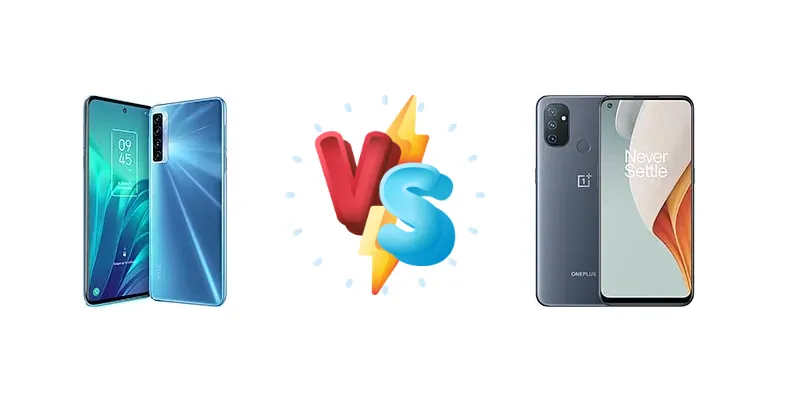
The TCL 20L and OnePlus Nord N100 represent the fiercely competitive sub-$200 smartphone market. Both aim to deliver essential smartphone functionality at an accessible price, but they achieve this with different chipsets – the Qualcomm Snapdragon 662 in the TCL 20L and the Snapdragon 460 in the OnePlus. This comparison dissects the architectural differences and real-world implications of these processors to determine which phone offers the best value.
🏆 Quick Verdict
For most users, the TCL 20L emerges as the better choice. Its Snapdragon 662 chipset provides a noticeable performance advantage over the Nord N100’s Snapdragon 460, translating to smoother multitasking and a more responsive user experience. While both offer 18W charging, the TCL 20L’s superior processing power justifies its slightly higher price point.
| Network |
|---|
| 2G bands | GSM 850 / 900 / 1800 / 1900 | GSM 850 / 900 / 1800 / 1900 |
| 3G bands | HSDPA 850 / 900 / 1900 / 2100 - EU/MEA/APAC | HSDPA 850 / 900 / 1700(AWS) / 1900 / 2100 |
| 4G bands | 1, 3, 5, 7, 8, 20, 28, 38, 40, 41 - EU/MEA/APAC | 1, 2, 3, 4, 5, 7, 8, 12, 17, 20, 28, 38, 40, 41 - International |
| Speed | HSPA 42.2/5.76 Mbps, LTE Cat6 300/50 Mbps | HSPA 42.2/5.76 Mbps, LTE Cat13 400/50 Mbps |
| Technology | GSM / HSPA / LTE | GSM / CDMA / HSPA / LTE |
| | - | 1, 2, 3, 4, 5, 7, 8, 12, 13, 17, 20, 25, 26, 28, 38, 41, 66, 71 - USA |
| Launch |
|---|
| Announced | 2021, April 14 | 2020, October 26 |
| Status | Available. Released 2021, April 14 | Available. Released 2020, November 11 |
| Body |
|---|
| Build | Glass front, plastic back, plastic frame | Glass front (Gorilla Glass 3), plastic frame |
| Dimensions | 166.2 x 76.9 x 9.1 mm (6.54 x 3.03 x 0.36 in) | 164.9 x 75.1 x 8.5 mm (6.49 x 2.96 x 0.33 in) |
| SIM | · Nano-SIM· Nano-SIM + Nano-SIM | Nano-SIM + Nano-SIM |
| Weight | 199 g (7.02 oz) | 188 g (6.63 oz) |
| Display |
|---|
| Protection | - | Corning Gorilla Glass 3 |
| Resolution | 1080 x 2400 pixels, 20:9 ratio (~395 ppi density) | 720 x 1600 pixels, 20:9 ratio (~269 ppi density) |
| Size | 6.67 inches, 107.4 cm2 (~84.0% screen-to-body ratio) | 6.52 inches, 102.6 cm2 (~82.9% screen-to-body ratio) |
| Type | IPS LCD, 500 nits (peak) | IPS LCD, 90Hz |
| Platform |
|---|
| CPU | Octa-core (4x2.0 GHz Kryo 260 Gold & 4x1.8 GHz Kryo 260 Silver) | Octa-core (4x1.8 GHz Kryo 240 & 4x1.6 GHz Kryo 240) |
| Chipset | Qualcomm SM6115 Snapdragon 662 (11 nm) | Qualcomm SM4250 Snapdragon 460 (11 nm) |
| GPU | Adreno 610 | Adreno 610 |
| OS | Android 11, TCL UI | Android 10, OxygenOS 10.5.9 |
| Memory |
|---|
| Card slot | microSDXC (uses shared SIM slot) | microSDXC |
| Internal | 128GB 4GB RAM, 128GB 6GB RAM | 64GB 4GB RAM |
| | - | UFS 2.1 |
| Main Camera |
|---|
| Features | LED flash, HDR, panorama | LED flash, HDR, panorama |
| Quad | 48 MP, f/2.0, 26mm (wide), 1/2.0", 0.8µm, PDAF
8 MP, f/2.2, 13mm, 118˚ (ultrawide), 1/4.0", 1.12µm
2 MP (macro)
Auxiliary lens | - |
| Triple | - | 13 MP, f/2.2, (wide), PDAF
2 MP (macro)
Auxiliary lens |
| Video | 1080p@30/60fps | 1080p@30fps, gyro-EIS |
| Selfie camera |
|---|
| Features | HDR | HDR |
| Single | 16 MP, f/2.2, 28mm (wide), 1/3.06", 1.0µm | 8 MP, f/2.0 |
| Video | 1080p@30/60fps | 1080p@30fps |
| Sound |
|---|
| 3.5mm jack | - | Yes |
| 35mm jack | Yes | Yes |
| Loudspeaker | Yes | Yes, with stereo speakers |
| Comms |
|---|
| Bluetooth | 5.0, A2DP, LE, aptX | 5.0, A2DP, LE |
| NFC | Yes | - |
| Positioning | GPS, GLONASS, GALILEO, BDS | GPS, GLONASS, GALILEO, BDS |
| Radio | Unspecified | FM radio |
| USB | USB Type-C 2.0, OTG | USB Type-C 2.0, OTG |
| WLAN | Wi-Fi 802.11 a/b/g/n/ac, dual-band, Wi-Fi Direct | Wi-Fi 802.11 a/b/g/n/ac, dual-band, Wi-Fi Direct |
| Features |
|---|
| Sensors | Fingerprint (side-mounted), accelerometer, gyro, proximity, compass | Fingerprint (rear-mounted), accelerometer, gyro, proximity, compass |
| Battery |
|---|
| Charging | 18W wired | 18W wired |
| Type | Li-Po 5000 mAh | Li-Po 5000 mAh |
| Misc |
|---|
| Colors | Eclipse Black, Luna Blue | Midnight Frost |
| Models | T774H, T774B | BE2013, BE2015, BE2011, BE2012 |
| Price | About 180 EUR | About 80 EUR |
| Pricing |
|---|
| 64GB 4GB RAM | - | $ 125.00 |
| RENEWED | - | $ 129.00 |
TCL 20L
- Superior performance with Snapdragon 662
- More responsive user experience
- Better image processing capabilities
- Potentially slightly higher price
- Battery life may be comparable to N100
OnePlus Nord N100
- Lowest possible price point
- Decent battery life for basic usage
- Functional for essential smartphone tasks
- Noticeably slower performance
- Struggles with multitasking and demanding apps
- Inferior image processing
Display Comparison
Neither TCL nor OnePlus provide display specifications beyond the basic panel type. However, the chipset differences indirectly impact display experience. The Snapdragon 662’s more capable GPU in the TCL 20L can drive the display more efficiently, potentially resulting in smoother animations and transitions. While both likely utilize LCD panels, the 662’s processing power could contribute to better image processing and color reproduction. Bezels are expected to be similar on both devices, given their price bracket.
Camera Comparison
Without detailed camera specifications, a direct comparison is limited. However, the Snapdragon 662’s image signal processor (ISP) in the TCL 20L is significantly more capable than the ISP in the Snapdragon 460. This translates to better image processing, improved dynamic range, and potentially superior low-light performance. While both phones likely feature a multi-camera setup, the TCL 20L will likely extract more detail and clarity from its sensors. The presence of a more powerful ISP is more impactful than sensor megapixel counts at this price point.
Performance
The core difference lies in the chipsets. The TCL 20L’s Snapdragon 662, built on an 11nm process, features an octa-core configuration with Kryo 260 Gold cores clocked at 2.0 GHz and Silver cores at 1.8 GHz. This architecture prioritizes performance and efficiency. Conversely, the OnePlus Nord N100 utilizes the Snapdragon 460, also on 11nm, but with Kryo 240 cores clocked lower at 1.8 GHz and 1.6 GHz. This indicates a focus on power efficiency over raw processing power. The 662’s higher clock speeds and more advanced core design will result in faster app loading times, smoother multitasking, and improved gaming performance. The N100 will likely struggle with demanding applications.
Battery Life
Both devices feature 18W wired charging, suggesting similar charging speeds – approximately 2-3 hours for a full charge. Battery capacity is not specified, but the Snapdragon 460’s lower power consumption in the OnePlus Nord N100 could result in slightly longer battery life during basic usage. However, the TCL 20L’s more efficient processor and potentially optimized software could mitigate this difference. The real-world battery experience will depend heavily on usage patterns.
Buying Guide
Buy the TCL 20L if you prioritize a smoother, more responsive user experience and anticipate running multiple apps or engaging in light gaming. The Snapdragon 662 offers a tangible performance boost. Buy the OnePlus Nord N100 if your primary needs are basic communication, social media, and light web browsing, and you are seeking the absolute lowest price point. The N100 is a functional device for minimal smartphone usage.
Frequently Asked Questions
❓ Will the OnePlus Nord N100 struggle with popular apps like TikTok or Facebook?
The Snapdragon 460 in the Nord N100 is adequate for basic social media usage, but you may experience occasional lag or slowdowns when scrolling through feeds or using features within apps like TikTok or Facebook, especially with multiple apps open simultaneously. The TCL 20L’s Snapdragon 662 will handle these apps much more smoothly.
❓ Is the performance difference between the Snapdragon 662 and 460 noticeable in everyday use?
Yes, the difference is quite noticeable. The Snapdragon 662 in the TCL 20L offers a significantly more responsive experience when launching apps, switching between tasks, and navigating the user interface. The Nord N100’s Snapdragon 460 will feel sluggish in comparison, particularly when multitasking.
❓ Can either of these phones handle mobile gaming?
The TCL 20L is the better choice for mobile gaming. While neither phone is a gaming powerhouse, the Snapdragon 662’s GPU provides a more playable experience in most mobile games. The Nord N100’s Snapdragon 460 will struggle with graphically demanding titles, requiring lower settings and potentially experiencing frame rate drops.