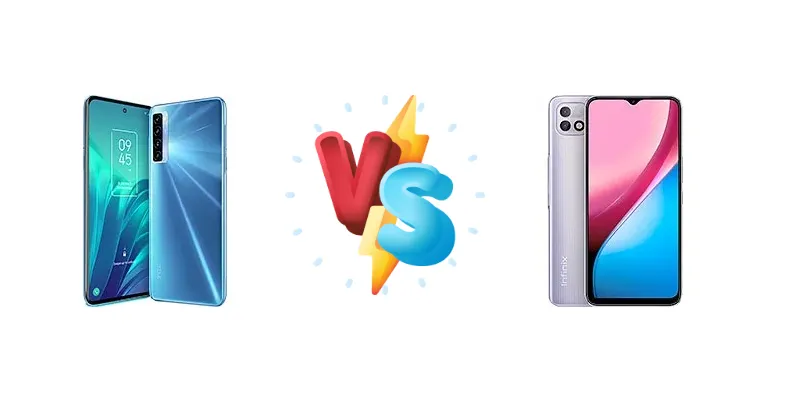
The TCL 20L and Infinix Hot 10i represent two compelling options in the crowded sub-$200 smartphone market. Both aim to deliver essential features at an accessible price, but they take different approaches under the hood. This comparison focuses on the core differences – specifically, the Qualcomm Snapdragon 662 versus the MediaTek Helio G70 – and how those impact real-world performance and user experience.
🏆 Quick Verdict
For the average user prioritizing sustained performance and efficiency, the TCL 20L is the better choice. While the Infinix Hot 10i’s Helio G70 offers a slight theoretical CPU boost, the Snapdragon 662’s 11nm process and optimized architecture translate to better thermal management and smoother multitasking over extended use.
| Network |
|---|
| 2G bands | GSM 850 / 900 / 1800 / 1900 | GSM 850 / 900 / 1800 / 1900 |
| 3G bands | HSDPA 850 / 900 / 1900 / 2100 - EU/MEA/APAC | HSDPA 850 / 900 / 1700(AWS) / 1900 / 2100 |
| 4G bands | 1, 3, 5, 7, 8, 20, 28, 38, 40, 41 - EU/MEA/APAC | 1, 2, 3, 4, 5, 7, 8, 20, 28, 38, 40, 41, 66 |
| Speed | HSPA 42.2/5.76 Mbps, LTE Cat6 300/50 Mbps | HSPA 42.2/5.76 Mbps, LTE Cat4 150/50 Mbps |
| Technology | GSM / HSPA / LTE | GSM / HSPA / LTE |
| | - | 1, 3, 5, 8, 38, 40, 41 |
| Launch |
|---|
| Announced | 2021, April 14 | 2021, May 20 |
| Status | Available. Released 2021, April 14 | Available. Released 2021, May 20 |
| Body |
|---|
| Build | Glass front, plastic back, plastic frame | - |
| Dimensions | 166.2 x 76.9 x 9.1 mm (6.54 x 3.03 x 0.36 in) | 164.3 x 76 x 9.6 mm (6.47 x 2.99 x 0.38 in) |
| SIM | · Nano-SIM· Nano-SIM + Nano-SIM | Nano-SIM + Nano-SIM |
| Weight | 199 g (7.02 oz) | - |
| Display |
|---|
| Resolution | 1080 x 2400 pixels, 20:9 ratio (~395 ppi density) | 720 x 1600 pixels, 20:9 ratio (~269 ppi density) |
| Size | 6.67 inches, 107.4 cm2 (~84.0% screen-to-body ratio) | 6.52 inches, 102.6 cm2 (~82.2% screen-to-body ratio) |
| Type | IPS LCD, 500 nits (peak) | IPS LCD, 500 nits (peak) |
| Platform |
|---|
| CPU | Octa-core (4x2.0 GHz Kryo 260 Gold & 4x1.8 GHz Kryo 260 Silver) | Octa-core (2x2.0 GHz Cortex-A75 & 6x1.7 GHz Cortex-A55) |
| Chipset | Qualcomm SM6115 Snapdragon 662 (11 nm) | Mediatek MT6769V Helio G70 (12 nm) |
| GPU | Adreno 610 | Mali-G52 MC2 |
| OS | Android 11, TCL UI | Android 11, XOS 7.5 |
| Memory |
|---|
| Card slot | microSDXC (uses shared SIM slot) | microSDXC (dedicated slot) |
| Internal | 128GB 4GB RAM, 128GB 6GB RAM | 32GB 3GB RAM, 64GB 2GB RAM, 64GB 4GB RAM, 128GB 6GB RAM |
| | - | eMMC 5.1 |
| Main Camera |
|---|
| Dual | - | 13 MP, f/1.8, (wide), AF
Auxiliary lens |
| Features | LED flash, HDR, panorama | Quad-LED flash |
| Quad | 48 MP, f/2.0, 26mm (wide), 1/2.0", 0.8µm, PDAF
8 MP, f/2.2, 13mm, 118˚ (ultrawide), 1/4.0", 1.12µm
2 MP (macro)
Auxiliary lens | - |
| Single | - | 5 MP, (wide) |
| Video | 1080p@30/60fps | 1440p@30fps |
| Selfie camera |
|---|
| Features | HDR | - |
| Single | 16 MP, f/2.2, 28mm (wide), 1/3.06", 1.0µm | 5 MP, (wide) |
| Video | 1080p@30/60fps | Unspecified |
| Sound |
|---|
| 3.5mm jack | - | Yes |
| 35mm jack | Yes | Yes |
| Loudspeaker | Yes | Yes |
| Comms |
|---|
| Bluetooth | 5.0, A2DP, LE, aptX | Yes |
| NFC | Yes | No |
| Positioning | GPS, GLONASS, GALILEO, BDS | GPS |
| Radio | Unspecified | FM radio |
| USB | USB Type-C 2.0, OTG | microUSB 2.0 |
| WLAN | Wi-Fi 802.11 a/b/g/n/ac, dual-band, Wi-Fi Direct | Wi-Fi 802.11 a/b/g/n/ac, dual-band, Wi-Fi Direct |
| Features |
|---|
| Sensors | Fingerprint (side-mounted), accelerometer, gyro, proximity, compass | Fingerprint (rear-mounted), accelerometer, proximity |
| Battery |
|---|
| Charging | 18W wired | 18W wired |
| Type | Li-Po 5000 mAh | 6000 mAh |
| Misc |
|---|
| Colors | Eclipse Black, Luna Blue | Black, Purple, Morandi Green, Heart of Ocean |
| Models | T774H, T774B | X659B, PR652B, X658E, PR652C, X658B, X659 |
| Price | About 180 EUR | About 100 EUR |
TCL 20L
- More efficient Snapdragon 662 chipset
- Potentially better camera image processing
- Smoother multitasking and sustained performance
- Potentially lower peak CPU performance compared to Helio G70
- Limited information on display quality
Infinix Hot 10i
- Higher peak CPU clock speeds (Cortex-A75 cores)
- Competitive price point
- Fast 18W charging
- Less efficient Helio G70 chipset
- Potential for thermal throttling under load
- Likely shorter battery life
Display Comparison
Neither TCL nor Infinix provide detailed display specs beyond resolution. However, given the price point, both likely utilize IPS LCD panels. The key difference lies in the chipsets driving them. The Snapdragon 662 includes a more capable ISP (Image Signal Processor) which can contribute to better image processing from the front and rear cameras, potentially improving the visual experience. Bezels are expected to be similar on both devices, reflecting the budget nature of the phones.
Camera Comparison
Without detailed camera sensor information, a direct comparison is difficult. However, the Snapdragon 662’s superior ISP provides a processing advantage. This translates to potentially better dynamic range, noise reduction, and overall image quality, even with similar sensors. The Helio G70’s ISP is adequate, but likely won’t match the Snapdragon’s capabilities. The prevalence of 2MP macro/depth sensors on both phones suggests limited photographic versatility; focus should be on the main sensor’s quality (which is unspecified in the provided data).
Performance
The core of this comparison is the chipset battle. The TCL 20L’s Qualcomm Snapdragon 662 (11nm) features an octa-core CPU with a Kryo 260 Gold/Silver configuration. This architecture prioritizes efficiency alongside performance. Conversely, the Infinix Hot 10i’s MediaTek Helio G70 (12nm) utilizes a Cortex-A75/A55 setup. While the A75 cores offer higher peak clock speeds (2.0 GHz vs 2.0 GHz), the larger 12nm process node inherently consumes more power. This means the Helio G70 is likely to throttle more aggressively under sustained load, impacting gaming and multitasking. The Snapdragon 662’s efficiency is a significant advantage for all-day use.
Battery Life
Both phones feature 18W wired charging, suggesting similar charging speeds (approximately 2-3 hours for a full charge). The battery capacity is not specified, but the Snapdragon 662’s efficiency gives the TCL 20L an edge in battery life. The Helio G70’s higher power consumption will necessitate more frequent charging, even with a comparable battery size. The 11nm process allows the TCL 20L to deliver more performance per watt, extending usable time between charges.
Buying Guide
Buy the TCL 20L if you need a phone that can handle daily tasks and moderate gaming without significant slowdowns, and if you value long-term stability and software optimization. Buy the Infinix Hot 10i if you prioritize raw CPU power for short bursts of demanding tasks and are comfortable with potentially more aggressive battery management to achieve peak performance.
Frequently Asked Questions
❓ Will the Helio G70 in the Infinix Hot 10i overheat during prolonged gaming sessions?
The MediaTek Helio G70, built on a 12nm process, is more prone to thermal throttling than the Snapdragon 662. While it can handle short gaming bursts, expect performance to decrease and the phone to get noticeably warm during extended gameplay. The TCL 20L’s Snapdragon 662 will maintain more consistent performance over longer periods.
❓ Does the TCL 20L offer a noticeable advantage in app loading times compared to the Infinix Hot 10i?
While both phones have 8-core CPUs, the Snapdragon 662’s optimized architecture and efficient processing will likely result in slightly faster app loading times and smoother transitions between applications. The difference won’t be dramatic, but it contributes to a more responsive user experience.
❓ Is the 18W charging on both phones equally effective?
The 18W charging wattage is the same on both devices, but the TCL 20L’s more efficient power management may allow it to reach full charge slightly faster, as it won’t be battling as much internal power draw during the charging process. However, the difference will likely be minimal.