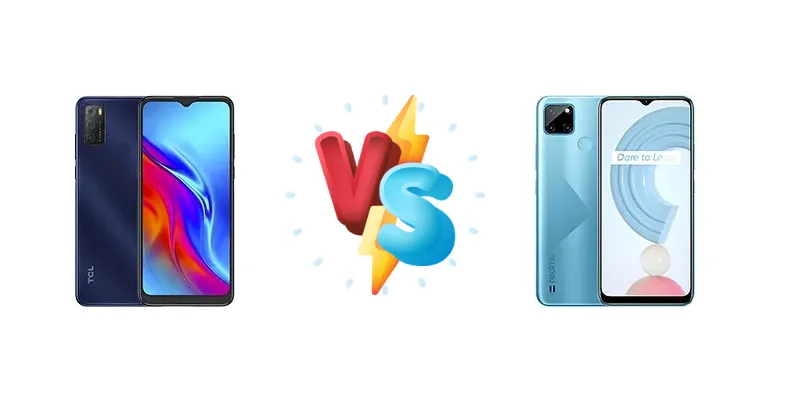
The TCL 20E and Realme C21Y represent the fiercely competitive sub-$150 smartphone market. Both aim to deliver essential functionality at an accessible price, but they take different approaches to achieving this. The TCL 20E relies on the established MediaTek Helio P22, while the Realme C21Y opts for the newer Unisoc T610. This comparison will dissect the key differences to determine which device offers the best value for your money.
🏆 Quick Verdict
For most users, the Realme C21Y emerges as the stronger choice. Its Unisoc T610 chipset, featuring a mix of Cortex-A75 and A55 cores, provides a noticeable performance uplift over the TCL 20E’s aging Helio P22. The inclusion of reverse wired charging is a unique bonus, making it a more versatile option.
| Network |
|---|
| 2G bands | GSM 850 / 900 / 1800 / 1900 | GSM 850 / 900 / 1800 / 1900 |
| 3G bands | HSDPA 850 / 900 / 1900 / 2100 | HSDPA 850 / 900 / 2100 |
| 4G bands | 1, 3, 5, 7, 8, 20, 28, 38, 40, 41 | 1, 3, 5, 8, 38, 40, 41 |
| Speed | HSPA, LTE | HSPA, LTE |
| Technology | GSM / HSPA / LTE | GSM / HSPA / LTE |
| Launch |
|---|
| Announced | 2021, October 12 | 2021, June 21 |
| Status | Available. Released 2021, October 12 | Available. Released 2021, July 02 |
| Body |
|---|
| Build | Glass front, plastic frame, plastic back | Glass front, plastic back, plastic frame |
| Dimensions | 165.6 x 75.6 x 8.8 mm (6.52 x 2.98 x 0.35 in) | 164.5 x 76 x 9.1 mm (6.48 x 2.99 x 0.36 in) |
| SIM | Nano-SIM + Nano-SIM | Nano-SIM + Nano-SIM |
| Weight | 190 g (6.70 oz) | 200 g (7.05 oz) |
| Display |
|---|
| Resolution | 720 x 1600 pixels, 20:9 ratio (~269 ppi density) | 720 x 1600 pixels, 20:9 ratio (~270 ppi density) |
| Size | 6.52 inches, 102.6 cm2 (~82.0% screen-to-body ratio) | 6.5 inches, 102.0 cm2 (~81.6% screen-to-body ratio) |
| Type | IPS LCD, | IPS LCD, 400 nits (typ) |
| Platform |
|---|
| CPU | Octa-core 2.0 GHz Cortex-A53 | Octa-core (2x1.8 GHz Cortex-A75 & 6x1.8 GHz Cortex-A55) |
| Chipset | Mediatek MT6762 Helio P22 (12 nm) | Unisoc T610 (12 nm) |
| GPU | PowerVR GE8320 | Mali-G52 MP2 |
| OS | Android 11, TCL UI | Android 10/ Android 11 |
| Memory |
|---|
| Card slot | microSDXC (uses shared SIM slot) | microSDXC (dedicated slot) |
| Internal | 64GB 3GB RAM, 64GB 4GB RAM, 128GB 4GB RAM | 32GB 3GB RAM, 64GB 4GB RAM |
| | - | eMMC 5.1 |
| Main Camera |
|---|
| Dual | - | 13 MP, f/2.2, 26mm (wide), 1/3.06", 1.12µm, PDAF
2 MP (macro)
Auxiliary lens |
| Features | LED flash, HDR, panorama | LED flash, HDR, panorama |
| Single | - | 5 MP, f/2.2, (wide), 1/5.0", 1.12µm |
| Triple | 13 MP, f/2.2, 27mm (wide) 1/3.0", 1.12µm, PDAF
2 MP (macro)
Auxiliary lens | - |
| Video | 1080p@30fps | 1080p@30fps |
| Selfie camera |
|---|
| Features | - | HDR, panorama |
| Single | 5 MP or 8 MP | 5 MP, f/2.2, (wide), 1/5.0", 1.12µm |
| Video | 720p@30fps | 1080p@30fps |
| Sound |
|---|
| 3.5mm jack | - | Yes |
| 35mm jack | Yes | Yes |
| Loudspeaker | Yes | Yes |
| Comms |
|---|
| Bluetooth | 5.0, A2DP, LE | 5.0, A2DP, LE |
| NFC | No | No |
| Positioning | GPS, GLONASS, GALILEO, BDS | GPS, GLONASS, BDS |
| Radio | Unspecified | Unspecified |
| USB | microUSB 2.0 | microUSB 2.0, OTG |
| WLAN | Wi-Fi 802.11 b/g/n | Wi-Fi 802.11 b/g/n |
| Features |
|---|
| Sensors | Fingerprint (rear-mounted), accelerometer, proximity, compass | Fingerprint (rear-mounted), accelerometer, proximity, compass |
| Battery |
|---|
| Charging | 10W wired | Reverse wired |
| Type | Li-Po 4000 mAh | 5000 mAh |
| Misc |
|---|
| Colors | Black, Blue, Green | Cross Black, Cross Blue |
| Models | 6125F, 6125D, 6125H | RMX3261, RMX3263 |
| Price | About 160 EUR | About 130 EUR |
TCL 20E
- Familiar MediaTek chipset
- Reliable for basic tasks
- Generally affordable
- Aging Helio P22 processor
- Limited performance for multitasking
- No reverse charging
Realme C21Y
- More powerful Unisoc T610 chipset
- Reverse wired charging capability
- Improved multitasking performance
- Unisoc chipset may have limited software support
- Potentially less brand recognition
Display Comparison
Neither device boasts a standout display. Both are likely utilizing LCD panels, typical for this price bracket. Without specific resolution or brightness data, it’s difficult to declare a clear winner. However, the Realme C21Y’s slightly larger screen size (typically 6.5 inches vs the TCL 20E’s 6.51 inches) may offer a marginally more immersive viewing experience. Color accuracy and viewing angles are expected to be average on both.
Camera Comparison
Both phones likely feature a primary camera around 13MP, but detailed sensor size and aperture information is missing. Without this data, a direct comparison is difficult. However, the image processing capabilities of Unisoc chipsets have improved, potentially giving the Realme C21Y an edge in image quality. The TCL 20E’s camera performance is likely to be adequate for basic photography in good lighting conditions, but will struggle in low-light scenarios. The presence of 2MP macro/depth sensors on both devices is largely marketing fluff and shouldn’t heavily influence your decision.
Performance
The core difference lies in the chipsets. The TCL 20E’s MediaTek Helio P22, with its eight Cortex-A53 cores clocked at 2.0 GHz, is a well-known but aging processor. The Realme C21Y’s Unisoc T610, featuring two Cortex-A75 cores at 1.8 GHz and six Cortex-A55 cores at 1.8 GHz, offers a significant architectural advantage. The A75 cores provide a substantial boost in single-core performance, translating to snappier app launches and smoother multitasking. While both are 12nm chips, the newer architecture of the T610 provides better efficiency. This means the Realme C21Y is likely to handle demanding tasks for longer without significant throttling.
Battery Life
Both devices likely house around a 5000mAh battery, providing all-day battery life for moderate usage. However, the Realme C21Y’s inclusion of reverse wired charging is a key differentiator. This allows you to use the phone as a power bank to charge accessories like earbuds or smartwatches. The TCL 20E is limited to 10W wired charging, while the Realme C21Y’s charging speed is unspecified but likely similar. The reverse charging feature adds significant utility, especially for users with multiple devices.
Buying Guide
Buy the TCL 20E if your primary need is a basic, reliable smartphone for essential tasks like calls, messaging, and light social media use, and you prioritize a known chipset brand. Buy the Realme C21Y if you want a more responsive experience for multitasking, occasional gaming, and appreciate the convenience of reverse charging to top up accessories.
Frequently Asked Questions
❓ Is the Unisoc T610 in the Realme C21Y a reliable chipset for long-term use?
While Unisoc has historically been less prominent than MediaTek or Qualcomm, the T610 is a relatively recent chipset and offers a significant performance improvement over the Helio P22. Reliability will depend on Realme’s software support and updates, but the chipset itself is capable of handling everyday tasks for several years.
❓ How useful is the reverse charging feature on the Realme C21Y in real-world scenarios?
The reverse charging feature is surprisingly practical. It allows you to top up accessories like wireless earbuds, smartwatches, or even another phone in a pinch. While it won’t fully charge another device quickly, it can provide a crucial boost when you’re away from a power outlet.
❓ Will the TCL 20E struggle with popular apps like Facebook or WhatsApp?
The TCL 20E’s Helio P22 chipset can run apps like Facebook and WhatsApp, but you may experience occasional lag or slowdowns, especially when multitasking. The phone is best suited for light usage and may not provide a smooth experience with more demanding apps.