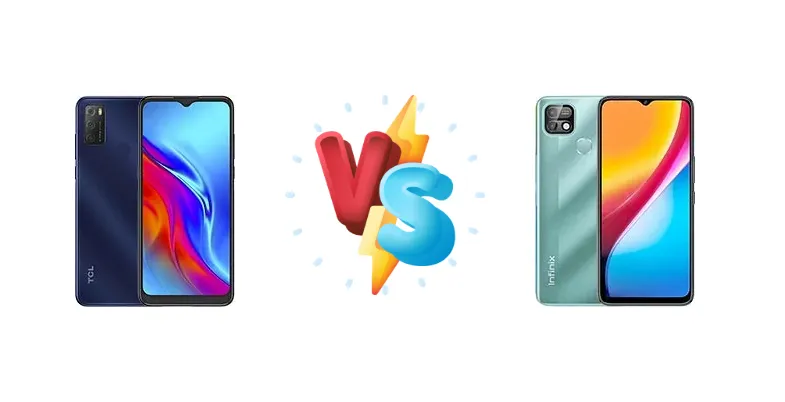
The TCL 20E and Infinix Smart 5 Pro represent the extreme end of the budget smartphone market, targeting users prioritizing affordability above all else. Both devices aim to deliver a functional smartphone experience, but they take different approaches to achieving this, primarily through their chipset choices. This comparison dissects those choices and their implications for everyday use.
🏆 Quick Verdict
For the average user, the TCL 20E emerges as the slightly better choice. While both phones offer a basic experience, the Mediatek Helio P22’s Cortex-A53 cores, despite being older architecture, generally provide a more consistent and responsive experience than the Unisoc SC9863A’s mixed Cortex-A55 configuration, especially in multi-tasking scenarios.
| Network |
|---|
| 2G bands | GSM 850 / 900 / 1800 / 1900 | GSM 850 / 900 / 1800 / 1900 |
| 3G bands | HSDPA 850 / 900 / 1900 / 2100 | HSDPA 850 / 900 / 2100 |
| 4G bands | 1, 3, 5, 7, 8, 20, 28, 38, 40, 41 | 1, 3, 5, 8, 38, 40, 41 |
| Speed | HSPA, LTE | HSPA 21.1/5.76 Mbps, LTE Cat4 150/50 Mbps |
| Technology | GSM / HSPA / LTE | GSM / HSPA / LTE |
| | - | 1, 2, 3, 4, 5, 7, 8, 20, 28, 38, 41, 40, 66 |
| Launch |
|---|
| Announced | 2021, October 12 | 2021, November 17 |
| Status | Available. Released 2021, October 12 | Available. Released 2021, November 17 |
| Body |
|---|
| Build | Glass front, plastic frame, plastic back | Glass front, plastic back, plastic frame |
| Dimensions | 165.6 x 75.6 x 8.8 mm (6.52 x 2.98 x 0.35 in) | 164.4 x 75.6 x 9.5 mm (6.47 x 2.98 x 0.37 in) |
| SIM | Nano-SIM + Nano-SIM | Nano-SIM + Nano-SIM |
| Weight | 190 g (6.70 oz) | - |
| Display |
|---|
| Resolution | 720 x 1600 pixels, 20:9 ratio (~269 ppi density) | 720 x 1600 pixels, 20:9 ratio (~269 ppi density) |
| Size | 6.52 inches, 102.6 cm2 (~82.0% screen-to-body ratio) | 6.52 inches, 102.6 cm2 (~82.6% screen-to-body ratio) |
| Type | IPS LCD, | IPS LCD, 500 nits (peak) |
| Platform |
|---|
| CPU | Octa-core 2.0 GHz Cortex-A53 | Octa-core (4x1.6 GHz Cortex-A55 & 4x1.2 GHz Cortex-A55) |
| Chipset | Mediatek MT6762 Helio P22 (12 nm) | Unisoc SC9863A (28 nm) |
| GPU | PowerVR GE8320 | IMG8322 |
| OS | Android 11, TCL UI | Android 11 (Go edition), XOS 7.6 |
| Memory |
|---|
| Card slot | microSDXC (uses shared SIM slot) | microSDXC (dedicated slot) |
| Internal | 64GB 3GB RAM, 64GB 4GB RAM, 128GB 4GB RAM | 32GB 2GB RAM |
| | - | eMMC 5.1 |
| Main Camera |
|---|
| Dual | - | 13 MP, f/1.8, AF
Auxiliary lens |
| Features | LED flash, HDR, panorama | Quad-LED flash |
| Single | - | 8 MP |
| Triple | 13 MP, f/2.2, 27mm (wide) 1/3.0", 1.12µm, PDAF
2 MP (macro)
Auxiliary lens | - |
| Video | 1080p@30fps | 1440p@30fps |
| Selfie camera |
|---|
| Features | - | Dual-LED flash |
| Single | 5 MP or 8 MP | 8 MP |
| Video | 720p@30fps | 1080p@30fps |
| Sound |
|---|
| 3.5mm jack | - | Yes |
| 35mm jack | Yes | Yes |
| Loudspeaker | Yes | Yes |
| Comms |
|---|
| Bluetooth | 5.0, A2DP, LE | 4.2, A2DP |
| NFC | No | No |
| Positioning | GPS, GLONASS, GALILEO, BDS | GPS |
| Radio | Unspecified | FM radio |
| USB | microUSB 2.0 | microUSB 2.0 |
| WLAN | Wi-Fi 802.11 b/g/n | Wi-Fi 802.11 b/g/n |
| Features |
|---|
| Sensors | Fingerprint (rear-mounted), accelerometer, proximity, compass | Fingerprint (rear-mounted), accelerometer, proximity |
| Battery |
|---|
| Charging | 10W wired | 10W wired |
| Type | Li-Po 4000 mAh | 6000 mAh |
| Misc |
|---|
| Colors | Black, Blue, Green | Morandi Green, Heart of Ocean |
| Models | 6125F, 6125D, 6125H | - |
| Price | About 160 EUR | About 70 EUR |
TCL 20E
- More consistent performance with the Helio P22 chipset.
- Potentially better image processing capabilities.
- More mature chipset driver support.
- Older Cortex-A53 architecture.
- Likely similar battery life to the Infinix Smart 5 Pro.
Infinix Smart 5 Pro
- Potentially longer battery life during light usage.
- More modern Cortex-A55 cores (though split configuration).
- Lower price point (likely).
- Less consistent performance due to the mixed core configuration.
- Larger process node (28nm) leads to lower efficiency.
Display Comparison
Neither TCL nor Infinix provide display specifications beyond resolution in their marketing materials. Given the price point, both likely utilize IPS LCD panels. However, the chipset differences hint at potential variations in display driver efficiency. The Helio P22’s more mature driver support might translate to slightly better color accuracy and brightness control on the TCL 20E, though this is speculative. Bezels are expected to be substantial on both devices, reflecting their budget nature.
Camera Comparison
Both phones are expected to feature basic camera setups. Without detailed sensor information, it’s difficult to make a definitive comparison. However, the TCL 20E’s chipset generally supports more advanced image signal processing (ISP) capabilities than the Unisoc SC9863A. This *could* translate to slightly better image quality, particularly in low-light conditions, even with similar sensors. Expect both phones to struggle with dynamic range and detail in challenging lighting scenarios. The prevalence of 2MP macro/depth sensors on both devices suggests these are largely marketing features with limited practical benefit.
Performance
The core difference lies in the chipsets. The TCL 20E’s Mediatek Helio P22 (12nm) features eight Cortex-A53 cores clocked at 2.0 GHz. This is an older architecture, but the consistent core design offers predictable performance. The Infinix Smart 5 Pro utilizes the Unisoc SC9863A (28nm), a more modern but less refined chipset. Its octa-core configuration is split between four Cortex-A55 cores at 1.6 GHz and four at 1.2 GHz. This 'big.LITTLE' approach *can* improve efficiency, but the SC9863A’s larger process node (28nm vs 12nm) and less optimized architecture likely result in lower sustained performance and potentially more heat generation under load. The Helio P22’s 12nm process gives it an edge in power efficiency, even with the older architecture.
Battery Life
Both devices feature 10W wired charging, indicating similar charging speeds. Battery capacity is not specified in the provided data. However, the Unisoc SC9863A’s lower peak performance and potentially more aggressive power management *could* result in slightly longer battery life during light usage. The Helio P22, while more powerful, is also more efficient at its core, meaning the difference in real-world battery life will likely be marginal and heavily dependent on usage patterns. Expect both phones to require daily charging with moderate use.
Buying Guide
Buy the TCL 20E if you need a phone that can handle basic multitasking and everyday apps with reasonable smoothness. It’s a better option for users who occasionally play less demanding games or browse the web with multiple tabs open. Buy the Infinix Smart 5 Pro if your primary needs are limited to calls, texts, and very light app usage, and you prioritize potentially longer battery life due to the Unisoc chip’s lower power draw under minimal load.
Frequently Asked Questions
❓ Will the TCL 20E handle popular social media apps like Facebook and Instagram smoothly?
Yes, the TCL 20E’s Mediatek Helio P22 chipset is capable of running social media apps without significant lag. However, expect some slowdown when multitasking between several apps or using resource-intensive features within those apps.
❓ Is the Unisoc SC9863A in the Infinix Smart 5 Pro known for overheating during prolonged use?
The Unisoc SC9863A is not a high-performance chip and generally doesn’t overheat significantly. However, its 28nm process node is less efficient than the TCL 20E’s 12nm node, meaning it may get warmer during extended gaming or video playback.
❓ Can either of these phones run PUBG Mobile, and if so, at what settings?
Both phones can *launch* PUBG Mobile, but the experience will be far from ideal. Expect to play at the lowest possible settings (graphics and frame rate) and still experience noticeable lag and stuttering. These phones are not designed for gaming.
❓ How much storage does each phone typically offer, and is it expandable?
While not specified, both phones in this price segment typically offer 32GB of internal storage, with microSD card support for expansion. Checking the specific retailer listing is crucial to confirm the exact storage configuration.