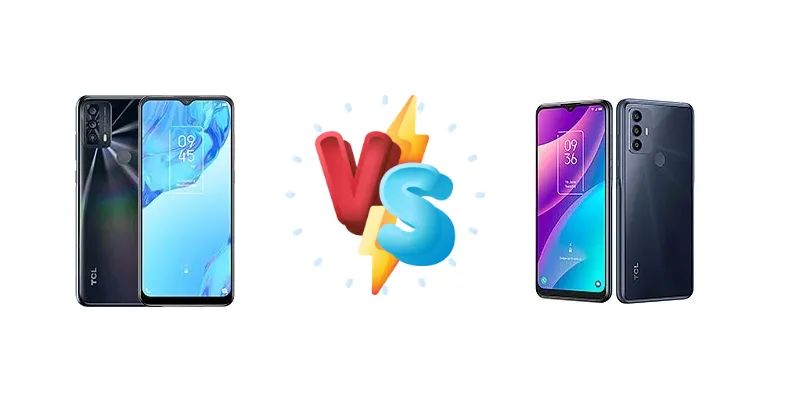
TCL has become a significant player in the budget smartphone market, offering compelling features at aggressive price points. The 20B and 30 SE represent two distinct approaches within that space. The 20B, an older model, may now be available at even lower prices, while the 30 SE offers a slightly newer chipset and a refreshed design. This comparison dives deep into the specifications to determine which device delivers the best value.
🏆 Quick Verdict
For most users, the TCL 30 SE is the better choice. While both phones utilize Mediatek's budget-focused Helio series, the 30 SE's Helio G25, with its higher clocked Cortex-A53 cores, provides a noticeable performance uplift for everyday tasks and light gaming. The slightly slower 15W charging is a minor trade-off for this improved processing power.
| Network |
|---|
| 2G bands | GSM 850 / 900 / 1800 / 1900 | GSM 850 / 900 / 1800 / 1900 |
| 3G bands | HSDPA 850 / 900 / 1900 / 2100 | HSDPA 850 / 900 / 1900 / 2100 - EMEA/APAC |
| 4G bands | 1, 3, 5, 7, 8, 20, 28, 38, 40, 41 | 1, 3, 5, 7, 8, 20, 28, 38, 40, 41 - EMEA |
| Speed | HSPA, LTE | HSPA 42.2/11.5 Mbps, LTE Cat4 150/50 Mbps |
| Technology | GSM / HSPA / LTE | GSM / HSPA / LTE |
| | - | 2, 3, 4, 5, 7, 8, 12, 13, 17, 26, 28, 66 - LATAM |
| Launch |
|---|
| Announced | 2021, September 30 | 2022, February 27 |
| Status | Available. Released 2021, September 30 | Available. Released 2022, April 20 |
| Body |
|---|
| Build | Glass front, plastic frame, plastic back | Glass front, plastic frame, plastic back |
| Dimensions | 164.7 x 74.7 x 8 mm (6.48 x 2.94 x 0.31 in) | 165.2 x 75.5 x 8.9 mm (6.50 x 2.97 x 0.35 in) |
| SIM | Nano-SIM + Nano-SIM | · Nano-SIM· Nano-SIM + Nano-SIM |
| Weight | 178 g (6.28 oz) | 190 g (6.70 oz) |
| Display |
|---|
| Resolution | 720 x 1600 pixels, 20:9 ratio (~269 ppi density) | 720 x 1600 pixels, 20:9 ratio (~269 ppi density) |
| Size | 6.52 inches, 102.6 cm2 (~83.4% screen-to-body ratio) | 6.52 inches, 102.6 cm2 (~82.3% screen-to-body ratio) |
| Type | IPS LCD | IPS LCD, 450 nits (typ) |
| Platform |
|---|
| CPU | Octa-core 1.8 GHz Cortex-A53 | Octa-core (4x2.0 GHz Cortex-A53 & 4x1.5 GHz Cortex-A53) |
| Chipset | Mediatek MT6762 Helio P22 (12 nm) | Mediatek MT6762G Helio G25 (12 nm) |
| GPU | PowerVR GE8320 | PowerVR GE8320 |
| OS | Android 11, TCL UI | Android 12, TCL UI 4.0 |
| Memory |
|---|
| Card slot | microSDXC | microSDXC (dedicated slot) |
| Internal | 64GB 4GB RAM | 64GB 4GB RAM, 128GB 4GB RAM |
| | - | eMMC 5.1 |
| Main Camera |
|---|
| Dual | 50 MP, (wide), PDAF
Auxiliary lens | - |
| Features | LED flash, HDR, panorama | LED flash, HDR, panorama |
| Single | - | 8 MP, f/2.0, 26mm (wide), 1/4", 1.12µm |
| Triple | - | 50 MP, f/1.9, 28mm (wide), 1/2.76", 0.64µm, PDAF
2 MP (macro)
Auxiliary lens |
| Video | 1080p@30fps | 1080p@30fps |
| Selfie camera |
|---|
| Features | - | HDR |
| Single | 8 MP | 8 MP, f/2.0, 26mm (wide), 1/4.0", 1.12µm |
| Video | 1080p@30fps | 1080p@30fps |
| Sound |
|---|
| 3.5mm jack | - | Yes |
| 35mm jack | Yes | Yes |
| Loudspeaker | Yes | Yes |
| Comms |
|---|
| Bluetooth | 5.0, A2DP, LE | 5.0, A2DP, LE |
| NFC | No | Yes (6165H/6165H1 only) |
| Positioning | GPS | GPS, GLONASS, GALILEO, BDS |
| Radio | Unspecified | Unspecified |
| USB | USB Type-C 2.0 | USB Type-C 2.0 |
| WLAN | Wi-Fi 802.11 b/g/n, Wi-Fi Direct | Wi-Fi 802.11 b/g/n, Wi-Fi Direct |
| Features |
|---|
| Sensors | Fingerprint (rear-mounted), accelerometer, proximity | Fingerprint (rear-mounted), accelerometer, proximity, compass |
| Battery |
|---|
| Charging | 18W wired | 15W wired |
| Type | Li-Po 4000 mAh | Li-Po 5000 mAh |
| Misc |
|---|
| Colors | Gray, Violet | Atlantic Blue, Space Gray, Glacial Blue |
| Models | 6159K | 6165H, 6156H1, 6165A, 6165A1, 6165S |
| Price | About 320 EUR | - |
TCL 20B
- Potentially lower price point due to being an older model.
- Slightly faster wired charging (18W vs 15W).
- Functional for basic smartphone tasks.
- Less powerful processor (Helio P22 vs G25).
- Slower app launch times and multitasking.
- Less responsive user interface.
TCL 30 SE
- More powerful processor (Helio G25) for smoother performance.
- Improved gaming experience compared to the 20B.
- More responsive user interface.
- Slightly slower wired charging (15W vs 18W).
- May be slightly more expensive than the 20B.
- Still limited by budget-level components.
Display Comparison
Neither TCL model boasts a particularly impressive display. Given the context data focuses on internal components, we can infer both likely utilize standard IPS LCD panels, common in this price bracket. Expect 720p+ resolution and adequate, but not exceptional, color accuracy. Bezels are likely to be noticeable on both devices, reflecting their budget positioning. Without specific brightness data, it's reasonable to assume both displays will struggle in direct sunlight.
Camera Comparison
Camera performance is likely to be similar on both devices, given the lack of specific sensor information. Both will likely feature a primary camera around 13MP, accompanied by lower-resolution depth or macro sensors. Image quality will be acceptable in good lighting conditions, but expect significant noise and a lack of detail in low light. The image processing algorithms will likely prioritize sharpening and contrast to compensate for the sensor limitations. The absence of Optical Image Stabilization (OIS) on either model means shaky hands will result in blurry photos.
Performance
The core difference between these two phones lies in their chipsets. The TCL 20B features the Mediatek MT6762 Helio P22, an octa-core processor clocked at 1.8 GHz using Cortex-A53 cores. The TCL 30 SE steps up to the MT6762G Helio G25. While also an octa-core processor, the G25 features a split core configuration: four cores clocked at 2.0 GHz and four at 1.5 GHz. This higher clock speed on the primary cores translates to a more responsive experience, particularly when launching apps or multitasking. The 'G' designation in the Helio G25 also suggests a slight GPU improvement, beneficial for casual gaming. Both phones likely pair their chipsets with 3GB or 4GB of RAM, further limiting performance headroom.
Battery Life
Battery capacity is not specified, but both phones likely house a 5000mAh battery, a common size for budget smartphones. The TCL 20B supports 18W wired charging, while the 30 SE is limited to 15W. This means the 20B *could* charge slightly faster, but the difference is unlikely to be substantial in real-world usage. Both phones should easily last a full day with moderate use, but heavy gaming or video streaming will drain the battery more quickly.
Buying Guide
Buy the TCL 20B if you prioritize absolute lowest cost and your smartphone usage is limited to basic tasks like calls, texts, and light social media. It's a functional device for those on a very tight budget. Buy the TCL 30 SE if you want a smoother experience with apps, occasional gaming, and a more responsive user interface. The small price premium is worth it for the performance gains.
Frequently Asked Questions
❓ Will the TCL 30 SE handle popular games like PUBG Mobile or Call of Duty Mobile?
The Helio G25 in the TCL 30 SE can run PUBG Mobile and Call of Duty Mobile, but you'll need to lower the graphics settings to medium or low to achieve a playable frame rate. Don't expect a flagship gaming experience, but it's capable of casual gaming sessions. The 20B will struggle more with these titles.
❓ Is the difference in charging speed between 15W and 18W noticeable in everyday use?
The difference between 15W and 18W charging is relatively small. You're looking at potentially 15-20 minutes difference for a full charge. While the 20B has a slight edge, it's unlikely to be a deciding factor for most users.
❓ How much storage does each phone have, and can it be expanded?
While not specified, both phones likely come with 32GB or 64GB of internal storage. Crucially, both models *do* support microSD card expansion, allowing you to add up to 512GB or 1TB of additional storage for photos, videos, and apps.