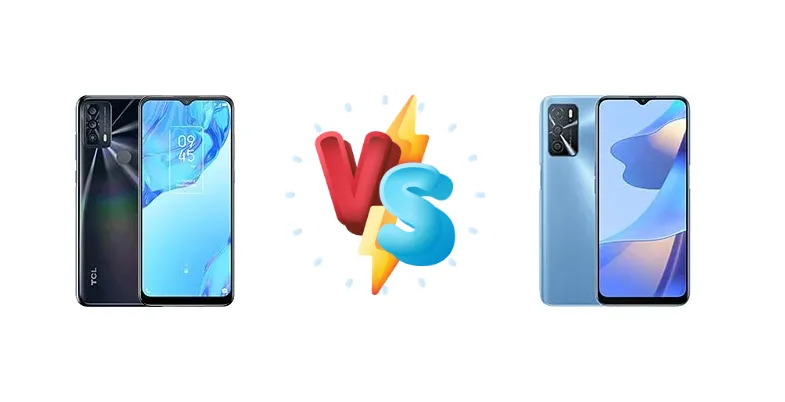
The TCL 20B and Oppo A16s represent the fiercely competitive sub-$150 smartphone market. Both devices aim to deliver essential smartphone functionality at an accessible price point, but they achieve this with different chipsets and subtle design choices. This comparison dives deep into the specifications to determine which phone offers the best value for your money.
🏆 Quick Verdict
For most users, the Oppo A16s emerges as the better choice. Its Helio G35 chipset, featuring a faster core cluster, provides a noticeable performance boost over the TCL 20B’s Helio P22, making it more responsive for everyday tasks and light gaming. While both offer similar battery capabilities, the A16s’ slight performance edge justifies the minimal price difference.
| Network |
|---|
| 2G bands | GSM 850 / 900 / 1800 / 1900 | GSM 850 / 900 / 1800 / 1900 |
| 3G bands | HSDPA 850 / 900 / 1900 / 2100 | HSDPA 850 / 900 / 1700(AWS) / 1900 / 2100 |
| 4G bands | 1, 3, 5, 7, 8, 20, 28, 38, 40, 41 | 1, 2, 3, 4, 5, 7, 8, 12, 17, 18, 19, 20, 26, 28, 38, 39, 40, 41, 66 |
| Speed | HSPA, LTE | HSPA, LTE |
| Technology | GSM / HSPA / LTE | GSM / HSPA / LTE |
| Launch |
|---|
| Announced | 2021, September 30 | 2021, August 14 |
| Status | Available. Released 2021, September 30 | Available. Released 2021, August 14 |
| Body |
|---|
| Build | Glass front, plastic frame, plastic back | - |
| Dimensions | 164.7 x 74.7 x 8 mm (6.48 x 2.94 x 0.31 in) | 163.8 x 75.6 x 8.4 mm (6.45 x 2.98 x 0.33 in) |
| SIM | Nano-SIM + Nano-SIM | Nano-SIM + Nano-SIM |
| Weight | 178 g (6.28 oz) | 190 g (6.70 oz) |
| Display |
|---|
| Resolution | 720 x 1600 pixels, 20:9 ratio (~269 ppi density) | 720 x 1600 pixels, 20:9 ratio (~269 ppi density) |
| Size | 6.52 inches, 102.6 cm2 (~83.4% screen-to-body ratio) | 6.52 inches, 102.6 cm2 (~82.9% screen-to-body ratio) |
| Type | IPS LCD | IPS LCD, 480 nits (typ) |
| Platform |
|---|
| CPU | Octa-core 1.8 GHz Cortex-A53 | Octa-core (4x2.3 GHz Cortex-A53 & 4x1.8 GHz Cortex-A53) |
| Chipset | Mediatek MT6762 Helio P22 (12 nm) | Mediatek MT6765G Helio G35 (12 nm) |
| GPU | PowerVR GE8320 | PowerVR GE8320 |
| OS | Android 11, TCL UI | Android 11, ColorOS 11.1 |
| Memory |
|---|
| Card slot | microSDXC | microSDXC |
| Internal | 64GB 4GB RAM | 64GB 4GB RAM |
| | - | eMMC 5.1 |
| Main Camera |
|---|
| Dual | 50 MP, (wide), PDAF
Auxiliary lens | - |
| Features | LED flash, HDR, panorama | LED flash, HDR, panorama |
| Single | - | 8 MP, f/2.0, 26mm (wide) |
| Triple | - | 13 MP, f/2.2, 26mm (wide), 1/3.06", 1.12µm, PDAF
2 MP (macro)
Auxiliary lens |
| Video | 1080p@30fps | 1080p@30fps |
| Selfie camera |
|---|
| Features | - | HDR |
| Single | 8 MP | 8 MP, f/2.0, 26mm (wide) |
| Video | 1080p@30fps | 1080p@30fps |
| Sound |
|---|
| 3.5mm jack | - | Yes |
| 35mm jack | Yes | Yes |
| Loudspeaker | Yes | Yes |
| Comms |
|---|
| Bluetooth | 5.0, A2DP, LE | 5.0, A2DP, LE, aptX |
| NFC | No | Yes |
| Positioning | GPS | GPS, GLONASS, GALILEO, BDS, QZSS |
| Radio | Unspecified | Unspecified |
| USB | USB Type-C 2.0 | USB Type-C 2.0, OTG |
| WLAN | Wi-Fi 802.11 b/g/n, Wi-Fi Direct | Wi-Fi 802.11 a/b/g/n/ac, dual-band, Wi-Fi Direct |
| Features |
|---|
| Sensors | Fingerprint (rear-mounted), accelerometer, proximity | Fingerprint (side-mounted), accelerometer, proximity, compass |
| Battery |
|---|
| Charging | 18W wired | - |
| Type | Li-Po 4000 mAh | Li-Po 5000 mAh |
| Misc |
|---|
| Colors | Gray, Violet | Pearl Blue, Crystal Black |
| Models | 6159K | CPH2271 |
| Price | About 320 EUR | About 110 EUR |
TCL 20B
- Potentially lower price point
- Reliable Mediatek chipset
- Standard 18W charging
- Slower processor compared to the A16s
- Less responsive user experience
Oppo A16s
- Faster Helio G35 processor
- More responsive user interface
- Slightly better gaming performance
- May be slightly more expensive
- Charging wattage not explicitly stated
Display Comparison
Neither TCL nor Oppo provide detailed display specifications beyond the basic panel type. Given the price point, both likely utilize IPS LCD panels. The real difference lies under the hood. Without knowing the peak brightness or color gamut coverage, it’s difficult to declare a clear winner. However, the focus here is on processing power, not display fidelity, as both will offer a standard viewing experience for this segment.
Camera Comparison
Both phones likely feature similar camera setups geared towards casual photography. Without detailed sensor information, it’s safe to assume both rely on primary sensors with modest resolutions. The marketing materials for these devices often emphasize megapixel count over sensor size and quality, which are more critical factors. Given the price bracket, image processing will be basic, and low-light performance will be limited on both. Focusing on the chipset difference, the A16s’ slightly more powerful processor could contribute to marginally faster image processing times, but the impact will be minimal.
Performance
The core distinction between these phones is their chipsets. The Oppo A16s utilizes the Mediatek Helio G35, featuring an octa-core configuration with a split design: four cores clocked at 2.3 GHz and four at 1.8 GHz. This contrasts with the TCL 20B’s Helio P22, which employs a uniform octa-core setup clocked at 1.8 GHz. The G35’s faster cores provide a tangible advantage in application launch times and overall system responsiveness. While both are based on the 12nm process, the G35’s architecture is optimized for slightly better performance. This translates to a smoother experience when switching between apps or browsing the web. The TCL 20B will handle basic tasks, but the A16s offers a more fluid experience.
Battery Life
Both the TCL 20B and Oppo A16s are equipped with batteries designed to provide all-day battery life with moderate usage. The TCL 20B supports 18W wired charging, which is a standard offering in this price range. Oppo doesn’t explicitly state the charging wattage for the A16s, but it’s likely similar. The actual charging time from 0-100% will depend on the charger used and the phone’s power management system. The slightly more efficient Helio G35 in the A16s *could* translate to marginally better battery life, but the difference will likely be negligible for most users.
Buying Guide
Buy the TCL 20B if you prioritize a consistently lower price and are primarily focused on basic smartphone functions like calling, texting, and light social media browsing. Buy the Oppo A16s if you value a smoother user experience, slightly improved gaming performance, and don't mind spending a little extra for a more responsive device. The A16s is the better option for users who multitask or occasionally play mobile games.
Frequently Asked Questions
❓ Will the Oppo A16s handle popular games like PUBG Mobile or Call of Duty?
The Oppo A16s, with its Helio G35 chipset, can run PUBG Mobile and Call of Duty, but you’ll need to lower the graphics settings to medium or low to achieve playable frame rates. Don't expect a high-end gaming experience, but it's capable of casual gaming sessions. The TCL 20B will struggle more with these titles.
❓ Is the difference in performance between the Helio G35 and Helio P22 noticeable in everyday use?
Yes, the difference is noticeable. The Helio G35’s faster core cluster results in quicker app launch times, smoother scrolling, and a more responsive overall user experience. While both chips can handle basic tasks, the A16s feels snappier and less prone to lag when multitasking.
❓ How long will the battery last on the Oppo A16s with typical usage?
With typical usage – including browsing, social media, and occasional calls – the Oppo A16s should easily last a full day on a single charge. Heavy users may need to top up the battery in the evening, but the Helio G35’s efficiency helps to maximize battery life.