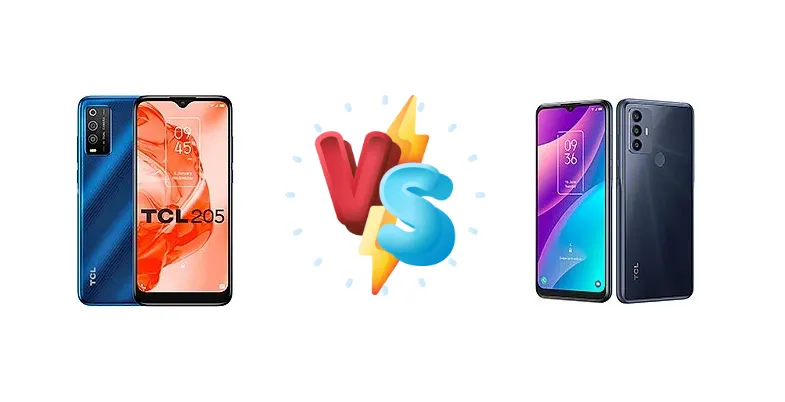
TCL has become a significant player in the budget smartphone space, offering compelling features at aggressive price points. The TCL 205 and TCL 30 SE represent two distinct approaches to affordability. The 205 focuses on basic functionality, while the 30 SE aims for a slight performance boost. This comparison dissects their core differences to determine which device best suits your needs.
🏆 Quick Verdict
For most users, the TCL 30 SE is the better choice. Its Mediatek Helio G25 chipset, built on a more efficient 12nm process, provides a noticeable performance advantage over the TCL 205’s Unisoc SC9863A. While neither phone excels in any single area, the 30 SE’s faster processor and 15W charging offer a more responsive and convenient user experience.
| Network |
|---|
| 2G bands | GSM 850 / 900 / 1800 / 1900 | GSM 850 / 900 / 1800 / 1900 |
| 3G bands | HSDPA 850 / 900 / 1900 / 2100 | HSDPA 850 / 900 / 1900 / 2100 - EMEA/APAC |
| 4G bands | 1, 3, 7, 8, 20, 28, 38, 40, 41 | 1, 3, 5, 7, 8, 20, 28, 38, 40, 41 - EMEA |
| Speed | HSPA 21.1/5.76 Mbps, LTE Cat4 150/50 Mbps | HSPA 42.2/11.5 Mbps, LTE Cat4 150/50 Mbps |
| Technology | GSM / HSPA / LTE | GSM / HSPA / LTE |
| | - | 2, 3, 4, 5, 7, 8, 12, 13, 17, 26, 28, 66 - LATAM |
| Launch |
|---|
| Announced | 2021, October 08 | 2022, February 27 |
| Status | Available. Released 2021, October | Available. Released 2022, April 20 |
| Body |
|---|
| Build | Glass front, plastic frame, plastic back | Glass front, plastic frame, plastic back |
| Dimensions | 159.2 x 75.2 x 8.7 mm (6.27 x 2.96 x 0.34 in) | 165.2 x 75.5 x 8.9 mm (6.50 x 2.97 x 0.35 in) |
| SIM | Nano-SIM + Nano-SIM | · Nano-SIM· Nano-SIM + Nano-SIM |
| Weight | 170.3 g (6.00 oz) | 190 g (6.70 oz) |
| Display |
|---|
| Resolution | 720 x 1520 pixels, 19:9 ratio (~270 ppi density) | 720 x 1600 pixels, 20:9 ratio (~269 ppi density) |
| Size | 6.22 inches, 96.6 cm2 (~80.7% screen-to-body ratio) | 6.52 inches, 102.6 cm2 (~82.3% screen-to-body ratio) |
| Type | IPS LCD | IPS LCD, 450 nits (typ) |
| Platform |
|---|
| CPU | Octa-core (4x1.6 GHz Cortex-A55 & 4x1.2 GHz Cortex-A55) | Octa-core (4x2.0 GHz Cortex-A53 & 4x1.5 GHz Cortex-A53) |
| Chipset | Unisoc SC9863A (28 nm) | Mediatek MT6762G Helio G25 (12 nm) |
| GPU | IMG8322 | PowerVR GE8320 |
| OS | Android 11 (Go edition), TCL UI | Android 12, TCL UI 4.0 |
| Memory |
|---|
| Card slot | microSDXC (uses shared SIM slot) | microSDXC (dedicated slot) |
| Internal | 32GB 2GB RAM | 64GB 4GB RAM, 128GB 4GB RAM |
| | eMMC 5.1 | eMMC 5.1 |
| Main Camera |
|---|
| Dual | 13 MP, f/2.2, (wide) 1/3.06", 1.12µm, AF
Auxiliary lens | - |
| Features | LED flash, HDR, panorama | LED flash, HDR, panorama |
| Single | 5 MP, f/2.2, (wide) 1/5.0", 1.12µm | 8 MP, f/2.0, 26mm (wide), 1/4", 1.12µm |
| Triple | - | 50 MP, f/1.9, 28mm (wide), 1/2.76", 0.64µm, PDAF
2 MP (macro)
Auxiliary lens |
| Video | 1080p@30fps | 1080p@30fps |
| Selfie camera |
|---|
| Features | HDR | HDR |
| Single | 5 MP, f/2.2, (wide) 1/5.0", 1.12µm | 8 MP, f/2.0, 26mm (wide), 1/4.0", 1.12µm |
| Video | 1080p@30fps | 1080p@30fps |
| Sound |
|---|
| 3.5mm jack | Yes | Yes |
| 35mm jack | Yes | Yes |
| Loudspeaker | Yes | Yes |
| Comms |
|---|
| Bluetooth | 5.0, A2DP | 5.0, A2DP, LE |
| NFC | No | Yes (6165H/6165H1 only) |
| Positioning | GPS | GPS, GLONASS, GALILEO, BDS |
| Radio | No | Unspecified |
| USB | microUSB 2.0 | USB Type-C 2.0 |
| WLAN | Wi-Fi 802.11 b/g/n, Wi-Fi Direct | Wi-Fi 802.11 b/g/n, Wi-Fi Direct |
| Features |
|---|
| Sensors | Accelerometer, proximity | Fingerprint (rear-mounted), accelerometer, proximity, compass |
| Battery |
|---|
| Charging | - | 15W wired |
| Type | Li-Po 4000 mAh | Li-Po 5000 mAh |
| Misc |
|---|
| Colors | Power Gray, Atlantic Blue | Atlantic Blue, Space Gray, Glacial Blue |
| Models | 4187D | 6165H, 6156H1, 6165A, 6165A1, 6165S |
| Price | About 110 EUR | - |
TCL 205
- Potentially lower price point
- Simple and straightforward user experience
- Reliable for basic communication
- Significantly slower processor
- Less efficient chipset (28nm)
- Slower charging speeds
TCL 30 SE
- Faster and more efficient processor (Helio G25)
- 15W wired charging for quicker top-ups
- Smoother multitasking and app loading
- May be slightly more expensive
- Camera performance likely similar to TCL 205
- Still a budget device with limitations
Display Comparison
Neither TCL device boasts a standout display. Details regarding panel type (IPS vs. TFT) and resolution are missing, suggesting both utilize budget-friendly components. However, the focus here is on the chipset impact on display responsiveness. A faster processor, like the Helio G25 in the 30 SE, can contribute to smoother scrolling and animations, even on a similar-quality panel. Bezels are likely comparable, given the price bracket, and color accuracy is expected to be standard for this segment.
Camera Comparison
Camera performance is likely similar on both devices, relying on budget sensors and image processing. Without specific sensor details, it’s safe to assume both feature a primary camera and potentially a depth or macro sensor. The image processing capabilities of the Helio G25 might offer slightly better noise reduction and dynamic range, but the difference will be marginal. The presence of a 2MP macro camera on either device is largely a marketing tactic, offering limited practical benefit due to the low resolution and lack of optical image stabilization.
Performance
The core difference lies in the chipsets. The TCL 30 SE’s Mediatek Helio G25 (12nm) is a clear upgrade over the TCL 205’s Unisoc SC9863A (28nm). The 12nm process node allows for greater transistor density and improved power efficiency, translating to better performance and potentially less heat generation. While both are octa-core CPUs, the Helio G25 utilizes Cortex-A53 cores clocked at 2.0 GHz, compared to the 205’s Cortex-A55 cores at 1.6 GHz and 1.2 GHz. This difference in architecture and clock speed will result in noticeably faster app loading times and smoother multitasking on the 30 SE. The 28nm process of the SC9863A is significantly older and less efficient, likely leading to more throttling under sustained load.
Battery Life
Battery capacity details are missing for both devices, but the TCL 30 SE gains an advantage with its 15W wired charging. The TCL 205 likely supports slower charging speeds, meaning longer times to reach a full charge. While a larger battery capacity on the 205 could offset the slower charging, the more efficient Helio G25 in the 30 SE will likely result in comparable or even better real-world battery life, even with a slightly smaller battery.
Buying Guide
Buy the TCL 205 if you prioritize extreme affordability and only need a phone for basic tasks like calls, texts, and light social media. It’s a suitable option for first-time smartphone users or as a reliable backup device. Buy the TCL 30 SE if you want a smoother, more responsive experience for everyday use, including browsing, streaming, and casual gaming. The faster processor and quicker charging make it a worthwhile upgrade for those who demand a bit more from their phone.
Frequently Asked Questions
❓ Will the Helio G25 in the TCL 30 SE handle popular games like PUBG Mobile?
The Helio G25 is capable of running PUBG Mobile, but you’ll likely need to play at lower graphics settings (balanced or low) to maintain a stable frame rate. It’s not a gaming powerhouse, but it offers a playable experience for casual gamers.
❓ Is the Unisoc SC9863A chipset known for overheating or performance throttling?
The Unisoc SC9863A, due to its older 28nm process, is more prone to thermal throttling under sustained load. This means that performance may decrease after prolonged use, such as during extended gaming sessions or video recording.
❓ Does the TCL 30 SE support fast charging beyond the 15W specification?
No, the TCL 30 SE is officially rated for 15W wired charging. While it might be compatible with chargers that deliver higher wattage, it will only draw up to 15W, preventing faster charging speeds.
❓ How does the RAM capacity affect performance on these devices?
RAM capacity details are missing, but assuming both devices have similar RAM configurations (likely 2GB or 3GB), the faster processor in the TCL 30 SE will be the more significant factor in overall performance. More RAM generally improves multitasking, but a faster processor is crucial for responsiveness.