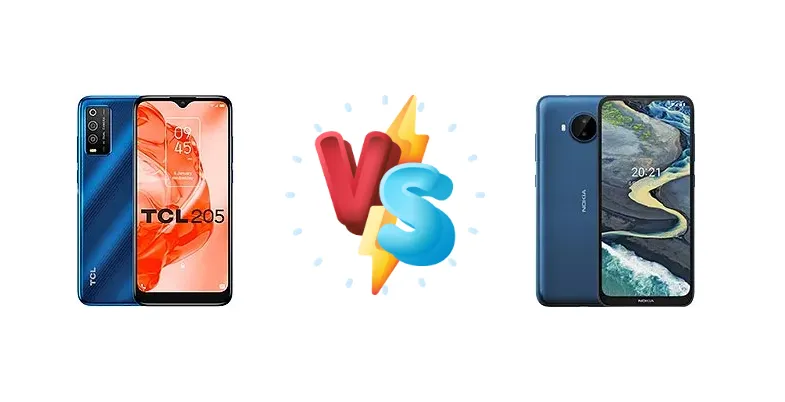
The TCL 205 and Nokia C20 Plus represent the absolute bottom end of the smartphone market, targeting first-time buyers or those needing a very basic, reliable device. Both rely on the Unisoc SC9863A chipset, making a direct performance comparison crucial. However, a key difference emerges with the Nokia C20 Plus including 10W charging, a feature absent from the provided specs for the TCL 205. This comparison will dissect these nuances to determine which phone offers the best value.
🏆 Quick Verdict
For the average user prioritizing a slightly faster charging experience and the Nokia brand's software commitment, the Nokia C20 Plus is the better choice. Both phones offer identical core performance, but the 10W charging provides a tangible benefit, especially given the likely limited battery capacity in both devices. The TCL 205 remains a viable option if found at a significantly lower price.
| Network |
|---|
| 2G bands | GSM 850 / 900 / 1800 / 1900 | GSM 850 / 900 / 1800 / 1900 |
| 3G bands | HSDPA 850 / 900 / 1900 / 2100 | HSDPA 850 / 900 / 1900 / 2100 |
| 4G bands | 1, 3, 7, 8, 20, 28, 38, 40, 41 | 1, 3, 5, 8, 34, 38, 29, 40, 41 |
| Speed | HSPA 21.1/5.76 Mbps, LTE Cat4 150/50 Mbps | HSPA 42.2/5.76 Mbps, LTE Cat4 150/50 Mbps |
| Technology | GSM / HSPA / LTE | GSM / HSPA / LTE |
| Launch |
|---|
| Announced | 2021, October 08 | 2021, June 11 |
| Status | Available. Released 2021, October | Available. Released 2021, June 16 |
| Body |
|---|
| Build | Glass front, plastic frame, plastic back | - |
| Dimensions | 159.2 x 75.2 x 8.7 mm (6.27 x 2.96 x 0.34 in) | 165.4 x 75.9 x 9.4 mm (6.51 x 2.99 x 0.37 in) |
| SIM | Nano-SIM + Nano-SIM | · Nano-SIM· Nano-SIM + Nano-SIM |
| Weight | 170.3 g (6.00 oz) | 204.7 g (7.23 oz) |
| Display |
|---|
| Resolution | 720 x 1520 pixels, 19:9 ratio (~270 ppi density) | 720 x 1600 pixels, 20:9 ratio (~270 ppi density) |
| Size | 6.22 inches, 96.6 cm2 (~80.7% screen-to-body ratio) | 6.5 inches, 102.0 cm2 (~81.3% screen-to-body ratio) |
| Type | IPS LCD | IPS LCD |
| Platform |
|---|
| CPU | Octa-core (4x1.6 GHz Cortex-A55 & 4x1.2 GHz Cortex-A55) | Octa-core (4x1.6 GHz Cortex-A55 & 4x1.2 GHz Cortex-A55) |
| Chipset | Unisoc SC9863A (28 nm) | Unisoc SC9863A (28 nm) |
| GPU | IMG8322 | IMG8322 |
| OS | Android 11 (Go edition), TCL UI | Android 11 (Go edition) |
| Memory |
|---|
| Card slot | microSDXC (uses shared SIM slot) | microSDXC |
| Internal | 32GB 2GB RAM | 32GB 3GB RAM |
| | eMMC 5.1 | eMMC 5.1 |
| Main Camera |
|---|
| Dual | 13 MP, f/2.2, (wide) 1/3.06", 1.12µm, AF
Auxiliary lens | 8 MP
Auxiliary lens |
| Features | LED flash, HDR, panorama | LED flash |
| Single | 5 MP, f/2.2, (wide) 1/5.0", 1.12µm | 5 MP |
| Video | 1080p@30fps | 720p@30fps |
| Selfie camera |
|---|
| Features | HDR | - |
| Single | 5 MP, f/2.2, (wide) 1/5.0", 1.12µm | 5 MP |
| Video | 1080p@30fps | 720p |
| Sound |
|---|
| 3.5mm jack | Yes | Yes |
| 35mm jack | Yes | Yes |
| Loudspeaker | Yes | Yes |
| Comms |
|---|
| Bluetooth | 5.0, A2DP | 4.2, A2DP |
| NFC | No | No |
| Positioning | GPS | GPS |
| Radio | No | FM radio |
| USB | microUSB 2.0 | microUSB 2.0 |
| WLAN | Wi-Fi 802.11 b/g/n, Wi-Fi Direct | Wi-Fi 802.11 b/g/n |
| Features |
|---|
| Sensors | Accelerometer, proximity | Accelerometer, proximity |
| Battery |
|---|
| Charging | - | 10W wired |
| Type | Li-Po 4000 mAh | Li-Ion 4950 mAh, removable |
| Misc |
|---|
| Colors | Power Gray, Atlantic Blue | Ocean Blue, Graphite black |
| Models | 4187D | TA-1388, TA-1380 |
| Price | About 110 EUR | About 90 EUR |
TCL 205
- Potentially lower price point
- Identical processing power to Nokia C20 Plus
- Compact and lightweight design (likely)
- No specified charging speed
- Likely slower charging than Nokia C20 Plus
- Uncertain software update commitment
Nokia C20 Plus
- 10W wired charging for faster top-ups
- Nokia's reputation for software reliability
- Potential for longer software support
- May be slightly more expensive than TCL 205
- Identical processing power to TCL 205
- Likely similar display quality to TCL 205
Display Comparison
Neither TCL nor Nokia provided display specifications beyond the device names. Given the price point, both likely utilize LCD panels with 720p+ resolution. Expect relatively low brightness levels, making outdoor visibility a challenge. Bezels are likely to be substantial on both devices, maximizing screen real estate within a compact form factor. Color accuracy will likely be standard for this segment, prioritizing power efficiency over vibrant colors.
Camera Comparison
Camera details are sparse for both devices. It's safe to assume both feature a basic rear camera setup, likely with a single main sensor and potentially a secondary depth or macro lens. Image quality will be heavily reliant on software processing and ambient lighting conditions. Without sensor size or aperture information, it's difficult to assess image quality differences. The presence of a 2MP macro camera on either device is largely a marketing tactic, offering limited practical benefit due to the low resolution and lack of optical image stabilization.
Performance
Both the TCL 205 and Nokia C20 Plus are powered by the Unisoc SC9863A (28nm) chipset, featuring an octa-core CPU configuration with 4x1.6 GHz Cortex-A55 cores and 4x1.2 GHz Cortex-A55 cores. This indicates identical processing power for everyday tasks like browsing, social media, and basic app usage. The 28nm manufacturing process is relatively dated, suggesting limited thermal headroom and potential for throttling under sustained load. RAM capacity, not specified, will be a critical factor; 2GB is likely, and will significantly impact multitasking performance. The shared chipset means performance will be nearly indistinguishable in real-world use.
Battery Life
Battery capacity remains undisclosed for the TCL 205. The Nokia C20 Plus supports 10W wired charging, a significant advantage over the TCL 205, which lacks any charging specification. While 10W isn't fast by modern standards, it's sufficient for topping up the battery overnight. Given the low-power chipset and likely modest battery capacity (estimated around 3000-4000mAh for both), both phones should achieve all-day battery life with light usage. The Nokia C20 Plus's 10W charging will reduce downtime compared to the TCL 205, assuming the TCL 205 relies on significantly slower charging via micro-USB.
Buying Guide
Buy the TCL 205 if you need the absolute cheapest possible smartphone and are willing to accept slower charging speeds. It's ideal for users who primarily need a device for calls, texts, and very light app usage. Buy the Nokia C20 Plus if you prefer a brand known for software updates and a slightly more convenient charging experience, even if it means paying a small premium. This phone suits users who want a reliable, basic smartphone with a bit more longevity in terms of software support.
Frequently Asked Questions
❓ Will the Unisoc SC9863A chipset struggle with popular apps like WhatsApp and Facebook?
While the Unisoc SC9863A is an entry-level chipset, it's generally sufficient for running lightweight apps like WhatsApp and Facebook. However, expect some lag when switching between apps or loading complex content. Optimizing app usage and limiting background processes will improve performance.
❓ How long will it take to fully charge the Nokia C20 Plus with the 10W charger?
Given the likely battery capacity of around 3000-4000mAh, a full charge with the 10W charger will likely take between 3-4 hours. While not fast charging, it's sufficient for overnight charging and provides a convenient top-up option.
❓ Does either phone support 4G LTE for faster data speeds?
Based on the chipset and target market, both the TCL 205 and Nokia C20 Plus are expected to support 4G LTE connectivity. This allows for faster data speeds compared to 3G, enabling smoother browsing and app usage.
❓ What version of Android do these phones run, and will they receive updates?
Both phones likely run Android Go Edition, a lightweight version of Android designed for devices with limited resources. Nokia generally provides more consistent software updates than TCL, potentially offering security patches and minor Android version upgrades for a longer period.