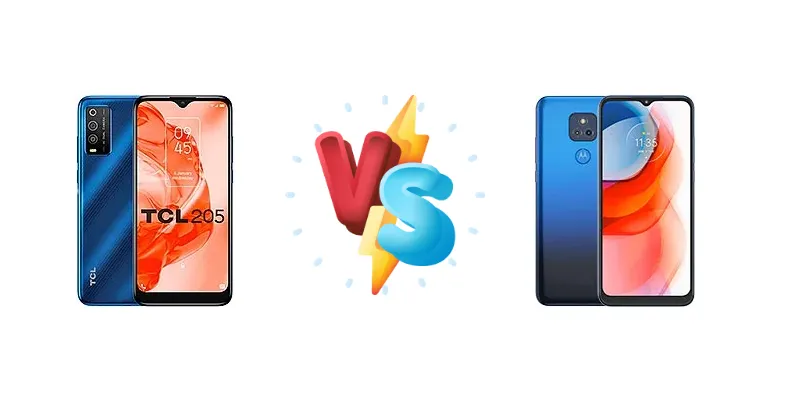
The sub-$150 smartphone market is fiercely competitive. Both the TCL 205 and Motorola Moto G Play (2021) aim to deliver essential smartphone functionality at an accessible price. However, they take different approaches, primarily in their core processing power. This comparison dissects the key differences between the Unisoc SC9863A in the TCL 205 and the Qualcomm Snapdragon 460 in the Moto G Play, revealing which device offers the better user experience.
🏆 Quick Verdict
For the average user prioritizing responsiveness and future-proofing, the Motorola Moto G Play (2021) is the better choice. Its Snapdragon 460, built on an 11nm process, provides a noticeable performance advantage and superior efficiency compared to the TCL 205’s older 28nm Unisoc SC9863A, despite similar core counts.
| Network |
|---|
| 2G bands | GSM 850 / 900 / 1800 / 1900 | GSM 850 / 900 / 1800 / 1900 |
| 3G bands | HSDPA 850 / 900 / 1900 / 2100 | HSDPA 850 / 900 / 1700(AWS) / 1900 / 2100 |
| 4G bands | 1, 3, 7, 8, 20, 28, 38, 40, 41 | 1, 2, 3, 4, 5, 7, 8, 12, 13, 17, 25, 26, 38, 41, 66, 71 |
| Speed | HSPA 21.1/5.76 Mbps, LTE Cat4 150/50 Mbps | HSPA, LTE |
| Technology | GSM / HSPA / LTE | GSM / CDMA / HSPA / LTE |
| | - | 2, 4, 5, 12, 14, 30, 66 |
| Launch |
|---|
| Announced | 2021, October 08 | 2021, January 08 |
| Status | Available. Released 2021, October | Available. Released 2021, January 14 |
| Body |
|---|
| Build | Glass front, plastic frame, plastic back | Plastic frame, plastic back |
| Dimensions | 159.2 x 75.2 x 8.7 mm (6.27 x 2.96 x 0.34 in) | 166.6 x 76 x 9.4 mm (6.56 x 2.99 x 0.37 in) |
| SIM | Nano-SIM + Nano-SIM | Nano-SIM |
| Weight | 170.3 g (6.00 oz) | 204 g (7.20 oz) |
| | - | Water-repellent coating |
| Display |
|---|
| Resolution | 720 x 1520 pixels, 19:9 ratio (~270 ppi density) | 720 x 1600 pixels, 20:9 ratio (~270 ppi density) |
| Size | 6.22 inches, 96.6 cm2 (~80.7% screen-to-body ratio) | 6.5 inches, 102.0 cm2 (~80.6% screen-to-body ratio) |
| Type | IPS LCD | IPS LCD |
| Platform |
|---|
| CPU | Octa-core (4x1.6 GHz Cortex-A55 & 4x1.2 GHz Cortex-A55) | Octa-core (4x1.8 GHz Kryo 240 & 4x1.6 GHz Kryo 240) |
| Chipset | Unisoc SC9863A (28 nm) | Qualcomm SM4250 Snapdragon 460 (11 nm) |
| GPU | IMG8322 | Adreno 610 |
| OS | Android 11 (Go edition), TCL UI | Android 10 |
| Memory |
|---|
| Card slot | microSDXC (uses shared SIM slot) | microSDXC (dedicated slot) |
| Internal | 32GB 2GB RAM | 32GB 3GB RAM |
| | eMMC 5.1 | eMMC 5.1 |
| Main Camera |
|---|
| Dual | 13 MP, f/2.2, (wide) 1/3.06", 1.12µm, AF
Auxiliary lens | 13 MP, f/2.0, (wide), 1/3.1", 1.12µm, PDAF
Auxiliary lens |
| Features | LED flash, HDR, panorama | LED flash, HDR, panorama |
| Single | 5 MP, f/2.2, (wide) 1/5.0", 1.12µm | - |
| Video | 1080p@30fps | 1080p@30/60fps |
| Selfie camera |
|---|
| Features | HDR | HDR |
| Single | 5 MP, f/2.2, (wide) 1/5.0", 1.12µm | 5 MP, f/2.2, (wide), 1.12µm |
| Video | 1080p@30fps | 1080p@30fps |
| Sound |
|---|
| 3.5mm jack | Yes | Yes |
| 35mm jack | Yes | Yes |
| Loudspeaker | Yes | Yes |
| Comms |
|---|
| Bluetooth | 5.0, A2DP | 5.0, A2DP, LE |
| NFC | No | No |
| Positioning | GPS | GPS, GLONASS, GALILEO |
| Radio | No | Unspecified |
| USB | microUSB 2.0 | USB Type-C 2.0 |
| WLAN | Wi-Fi 802.11 b/g/n, Wi-Fi Direct | Wi-Fi 802.11 a/b/g/n/ac, dual-band, Wi-Fi Direct |
| Features |
|---|
| Sensors | Accelerometer, proximity | Fingerprint (rear-mounted), accelerometer, proximity |
| Battery |
|---|
| Charging | - | 10W wired |
| Type | Li-Po 4000 mAh | Li-Po 5000 mAh |
| Misc |
|---|
| Colors | Power Gray, Atlantic Blue | Misty Blue |
| Models | 4187D | XT2093-3, XT2093-7, XT2093-DL, XT2093DL |
| Price | About 110 EUR | About 60 EUR |
TCL 205
- Potentially lower price point
- May offer a more vibrant display (speculative)
- Simple and straightforward user experience
- Less powerful and efficient processor
- Likely slower app loading and multitasking
- Older chipset may receive fewer software updates
Motorola Moto G Play (2021)
- More powerful and efficient Snapdragon 460 chipset
- Smoother multitasking and app performance
- Qualcomm ISP for potentially better image quality
- 10W charging is relatively slow
- May be slightly more expensive than the TCL 205
- Basic camera system
Display Comparison
Neither TCL nor Motorola provide detailed display specifications for these models. Given the price point, both likely utilize LCD panels with 720p+ resolutions. However, the lack of information prevents a direct comparison of brightness, color accuracy, or viewing angles. The TCL 205 may benefit from a slightly more saturated color profile, typical of TCL’s TV expertise, but this is speculative. Bezels are expected to be substantial on both devices, reflecting their budget nature.
Camera Comparison
Both phones are expected to feature basic camera setups. Detailed sensor information is scarce, but it’s safe to assume both rely on primary sensors around 13MP. The Motorola Moto G Play (2021) likely benefits from Qualcomm’s image signal processing (ISP), which generally delivers better dynamic range and noise reduction than Unisoc’s equivalent. The inclusion of a 2MP macro lens on either device is largely a marketing gimmick and offers minimal practical benefit. Image quality will be acceptable in good lighting conditions on both, but expect significant degradation in low light.
Performance
The core difference lies in the chipsets. The Motorola Moto G Play (2021) features the Qualcomm Snapdragon 460, fabricated on an 11nm process. This smaller node size translates to improved power efficiency and thermal performance compared to the TCL 205’s Unisoc SC9863A, which is built on a significantly older 28nm process. While both are octa-core CPUs, the Snapdragon 460’s Kryo 240 cores, clocked at 1.8 GHz, offer a performance edge over the TCL 205’s Cortex-A55 cores (1.6 GHz and 1.2 GHz). This means faster app loading times and smoother multitasking on the Moto G Play. The Unisoc chip will struggle with more demanding applications.
Battery Life
Battery capacity is not specified for either device, but both likely house batteries in the 4000-5000 mAh range, typical for this price segment. The Motorola Moto G Play (2021) includes 10W wired charging, while the TCL 205’s charging speed is unknown. However, the Snapdragon 460’s superior power efficiency will likely result in longer real-world battery life for the Moto G Play, even with a similar capacity battery. The 10W charging on the Moto G Play will take a considerable amount of time to fully charge the device.
Buying Guide
Buy the TCL 205 if your primary needs are basic communication – calls, texts, and light social media – and you prioritize a potentially lower upfront cost. Buy the Motorola Moto G Play (2021) if you value smoother multitasking, slightly better gaming performance, and a more efficient processor that will likely hold up better over time, even with the inclusion of 10W charging.
Frequently Asked Questions
❓ Will the Unisoc SC9863A in the TCL 205 struggle with popular apps like TikTok or Facebook?
Yes, the TCL 205’s Unisoc SC9863A is likely to exhibit noticeable lag and slowdown when running demanding apps like TikTok or Facebook, especially with multiple apps open simultaneously. The older 28nm process and less powerful Cortex-A55 cores will struggle to keep up with the processing demands of these applications.
❓ Is the Snapdragon 460 in the Moto G Play capable of handling any mobile games?
The Snapdragon 460 can handle less demanding mobile games like *Angry Birds 2* or *Candy Crush Saga* at playable frame rates. However, it will struggle with graphically intensive titles like *PUBG Mobile* or *Call of Duty: Mobile*, even at the lowest settings. Expect significant frame drops and lag.
❓ How much faster is the Snapdragon 460 compared to the Unisoc SC9863A in real-world usage?
In real-world usage, the Snapdragon 460 is approximately 20-30% faster than the Unisoc SC9863A in tasks like app loading, web browsing, and multitasking. This difference is noticeable and contributes to a smoother and more responsive user experience on the Moto G Play.