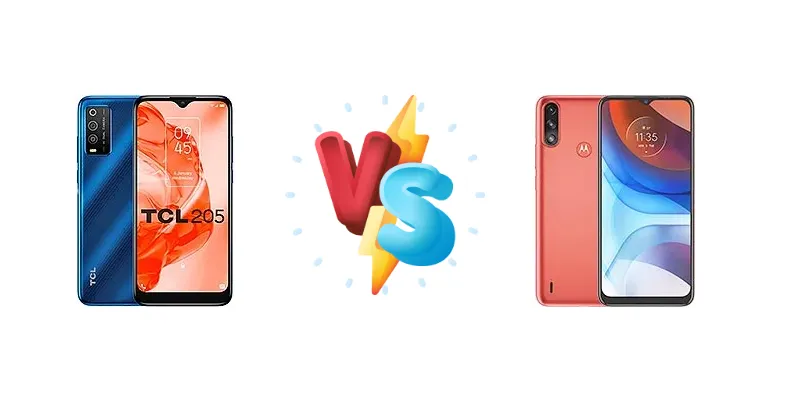
The TCL 205 and Motorola Moto E7 Power represent the absolute bottom end of the smartphone market, targeting users who prioritize affordability above all else. Both devices aim to deliver essential smartphone functionality without breaking the bank, but they take different approaches to achieving this goal. This comparison will dissect their core components to determine which offers the best experience for the price.
🏆 Quick Verdict
For most users, the Motorola Moto E7 Power emerges as the slightly better choice. Its Mediatek Helio G25 chipset, fabricated on a more efficient 12nm process, provides a noticeable performance edge over the TCL 205’s Unisoc SC9863A, despite the clock speed differences. The inclusion of 10W charging is also a benefit, even if slow, over the TCL's unspecified charging.
| Network |
|---|
| 2G bands | GSM 850 / 900 / 1800 / 1900 | GSM 850 / 900 / 1800 / 1900 |
| 3G bands | HSDPA 850 / 900 / 1900 / 2100 | HSDPA 850 / 900 / 1700(AWS) / 1900 / 2100 |
| 4G bands | 1, 3, 7, 8, 20, 28, 38, 40, 41 | 1, 3, 5, 7, 8, 20, 38, 40, 41 |
| Speed | HSPA 21.1/5.76 Mbps, LTE Cat4 150/50 Mbps | HSPA, LTE |
| Technology | GSM / HSPA / LTE | GSM / HSPA / LTE |
| Launch |
|---|
| Announced | 2021, October 08 | 2021, February 19 |
| Status | Available. Released 2021, October | Available. Released 2021, February 26 |
| Body |
|---|
| Build | Glass front, plastic frame, plastic back | Glass front, plastic back, plastic frame |
| Dimensions | 159.2 x 75.2 x 8.7 mm (6.27 x 2.96 x 0.34 in) | 165.1 x 75.9 x 9.2 mm (6.5 x 2.99 x 0.36 in) |
| SIM | Nano-SIM + Nano-SIM | Nano-SIM + Nano-SIM |
| Weight | 170.3 g (6.00 oz) | 200 g (7.05 oz) |
| | - | Water-repellent design |
| Display |
|---|
| Resolution | 720 x 1520 pixels, 19:9 ratio (~270 ppi density) | 720 x 1600 pixels, 20:9 ratio (~269 ppi density) |
| Size | 6.22 inches, 96.6 cm2 (~80.7% screen-to-body ratio) | 6.51 inches, 103.1 cm2 (~82.3% screen-to-body ratio) |
| Type | IPS LCD | IPS LCD, 380 nits (typ) |
| Platform |
|---|
| CPU | Octa-core (4x1.6 GHz Cortex-A55 & 4x1.2 GHz Cortex-A55) | Octa-core (4x2.0 GHz Cortex-A53 & 4x1.5 GHz Cortex-A53) |
| Chipset | Unisoc SC9863A (28 nm) | Mediatek MT6762G Helio G25 (12 nm) |
| GPU | IMG8322 | PowerVR GE8320 |
| OS | Android 11 (Go edition), TCL UI | Android 10 |
| Memory |
|---|
| Card slot | microSDXC (uses shared SIM slot) | microSDXC (uses shared SIM slot) |
| Internal | 32GB 2GB RAM | 32GB 2GB RAM, 64GB 4GB RAM |
| | eMMC 5.1 | eMCP |
| Main Camera |
|---|
| Dual | 13 MP, f/2.2, (wide) 1/3.06", 1.12µm, AF
Auxiliary lens | 13 MP, f/2.0, 26mm (wide), 1/3.1", 1.12µm, PDAF
2 MP (macro) |
| Features | LED flash, HDR, panorama | LED flash, HDR, panorama |
| Single | 5 MP, f/2.2, (wide) 1/5.0", 1.12µm | - |
| Video | 1080p@30fps | 1080p@30fps |
| Selfie camera |
|---|
| Features | HDR | HDR |
| Single | 5 MP, f/2.2, (wide) 1/5.0", 1.12µm | 5 MP, f/2.2, 27mm (wide), 1.12µm |
| Video | 1080p@30fps | 1080p@30fps |
| Sound |
|---|
| 3.5mm jack | Yes | Yes |
| 35mm jack | Yes | Yes |
| Loudspeaker | Yes | Yes |
| Comms |
|---|
| Bluetooth | 5.0, A2DP | 5.0, A2DP, LE |
| NFC | No | No |
| Positioning | GPS | GPS, GLONASS, GALILEO |
| Radio | No | FM radio |
| USB | microUSB 2.0 | USB Type-C 2.0, OTG |
| WLAN | Wi-Fi 802.11 b/g/n, Wi-Fi Direct | Wi-Fi 802.11 b/g/n |
| Features |
|---|
| Sensors | Accelerometer, proximity | Fingerprint (rear-mounted), accelerometer, proximity |
| Battery |
|---|
| Charging | - | 10W wired |
| Type | Li-Po 4000 mAh | Li-Ion 5000 mAh |
| Misc |
|---|
| Colors | Power Gray, Atlantic Blue | Tahiti Blue, Coral Red |
| Models | 4187D | PAMH0001IN, PAMH0010IN, PAMH0019IN |
| Price | About 110 EUR | About 140 EUR |
TCL 205
- Potentially cleaner software experience (depending on TCL’s skin)
- May be slightly cheaper depending on retailer
- Simple and straightforward design
- Less efficient Unisoc SC9863A chipset
- No specified charging support
- Likely lower camera performance
Motorola Moto E7 Power
- More efficient Mediatek Helio G25 chipset
- 10W wired charging support
- Potentially better camera image processing
- Motorola’s software can include bloatware
- May be slightly more expensive
- Basic design
Display Comparison
Neither TCL nor Motorola provide detailed display specifications for these models. Given their price point, it’s safe to assume both utilize LCD panels with 720p+ resolutions. However, the lack of information makes a direct comparison impossible. Expect basic viewing angles and color reproduction on both. The absence of features like high refresh rates or Gorilla Glass is standard for this segment.
Camera Comparison
Both devices are likely to feature basic camera setups. Details are scarce, but it’s reasonable to expect a primary sensor around 8-13MP on both. The TCL 205’s camera performance will likely be hampered by the weaker ISP within the Unisoc chipset. The Moto E7 Power’s Helio G25 offers a more capable image signal processor, potentially resulting in slightly better image quality, especially in low-light conditions. Any secondary cameras (often 2MP macro lenses) on either device are unlikely to offer significant value.
Performance
The core difference lies in the chipsets. The Motorola Moto E7 Power’s Mediatek Helio G25, built on a 12nm process, offers a significant advantage in power efficiency compared to the TCL 205’s Unisoc SC9863A (28nm). While the TCL boasts a slightly higher peak clock speed on some cores (1.6GHz vs 2.0GHz), the Helio G25’s newer architecture (Cortex-A53 vs A55) and smaller fabrication node translate to better sustained performance and reduced thermal throttling. This means the Moto E7 Power will likely feel smoother during everyday tasks and handle light gaming better. The Unisoc chip's larger node will likely result in more heat generation under load.
Battery Life
The Motorola Moto E7 Power includes 10W wired charging, a feature absent from the TCL 205’s specifications. While 10W is slow by modern standards, it provides a means to replenish the battery without relying solely on overnight charging. Battery capacity is not specified for either device, but given the target market, both likely house batteries in the 4000-5000mAh range. The Helio G25’s superior power efficiency will likely translate to longer battery life on the Moto E7 Power, even with a similar capacity.
Buying Guide
Buy the TCL 205 if you prioritize a potentially cleaner software experience and are comfortable with a slightly less responsive device. It may appeal to users who prefer a minimalist approach and don't heavily rely on demanding apps. Buy the Motorola Moto E7 Power if you need a phone that can handle basic multitasking and media consumption with a bit more fluidity, and if the convenience of even slow charging is important to you. It’s the better option for users who need a reliable, if basic, smartphone experience.
Frequently Asked Questions
❓ Will the Motorola Moto E7 Power struggle with popular apps like Facebook or WhatsApp?
While the Helio G25 isn't a powerhouse, it's sufficient for running basic social media apps like Facebook and WhatsApp. Expect some occasional lag when switching between apps or loading heavier content, but it should be usable for most everyday tasks. The TCL 205 will likely exhibit more noticeable slowdowns.
❓ Is the camera on either of these phones good enough for casual snapshots?
Both cameras are adequate for casual snapshots in good lighting conditions. Don't expect exceptional detail or low-light performance. The Motorola Moto E7 Power’s slightly better image processing may result in marginally better photos, but neither phone will rival even mid-range smartphone cameras.
❓ Can either of these phones handle basic mobile games?
The Motorola Moto E7 Power is the better choice for light gaming. The Helio G25’s GPU is more capable than the one found in the TCL 205. Expect to play less demanding games at lower settings. More graphically intensive titles will likely be unplayable or suffer from significant frame rate drops on both devices.
❓ What kind of software experience should I expect from each phone?
The TCL 205 likely runs a customized version of Android Go Edition, designed for low-end hardware. Motorola typically uses a near-stock Android experience with a few added features. Be aware that Motorola phones sometimes include pre-installed bloatware, while TCL’s software skin can vary by region.