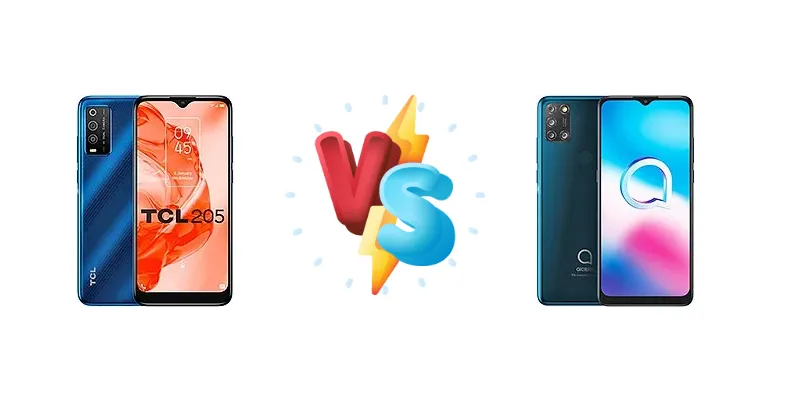
The TCL 205 and alcatel 3X (2020) represent the ultra-budget end of the smartphone spectrum. Both aim to deliver essential functionality at a minimal cost, but they achieve this with significantly different approaches to chipset design. This comparison dissects those differences, focusing on real-world performance implications for the average user.
🏆 Quick Verdict
For most users, the alcatel 3X (2020) offers a slightly better experience due to its more powerful Mediatek Helio P22 chipset. While the TCL 205 prioritizes power efficiency with its Unisoc SC9863A, the performance gap is noticeable in app loading and multitasking, making the alcatel the better all-rounder.
| Network |
|---|
| 2G bands | GSM 850 / 900 / 1800 / 1900 | GSM 850 / 900 / 1800 / 1900 |
| 3G bands | HSDPA 850 / 900 / 1900 / 2100 | HSDPA 850 / 900 / 1900 / 2100 |
| 4G bands | 1, 3, 7, 8, 20, 28, 38, 40, 41 | 1, 3, 5, 7, 8, 20, 28, 38, 40, 41 |
| Speed | HSPA 21.1/5.76 Mbps, LTE Cat4 150/50 Mbps | HSPA 42.2/11.5 Mbps, LTE Cat4 150/50 Mbps |
| Technology | GSM / HSPA / LTE | GSM / HSPA / LTE |
| Launch |
|---|
| Announced | 2021, October 08 | 2020, June. Released 2020, June |
| Status | Available. Released 2021, October | Discontinued |
| Body |
|---|
| Build | Glass front, plastic frame, plastic back | Glass front, plastic back, plastic frame |
| Dimensions | 159.2 x 75.2 x 8.7 mm (6.27 x 2.96 x 0.34 in) | 165 x 75 x 9.1 mm (6.50 x 2.95 x 0.36 in) |
| SIM | Nano-SIM + Nano-SIM | Nano-SIM + Nano-SIM |
| Weight | 170.3 g (6.00 oz) | 186 g (6.56 oz) |
| Display |
|---|
| Resolution | 720 x 1520 pixels, 19:9 ratio (~270 ppi density) | 720 x 1600 pixels, 20:9 ratio (~269 ppi density) |
| Size | 6.22 inches, 96.6 cm2 (~80.7% screen-to-body ratio) | 6.52 inches, 102.6 cm2 (~82.9% screen-to-body ratio) |
| Type | IPS LCD | IPS LCD |
| Platform |
|---|
| CPU | Octa-core (4x1.6 GHz Cortex-A55 & 4x1.2 GHz Cortex-A55) | Octa-core 2.0 GHz Cortex-A53 |
| Chipset | Unisoc SC9863A (28 nm) | Mediatek MT6762 Helio P22 (12 nm) |
| GPU | IMG8322 | PowerVR GE8320 |
| OS | Android 11 (Go edition), TCL UI | Android 10 |
| Memory |
|---|
| Card slot | microSDXC (uses shared SIM slot) | microSDXC (uses shared SIM slot) |
| Internal | 32GB 2GB RAM | 64GB 4GB RAM, 128GB 4GB RAM, 128GB 6GB RAM |
| | eMMC 5.1 | eMMC 5.1 |
| Main Camera |
|---|
| Dual | 13 MP, f/2.2, (wide) 1/3.06", 1.12µm, AF
Auxiliary lens | - |
| Features | LED flash, HDR, panorama | Dual-LED dual-tone flash, HDR, panorama |
| Quad | - | 16 MP, f/1.8, (wide), 1/2.8", 1.12µm, PDAF
5 MP, f/2.2, (ultrawide), 1/5.0", 1.12µm
2 MP (macro)
Auxiliary lens |
| Single | 5 MP, f/2.2, (wide) 1/5.0", 1.12µm | - |
| Video | 1080p@30fps | 1080p@30fps |
| Selfie camera |
|---|
| Features | HDR | - |
| Single | 5 MP, f/2.2, (wide) 1/5.0", 1.12µm | 8 MP, f/2.0, (wide), 1/4.0", 1.12µm |
| Video | 1080p@30fps | 1080p@30fps |
| Sound |
|---|
| 3.5mm jack | Yes | Yes |
| 35mm jack | Yes | Yes |
| Loudspeaker | Yes | Yes |
| Comms |
|---|
| Bluetooth | 5.0, A2DP | 5.0, A2DP, LE |
| NFC | No | No |
| Positioning | GPS | GPS |
| Radio | No | FM radio |
| USB | microUSB 2.0 | microUSB 2.0, OTG |
| WLAN | Wi-Fi 802.11 b/g/n, Wi-Fi Direct | Wi-Fi 802.11 b/g/n, Wi-Fi Direct |
| Features |
|---|
| Sensors | Accelerometer, proximity | Fingerprint (rear-mounted), accelerometer, proximity, compass |
| Battery |
|---|
| Charging | - | 10W wired |
| Type | Li-Po 4000 mAh | Li-Po 5000 mAh |
| Misc |
|---|
| Colors | Power Gray, Atlantic Blue | Black, Blue |
| Models | 4187D | 5061U, 5061K_EEA, 5061K, 5061U_EEA, 5061A |
| Price | About 110 EUR | About 170 EUR |
TCL 205
- Potentially longer battery life due to efficient chipset.
- Lower manufacturing cost, potentially translating to a lower price.
- Octa-core CPU offers multitasking capabilities.
- Significantly slower CPU performance compared to the alcatel 3X.
- Older 28nm process node leads to lower efficiency at peak loads.
- Less capable GPU for gaming and graphics-intensive tasks.
alcatel 3X (2020)
- Faster CPU performance for smoother app loading and multitasking.
- More modern 12nm process node offers a balance of performance and efficiency.
- Better GPU performance for gaming and video playback.
- 10W charging support.
- Shorter battery life compared to the TCL 205 under similar usage.
- Potentially higher price point.
Display Comparison
Neither TCL nor Alcatel provide display specifications beyond resolution. Given the price point, both likely utilize IPS LCD panels. However, the focus here is on the chipset's ability to drive the display efficiently. The TCL 205's less demanding chipset may result in slightly smoother animations at lower frame rates, but the alcatel 3X's faster CPU could handle more complex visual elements without stuttering.
Camera Comparison
Both phones likely feature basic camera setups geared towards casual photography. Without detailed sensor information, it’s difficult to make a definitive comparison. However, the alcatel 3X’s more powerful chipset could potentially handle more complex image processing algorithms, resulting in slightly better image quality in challenging lighting conditions. The presence of a 10W charging capability on the alcatel suggests a slightly more refined overall design and feature set.
Performance
The core difference lies in the chipsets. The alcatel 3X (2020) utilizes the Mediatek Helio P22, built on a 12nm process and featuring a 2.0 GHz octa-core CPU (Cortex-A53). This translates to higher clock speeds and a more modern architecture than the TCL 205’s Unisoc SC9863A, fabricated on a larger 28nm node. The Unisoc chip’s CPU is split into faster 1.6 GHz and slower 1.2 GHz Cortex-A55 cores, suggesting a focus on power saving. While the TCL 205’s octa-core configuration sounds competitive, the older architecture and larger process node mean the alcatel 3X will outperform it in CPU-intensive tasks. The Helio P22 also benefits from a more capable IMG PowerVR GE8320 GPU, offering a better gaming experience than the Unisoc’s integrated graphics.
Battery Life
Battery capacity is not specified for either device. However, the TCL 205’s Unisoc SC9863A, built on a 28nm process, is inherently more power-efficient than the alcatel 3X’s 12nm Helio P22. This means the TCL 205 will likely deliver longer battery life under similar usage conditions. The alcatel 3X (2020) does offer 10W wired charging, which is a slight advantage over potentially slower charging on the TCL 205, though neither is expected to offer rapid charging speeds.
Buying Guide
Buy the TCL 205 if your primary need is extended battery life and you primarily use your phone for basic tasks like calls, texts, and light social media. Its Unisoc chipset is designed for efficiency. Buy the alcatel 3X (2020) if you want a more responsive experience for app switching, occasional gaming, and generally smoother operation, even if it means slightly reduced battery longevity. The Helio P22 provides a performance boost.
Frequently Asked Questions
❓ Will the alcatel 3X (2020) struggle with demanding games like PUBG Mobile?
While the Helio P22 can run PUBG Mobile, expect to play at lower graphics settings and frame rates to maintain a stable experience. It's not a gaming phone, but it's capable of casual gaming. The TCL 205 will likely perform even worse in graphically intensive games.
❓ Is the power efficiency of the TCL 205 noticeable in everyday use?
Yes, the TCL 205's Unisoc SC9863A will result in longer battery life for basic tasks like browsing, calling, and texting. However, this advantage diminishes with heavier usage, as the Helio P22 will complete tasks faster, allowing the phone to return to an idle state sooner.
❓ Does the alcatel 3X (2020)'s 10W charging make a significant difference?
While 10W isn't fast charging by today's standards, it's still faster than the potentially slower charging speeds of the TCL 205. It will reduce the time it takes to fully charge the device, though a full charge will still take several hours.